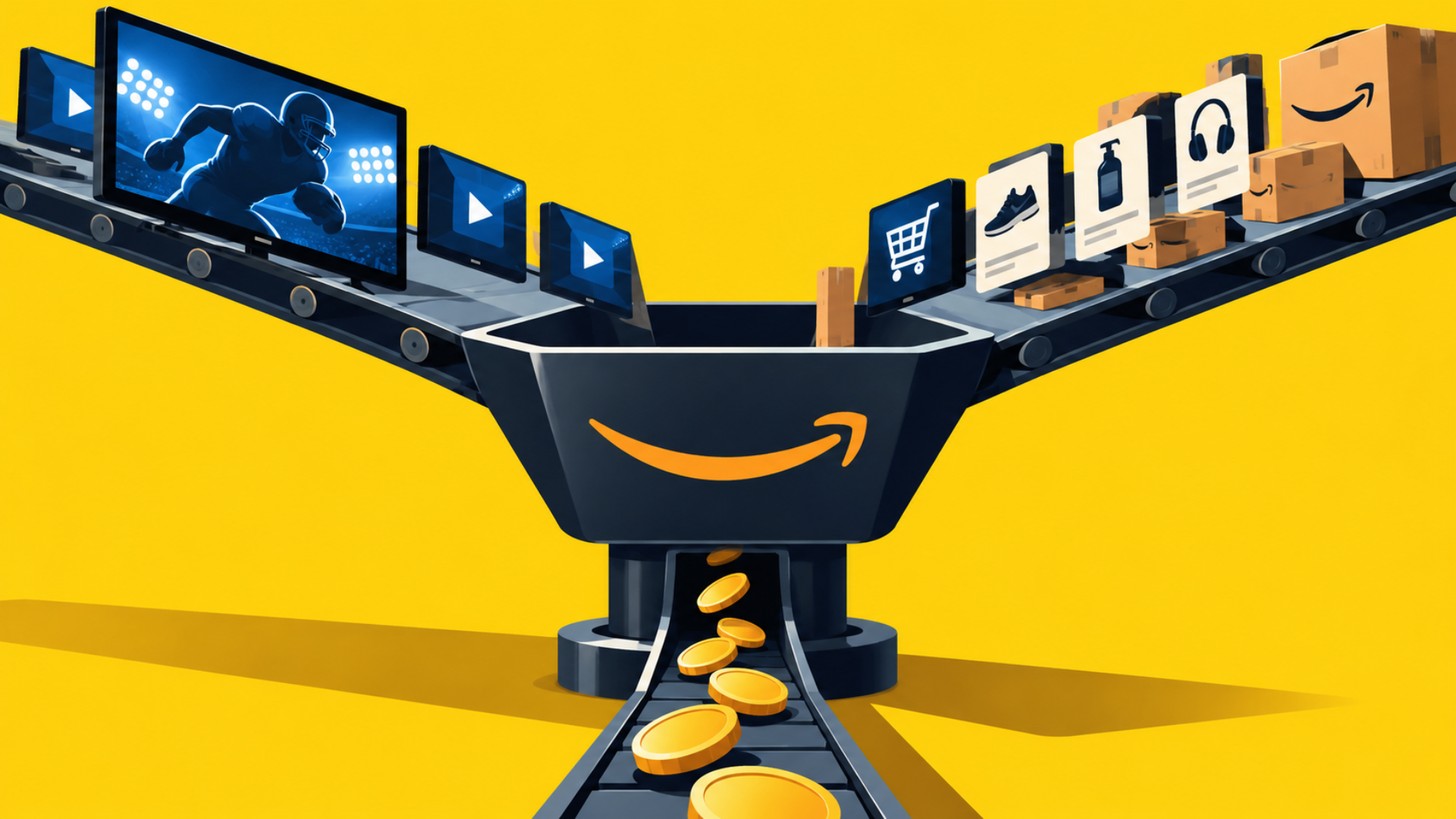
Amazon is putting streaming TV, sponsored products, display and online video inside one AI-managed advertising budget. Its new Full-Funnel Campaigns let advertisers selling through Amazon supply their products, budget and sales goals while Amazon decides how the money moves across formats. Prime Video gains access to retail advertising dollars that previously stayed closer to checkout, but it also has to compete against sponsored listings that convert shoppers into buyers. Rival CTV sellers have their own ways to connect advertising to commerce. Amazon’s integration increases the pressure to demonstrate incremental sales while raising the commercial value of independent buying, cross-retailer data and measurement.
Prime Video Has to Earn Its Share of the Search Budget
Amazon’s Full-Funnel Campaigns entered open beta for U.S. advertisers on September 29. The product combines sponsored ads, display, video and streaming TV in one campaign. Advertisers provide their products, budget and an optional return-on-ad-spend target. Amazon’s AI selects formats, allocates spending and continuously adjusts the campaign toward sales.
A commercial during Thursday Night Football can now compete for the same advertiser budget as a sponsored product appearing in Amazon search results.
Those placements serve different purposes. Sponsored search captures demand from consumers already shopping. Streaming TV reaches consumers earlier, potentially introducing products they weren’t considering or increasing the likelihood of a later purchase.
Amazon’s AI can evaluate those contributions together. If streaming exposure increases subsequent product searches, conversion rates or new-customer acquisition, the system has a reason to fund more TV. If sponsored listings deliver stronger measured returns, more spending can move toward those placements.
The system runs alongside advertisers’ existing campaigns, so adoption doesn’t automatically move every Amazon advertising dollar into the new product.
For advertisers that use it, Prime Video gains access to performance budgets that might never have entered TV. It also has to justify its allocation against formats much closer to the transaction.
Whether the advertiser’s next dollar goes toward Prime Video, display or sponsored products, the spending remains inside its advertising business.
That gives Amazon an economic advantage over media sellers whose revenue depends on winning an individual inventory allocation.
Amazon Already Owns Its Next Wave of TV Advertisers
Amazon’s existing merchant relationships reduce the cost of bringing new advertisers into streaming TV.
The company already offers self-service streaming TV advertising without a minimum spend requirement. Full-Funnel Campaigns remove additional work for merchants accustomed to buying sponsored listings and display advertising.
A seller can introduce streaming TV without creating a separate campaign structure or negotiating a traditional TV agreement. Amazon’s creative tools can generate TV-ready video from existing product assets, reducing production costs and making smaller campaigns more practical.
Amazon can therefore expand its TV advertiser base through an existing buying interface rather than acquiring every advertiser through a separate sales operation.
That lowers the incremental cost of advertiser acquisition and gives Amazon another opportunity to capture spending from merchants that previously concentrated their budgets on search and product pages.
The broader CTV market has been working to reduce the cost of acquiring and servicing advertisers. Self-service buying, lower minimums and automated creative allow smaller businesses to participate without the overhead associated with traditional TV campaigns.
Amazon’s established retail advertising business gives it a distribution advantage. Merchants already spending money to promote products can become streaming advertisers through a system they know.
Other CTV companies can offer comparable buying simplicity. They must attract those advertisers through their own relationships, agency partnerships, buying technology or retail-media integrations.
Amazon’s $19.6 Billion Ad Business Still Hides Prime Video’s Return
Amazon generated $19.64 billion in advertising services revenue during the third quarter of 2026, an 11% increase year over year, or 12% excluding currency changes.
Growth slowed from 26% on a constant-currency basis during the second quarter. Prime Day’s move into the second quarter this year, along with other timing factors, affected the comparison. Amazon expects advertising growth to return to the high teens in the fourth quarter.
The reported revenue includes sponsored listings, display, video and other advertising products. Amazon doesn’t disclose Prime Video’s advertising revenue separately or how much Full-Funnel Campaign spending reaches streaming TV.
The product’s September 29 open-beta launch also came one day before the quarter ended, leaving no meaningful period for the broader launch to affect third-quarter results.
Amazon’s sports investments give its advertising system premium inventory to distribute.
Prime Video’s fifth season of Thursday Night Football averaged 17.7 million viewers through its first six games, based on Nielsen figures released by Amazon. That was 16% above the previous season’s full-season average. Its NBA opening doubleheader attracted more than two million U.S. viewers.
Those audiences come with substantial programming costs. Ampere Analysis projects Amazon will spend approximately $3.8 billion on sports rights during 2026.
Live sports generate premium advertising inventory, attract audiences and support Prime membership. Full-Funnel Campaigns give Amazon another way to monetize that programming by connecting exposure to subsequent retail activity.
The financial contribution depends on how much incremental advertising spending the campaigns attract, how much reaches Prime Video and whether TV exposure increases sales enough to justify its cost.
Amazon hasn’t disclosed those results.
Owning the Checkout Doesn’t Prove the Commercial Caused the Sale
Amazon’s early Full-Funnel Campaigns results support its argument for coordinated buying.
The company says beta advertisers achieved 67% higher Long-Term ROAS compared with the same formats configured independently and acquired new-to-brand customers at a 29% lower cost per purchase.
Those findings come from Amazon’s internal data collected between June and August 2026. The comparison uses a blended average of other campaign performance across beta advertisers. It doesn’t isolate streaming TV’s contribution or establish how many additional sales the coordinated campaigns caused.
Amazon’s Long-Term Sales metric combines immediate conversions with an estimate of future value from new-to-brand customer actions over 12 months. That extends measurement beyond the initial transaction, but the future sales component remains model-based.
A consumer who watches a commercial and subsequently purchases a product may already have intended to buy it. Sponsored listings, promotions, recommendations and other advertising can influence the same transaction.
Amazon controls the buying system, campaign allocation and much of the transaction data used to evaluate performance for products sold through its store.
That reduces the work required to connect advertising exposure with a purchase. It also concentrates influence over how advertising receives credit.
Advertisers still need incrementality tests, control groups and independent analysis to determine which exposures created additional demand.
Amazon has less direct visibility into transactions completed outside its retail business. Vehicles purchased at dealerships, restaurant orders, insurance leads and subscriptions completed on another company’s website require other measurement arrangements.
CTV sellers and measurement providers that connect advertising to outcomes across those businesses have a different commercial opportunity.
Walmart and Roku Can Bring Receipts From Stores Amazon Doesn’t Own
Walmart is building a competing model around its own retail business.
The company completed its acquisition of Vibe.co in August 2026, adding self-service CTV buying and automated campaign management to Walmart Connect.
Vizio provides a TV operating-system footprint. Walmart Connect supplies shopper audiences and purchase measurement. Vibe contributes a buying interface designed to make streaming advertising accessible to smaller businesses and performance marketers.
Walmart is also expanding how advertisers access its retail data.
Its exclusive DSP arrangement with The Trade Desk ended in 2025, but the companies maintained their partnership. Walmart Connect’s DSP continues to operate with The Trade Desk technology while Walmart develops additional buying relationships.
A Yahoo DSP integration supported by Magnite initially made Walmart audiences and closed-loop measurement available against Vizio inventory. In October, Walmart expanded that initiative into an alpha program covering CTV inventory from additional publishers.
Advertisers gain more ways to activate Walmart’s shopper data without using a single buying interface.
Roku Commerce Media connects its streaming audience data with retail and commerce companies including Walmart, Kroger Precision Marketing, Instacart, Best Buy and Shopify. The integrations support different combinations of audience targeting, shoppable advertising and purchase measurement.
Roku can connect advertising exposure to transactions through participating merchants without owning each retailer’s checkout.
Its expanded relationship with iSpot adds another capability. The Roku and iSpot outcome-optimization integration feeds attribution signals directly into Roku’s campaign optimization system.
Early testing with SimpliSafe showed 23% more leads and 31% more website visits for an optimized group compared with a control group.
The comparison provides evidence that outcome-based optimization can improve campaign performance. It measures the effect of optimization within that test, rather than the incremental retail sales attributable to streaming TV itself. Roku and iSpot haven’t disclosed enough about the test’s scale or economics to establish whether those improvements extend across advertisers and campaign types.
Amazon’s beta results and Roku’s test also measure different things using different comparison methods. Neither establishes a universal advantage in incremental sales.
Cross-company measurement carries additional costs. Identity matching requires reliable identifiers, data agreements and technical integration. Coverage depends on participating retailers and the transactions that can be matched.
Amazon avoids some of that work when the advertised product is purchased through its store.
Walmart and Roku can pursue commerce relationships extending beyond Amazon’s retail business. Their competitiveness depends on the coverage, accuracy, cost and demonstrated incrementality of those measurement arrangements.
Independent Ad Tech Can Sell the Comparison Amazon Doesn’t Control
The Trade Desk, Magnite and independent measurement providers occupy different positions in this competition.
The Trade Desk gives advertisers a buying system that operates across publishers and channels without owning the streaming inventory it purchases. Its relationship with Walmart combines retail purchase data with programmatic buying across CTV and other media.
Advertisers can apply retailer data to inventory from multiple media owners and evaluate spending within a broader buying operation.
That approach is relevant to brands selling through several retailers or seeking to compare performance across streaming services.
Amazon DSP also buys inventory across third-party publishers. Amazon additionally owns substantial media inventory and the retail destination supplying many of its strongest commerce signals.
Independent buying technology offers advertisers an alternative decision-making system when evaluating spending across competing publishers and commerce environments.
Magnite addresses the supply side.
Its Magnite Orchestration initiative connects buyer agents with seller-side systems while allowing publishers to package inventory and audiences for AI-driven buying. The company is developing the product with integrations spanning multiple media formats and technology partners.
Media owners can make inventory accessible to automated buying systems while retaining more influence over packaging, pricing and supply decisions.
Neither company is free of commercial incentives. Independent infrastructure introduces technology fees and depends on access to data and inventory controlled by other businesses.
Its value depends on whether advertisers and publishers gain enough from broader market access, comparable measurement, pricing transparency and control to justify those costs.
Netflix Is Using Amazon’s Data While Building Its Own Scorecard
Netflix demonstrates how a major streaming seller can combine retail-media partnerships with its own advertising operation.
Advertisers can buy Netflix inventory through Amazon’s buying system and use Amazon Audiences, built from shopping, browsing and streaming signals, to inform targeting.
Netflix also supports other buying relationships, including The Trade Desk, Yahoo and Google Display & Video 360.
In October, Netflix expanded its own measurement capabilities with an enhanced Conversion API and Netflix Pixel designed to support more than 20 lower-funnel conversion events. Advertisers can use those tools for attribution, audience development and tests of incremental outcomes.
Netflix has also introduced single-publisher attribution within Yahoo DSP and plans additional measurement capabilities through The Trade Desk. Expanded third-party and advertiser-owned audience activation through The Trade Desk is scheduled for November.
Those arrangements give Netflix several routes into advertiser budgets while allowing it to develop more of the data and measurement capabilities used to evaluate its inventory.
The commercial tradeoff is control over audience selection, campaign execution and performance reporting. Outside buying systems can deliver incremental demand while gaining influence over which inventory advertisers purchase and how results are evaluated.
Netflix’s own measurement products also require credible testing. A publisher supplying its own conversion analysis has incentives similar to those of any other company selling advertising.
The value of maintaining several buying and measurement relationships depends on whether Netflix can attract additional spending, compare results reliably and retain enough influence over its advertising business to defend pricing.
The Streaming Wars Take
Data-sharing agreements between retailers, DSPs and streaming publishers now carry greater consequences for advertising revenue and negotiating power.
Those agreements determine who can use conversion data, which measurement methods advertisers can inspect, whether campaign results can be compared across buying systems and how much additional technology costs to establish performance.
A publisher that can demonstrate incremental outcomes through several credible measurement providers has more flexibility when negotiating inventory prices and commercial terms. Dependence on a single buyer’s attribution model gives that intermediary greater influence over how the publisher’s inventory is valued.
Retail-media networks face their own tradeoff. Keeping shopper data inside proprietary buying systems gives them more control over advertiser relationships. Making that data accessible through independent DSPs expands demand and allows brands to use established workflows, but gives other technology companies a role in campaign decisions and measurement.
The Trade Desk, Magnite and measurement providers can earn a place in those relationships by making performance evidence usable across multiple retailers and publishers. Their services become harder to justify when they add fees without materially improving market access, measurement accuracy or incremental returns.
For streaming services, control over the advertiser relationship increasingly depends on the ability to establish credible outcomes beyond the reporting supplied by a single media buyer.
Amazon can allocate spending across its own advertising products and connect much of that activity to transactions in its store. Other streaming sellers can combine inventory, retailer relationships and independent measurement across businesses that Amazon doesn’t control.
The commercial advantage for independent CTV will come from making its inventory’s incremental value comparable across buying systems. Publishers that can substantiate that value outside any single retailer’s reporting environment retain more negotiating power over what advertisers pay.
The Streaming Wars is intentionally ad-free
We don’t run display ads. Not because we can’t, but because we don’t believe in them.
They interrupt the reading experience. They cheapen the work. And they burn advertisers’ money on impressions nobody actually wants.
So we chose a different model.
We say the things people in this industry are already thinking but don’t say out loud. We connect the dots beyond the headline and focus on explaining why things matter to the people working in this business.
If you believe industry coverage can exist without clutter and interruption, you can support it here → SUPPORT TSW.
Support is optional. But it directly funds research and continued coverage — and helps prove this model can work.
Support TSW →