
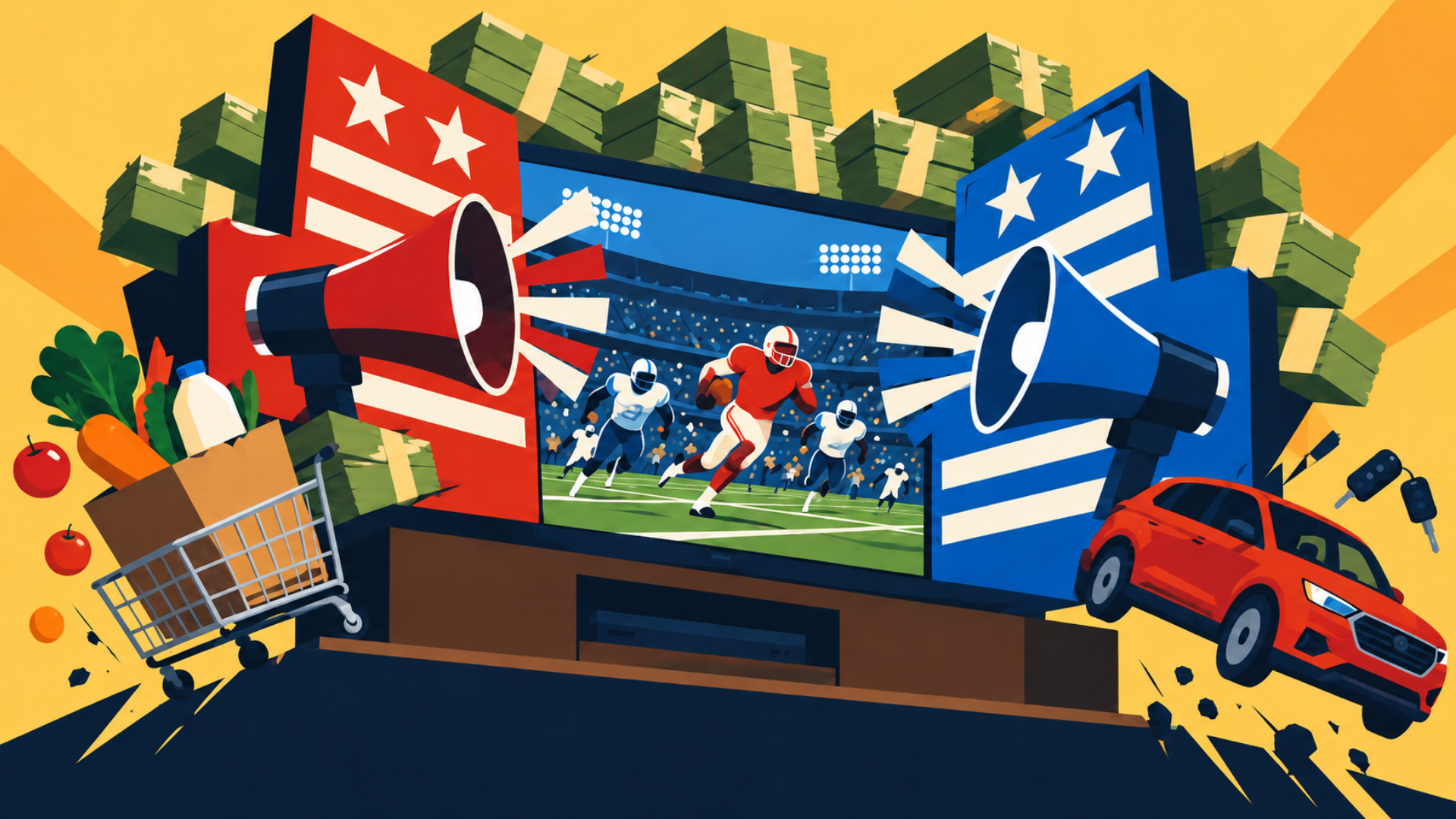
Political advertising spending and reservations crossed $11.6 billion on October 30, according to AdImpact, setting a new record for the 2025–26 election cycle. Premium CTV CPMs have climbed as high as $43 in some battleground markets. On local TV, political buyers have even bumped regular advertisers out of live programming.
Great payday for the stations. But after Tuesday, they’ll need those grocery stores, car dealers and other regular advertisers again. And those businesses have more places to spend their money than ever.
The Grocery Store Wanted the Football Game
A Texas grocery advertiser working with Dallas agency Moroch Partners got bumped from live college football coverage in September. Jacqueline Hoyos, the agency’s Chief Media Officer, said political buyers had already snapped up the remaining spots.
Sure, a station can offer a makegood after bumping the original. But imagine a retailer promoting a weekend sale. If the replacement ad runs after the sale ends, it’s worthless.
The competition for local TV and streaming inventory has become especially fierce in Texas, Wisconsin, Michigan and Maine. Media agency Collective Measures has seen premium CTV CPMs climb from roughly $34 or $35 to as much as $43 in some targeted markets.
At $35 per thousand impressions, a $100,000 budget buys about 2.86 million impressions. At $43, it buys 2.33 million. Nearly 19% less exposure for the same money.
Campaigns need to reach voters before November 3. Retailers have deadlines too. A furniture store advertising a weekend sale or a dealership promoting a limited-time financing offer can’t simply move its promotion because political campaigns bought up the best commercial spots.
Netflix, Prime Video and Disney+ don’t accept political advertising (good for them). That’s making them attractive to commercial advertisers looking to escape campaign-clogged TV. More buyers chasing that premium streaming inventory is pushing up prices there too. The services get the benefit of the election-year spending frenzy without taking political money themselves.
Meanwhile, the stations bumping regular advertisers are giving those customers a pretty good reason to take their business elsewhere.
Detroit Is Sending More Money Down to the Dealership
Car companies are spending less on national TV and moving a bigger share of what’s left into regional dealership advertising. Terrific timing, considering political campaigns have made some of those local markets ridiculously expensive.
Automakers spent an estimated $1.1 billion on national linear TV through August 2026, down 14.8% from the same period last year, according to iSpot.
Regional Tier 2 campaigns accounted for nearly 40% of automakers’ linear TV spending through August, up from roughly 20% in 2023. That’s a much bigger share of the budget, although it doesn’t mean regional spending doubled in actual dollars.
The shift toward streaming and local dealership offers makes sense. A national commercial can get people excited about a new vehicle. A regional ad can tell them which nearby dealers have it and what financing is available.
An automaker trying to move SUVs in Texas doesn’t need to spend money reaching people in Oregon. But if political campaigns are driving up local CTV rates, the savings from better targeting can disappear pretty quickly. Those impressions still have to help sell enough cars to justify the bill.
National networks are losing some of the automotive money that used to support primetime and sports. Local stations and streaming sellers have a shot at picking it up, but dealership advertisers want more control over where their commercials run, when they air and which offers they promote.
A dealer association might need to change a financing offer overnight. If a seller can’t get the new ad running quickly, or bumps it for a political campaign, that dealership money can go somewhere else.
Cable Still Runs Plenty of Ads. Buyers Want a Discount.
Comscore’s new Score Report puts 43.2% of measured TV ad-exposure time with broadcast and 34.5% with cable. That’s 77.7% combined, leaving 22.3% for streaming.
Those figures cover advertising on in-home TV screens, including commercials watched through services like YouTube TV that are credited back to the original networks. They’re a measure of time spent with ads, not how many different people saw them or how effective those ads were.
But all that commercial exposure hasn’t stopped advertisers from negotiating lower rates.
Media Dynamics estimates that streaming picked up $17.2 billion in 2026–27 primetime upfront commitments, compared with approximately $16.6 billion for broadcast and cable combined. Average CPMs still fell across the board: roughly 5% to $25.90 for streaming, 8.5% to $17.70 for cable and 4% to $41.65 for broadcast.
Those are national upfront averages negotiated over the summer. They’re a different kind of buy from the $43 premium CTV spots in battleground markets.
But the contrast is striking. Advertisers are getting discounts across much of the national TV market while paying a fortune to reach specific local audiences before Election Day.
Come Wednesday, much of that political demand disappears. Stations will be back competing for regular advertisers who have already shown they’re willing to push for lower prices and move their money elsewhere.
The Streaming Wars Take
Stations that want to keep their regular advertisers may have to start offering something more valuable than a makegood: a commercial spot that can’t be bumped.
That could mean charging more for guaranteed placements during football games and other premium programming. The station gives up the chance to sell that spot to somebody else when political demand heats up. But if the advertiser is a grocery chain or dealership group that buys TV all year, protecting that relationship could be worth more than the extra campaign money.
Stations are making a killing on political advertising. Pissing off the businesses that keep buying commercials after the election is over could turn a great payday into an expensive mistake.
And those regular advertisers have options. Streaming services can offer geographically targeted campaigns without competing political ads, while national networks are already negotiating lower rates.
The next time a political campaign offers more money for a Saturday football spot, the station had better know what its regular advertiser is worth before it takes the check.
The Streaming Wars is intentionally ad-free
We don’t run display ads. Not because we can’t, but because we don’t believe in them.
They interrupt the reading experience. They cheapen the work. And they burn advertisers’ money on impressions nobody actually wants.
So we chose a different model.
We say the things people in this industry are already thinking but don’t say out loud. We connect the dots beyond the headline and focus on explaining why things matter to the people working in this business.
If you believe industry coverage can exist without clutter and interruption, you can support it here → SUPPORT TSW.
Support is optional. But it directly funds research and continued coverage — and helps prove this model can work.
Support TSW →