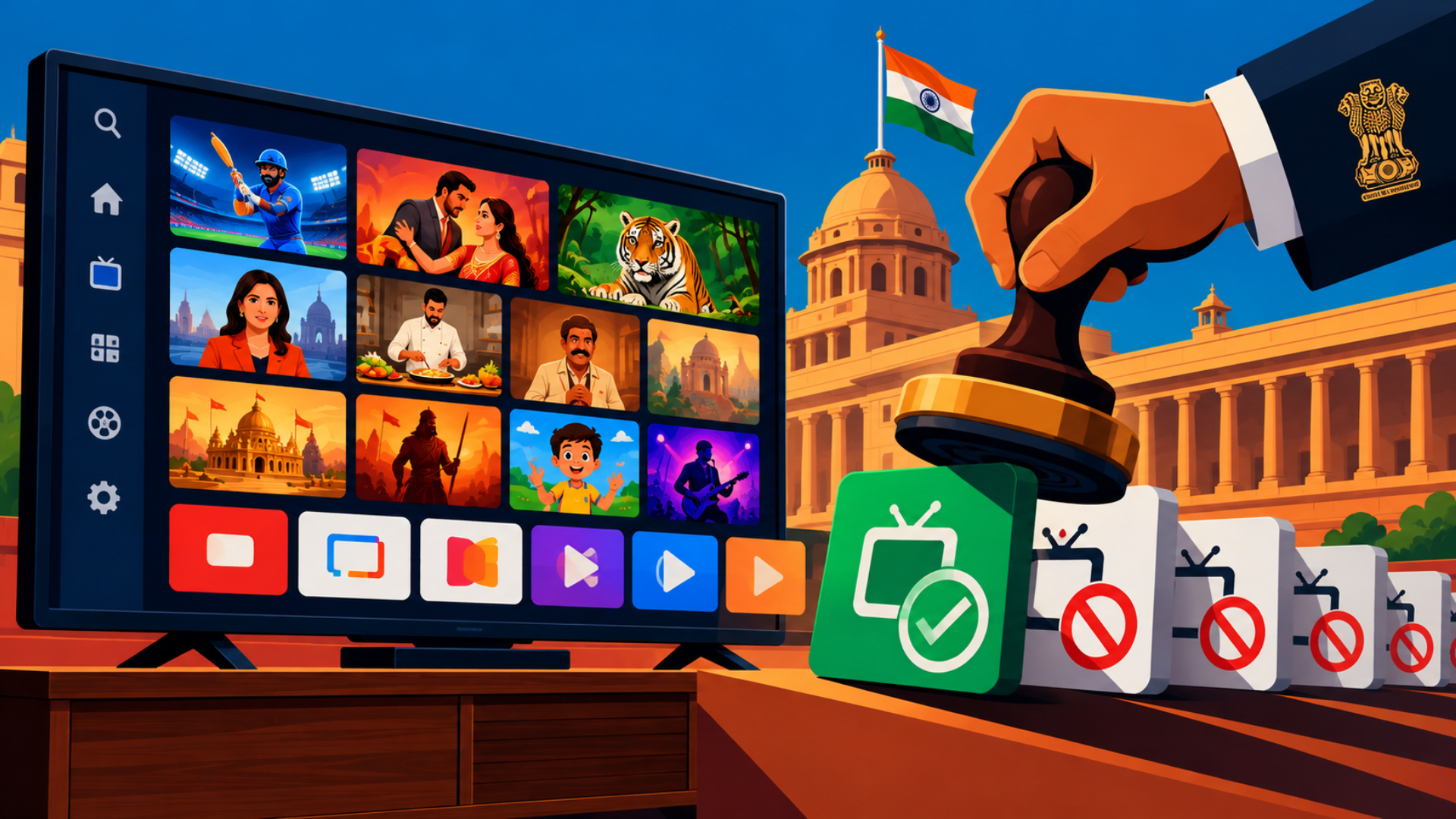
India’s telecom regulator wants smart-TV manufacturers and operating-system providers to restrict access to unauthorized apps that aggregate scheduled channels, including FAST services. TRAI’s October 26 recommendations would also impose recurring registration fees on internet-native channels and bring their viewing into India’s TV ratings framework.
For Samsung TV Plus, LG Channels and independent aggregators, government authorization would become a condition of distribution. Smaller channel owners would face additional operating costs, while advertisers could gain a more comparable way to evaluate FAST against traditional TV.
TRAI Would Make Samsung and LG Verify FAST Apps, Putting Smart-TV Distribution at Risk for Unauthorized Services
TRAI wants the Ministry of Information and Broadcasting (MIB) to maintain a master repository of authorized Application-based Linear Television Distribution (ALTD) services. TV manufacturers and operating-system providers would have to verify apps against that list, prevent unauthorized distribution and submit annual compliance reports.
The requirement would reach Samsung, LG and companies operating smart-TV environments such as Google TV and Amazon Fire TV.
Samsung and LG have an additional exposure. Both operate their own FAST services while controlling device interfaces that distribute streaming apps. Their compliance responsibilities would extend across their distribution businesses, including the services they own and third-party applications they make available.
Under the proposed framework, app providers would obtain national authorization for an initial 20 years, renewable in 10-year periods. The entry fee would be ₹1 lakh, plus ₹10,000 for processing, with no recurring authorization fee, bank guarantee or security deposit.
The financial risk sits primarily in access to viewers. An app that loses authorization could lose distribution through the devices and app stores enforcing the repository. Existing distribution agreements wouldn’t preserve that access.
TRAI also recommends nondiscriminatory treatment of authorized applications. Approval would establish eligibility for distribution, while TV operating systems would continue to control merchandising, recommendations and home-screen visibility.
A licensed FAST service could remain commercially disadvantaged if viewers rarely encounter it. Device operators would have to satisfy the authorization rules while continuing to compete over which approved services receive valuable placement.
TRAI’s Annual Channel Fee Raises FAST Operating Costs, Pressuring Smaller Publishers to Justify Every Feed
The modest one-time application fee understates the proposed cost for internet-native linear channels.
TRAI recommends a separate registration category for channels created specifically for internet distribution. Those channels would pay a ₹10,000 processing fee and an annual registration fee of ₹1 lakh per channel. Registration would last 10 years, with renewal available for another 10 years.
An operator maintaining ten qualifying internet-native channels would face ₹10 lakh in annual registration fees before programming, playout, delivery, advertising operations and sales costs.
Those expenses accumulate in a business where distribution partners already capture substantial portions of advertising revenue. Smaller channel owners have fewer feeds over which to spread their compliance expenses and less predictable advertising demand to recover them.
The proposed internet-native registration route would cover non-news and current affairs channels. Owners would also need an agreement with an Indian company for distribution and compliance purposes, adding another commercial relationship to manage.
Application providers would carry continuing obligations of their own. They would need to verify the authorization status of the channels they distribute, maintain grievance-redressal arrangements and submit compliance reports every six months.
Established broadcasters with existing channel permissions wouldn’t face the same new registration requirement for those already authorized feeds. Independent digital publishers could have to build an additional regulatory expense into channels that haven’t yet demonstrated reliable audience demand.
That raises the revenue threshold for keeping a niche channel operating. A distributor carrying dozens of marginal feeds would have another reason to remove channels that generate too little viewing or advertising revenue to support their costs.
TRAI Would Add FAST Audiences to TV Ratings, Pressuring Advertisers to Reassess Channel Reach and Pricing
TRAI recommends integrating viewing through ALTD applications into India’s television audience-measurement framework, bringing scheduled streaming channels into more direct comparison with cable, DTH and other established distribution services.
India’s TV Ratings Policy 2026 already provides for technology-neutral measurement, including connected TVs and channels available through OTT services. TRAI wants registered ratings agencies to develop a methodology for incorporating ALTD viewing once the authorization framework is finalized.
Authorized app providers would also be permitted to publish anonymized periodic viewing data under the ratings policy.
The commercial opportunity is a more comparable view of channel reach.
FAST distributors frequently sell advertising using their own measures of active users, viewing hours and device reach. Traditional TV advertisers often rely on ratings-based measures of audience delivery.
A common measurement framework could give broadcasters a better accounting of viewers who watch their channels across conventional TV and FAST apps. Independent FAST operators could also use comparable audience data to demonstrate reach that traditional TV buying systems currently struggle to capture.
Greater transparency would expose weaker channels as well. A service with extensive smart-TV distribution but limited viewing would have less room to defend advertising prices through device reach alone.
Methodology remains the constraint. Panel-based ratings and application-level viewing data capture different information. Registered agencies would need consistent treatment of household viewing, co-viewing, duplicate audiences and people watching the same channel across multiple devices.
A ratings system that recognizes incremental FAST viewing could support higher advertising valuations for productive channels. Poor measurement or duplicated audiences could distort those valuations.
TRAI has established the proposed regulatory treatment. The measurement system that would turn FAST audiences into a broadly comparable advertising currency still needs to be built.
TRAI Gives Cable and DTH Partial Regulatory Parity, Leaving FAST Aggregators With New Costs and Uneven Competition
Cable, DTH and traditional broadcasters pushed for regulatory obligations on internet services distributing scheduled TV channels.
Zee Entertainment, Bharti Airtel, Dish TV and cable operators supported bringing FAST-style distribution into a formal framework. JioStar, Sony and other digital stakeholders opposed applying telecom-style authorization requirements to applications operating over existing internet infrastructure.
TRAI recommended authorization while leaving out several of the heavier financial obligations associated with traditional distribution businesses.
The resulting framework would apply to applications and websites aggregating channels from multiple owners. Broadcaster-owned services distributing only their own group’s channels would be excluded, along with live streams on social media intermediaries.
That treatment gives broadcasters a different regulatory position from independent FAST aggregators.
A broadcaster distributing only its group’s authorized channels through its own app wouldn’t need the proposed ALTD authorization. An independent service assembling a lineup from multiple channel owners would have to obtain approval, monitor channel eligibility and maintain the corresponding compliance processes.
Social media livestreaming would remain outside the ALTD category as well, even where programming competes for some of the same viewing time and advertising demand.
TRAI has also deferred decisions on tariffs, interconnection and quality-of-service requirements until after the authorization framework is finalized.
That leaves a significant commercial question open: how future rules might affect channel supply agreements and the economics of carrying programming across traditional TV and FAST.
The initial authorization requirement would narrow part of the regulatory gap. Subsequent decisions on carriage terms and access to channel feeds could have a larger effect on the relative costs of competing distribution models.
The Streaming Wars Take
FAST carriage agreements in India could require a new layer of contractual protection around government authorization, channel registration and removal risk.
TV manufacturers would have an incentive to demand ongoing verification of an application’s status. Application providers would need assurances that every channel in their lineups maintains the necessary permission. Channel owners and distributors would have to negotiate responsibility for lost advertising revenue if a service or feed becomes ineligible for distribution.
Those obligations could influence revenue-sharing negotiations. Aggregators that absorb more monitoring, registration and compliance work may seek to recover the costs from programmers through revised commercial terms.
The proposed ratings integration introduces another negotiating variable. A channel that demonstrates incremental viewing across cable, DTH and FAST could make a stronger case for distribution, favorable placement and advertising revenue. Channels unable to demonstrate meaningful audiences would have to defend their economics while carrying additional recurring expenses.
TRAI recommends a one-year transition for existing applications and internet-native channels after the framework is notified. MIB must still decide whether to adopt the recommendations and issue the final rules.
If adopted, the framework would force FAST businesses to account for regulatory eligibility alongside content rights, distribution terms and advertising performance. Broadcasters with established permissions and device relationships could manage those requirements across existing operations. Smaller publishers would need to establish whether each channel generates enough revenue to justify its registration and ongoing compliance.
The pressure would reach carriage negotiations directly: who pays to register the channel, who guarantees its continued eligibility, who bears the loss if access disappears and how verified audience delivery determines the advertising split.
The Streaming Wars is intentionally ad-free
We don’t run display ads. Not because we can’t, but because we don’t believe in them.
They interrupt the reading experience. They cheapen the work. And they burn advertisers’ money on impressions nobody actually wants.
So we chose a different model.
We say the things people in this industry are already thinking but don’t say out loud. We connect the dots beyond the headline and focus on explaining why things matter to the people working in this business.
If you believe industry coverage can exist without clutter and interruption, you can support it here → SUPPORT TSW.
Support is optional. But it directly funds research and continued coverage — and helps prove this model can work.
Support TSW →