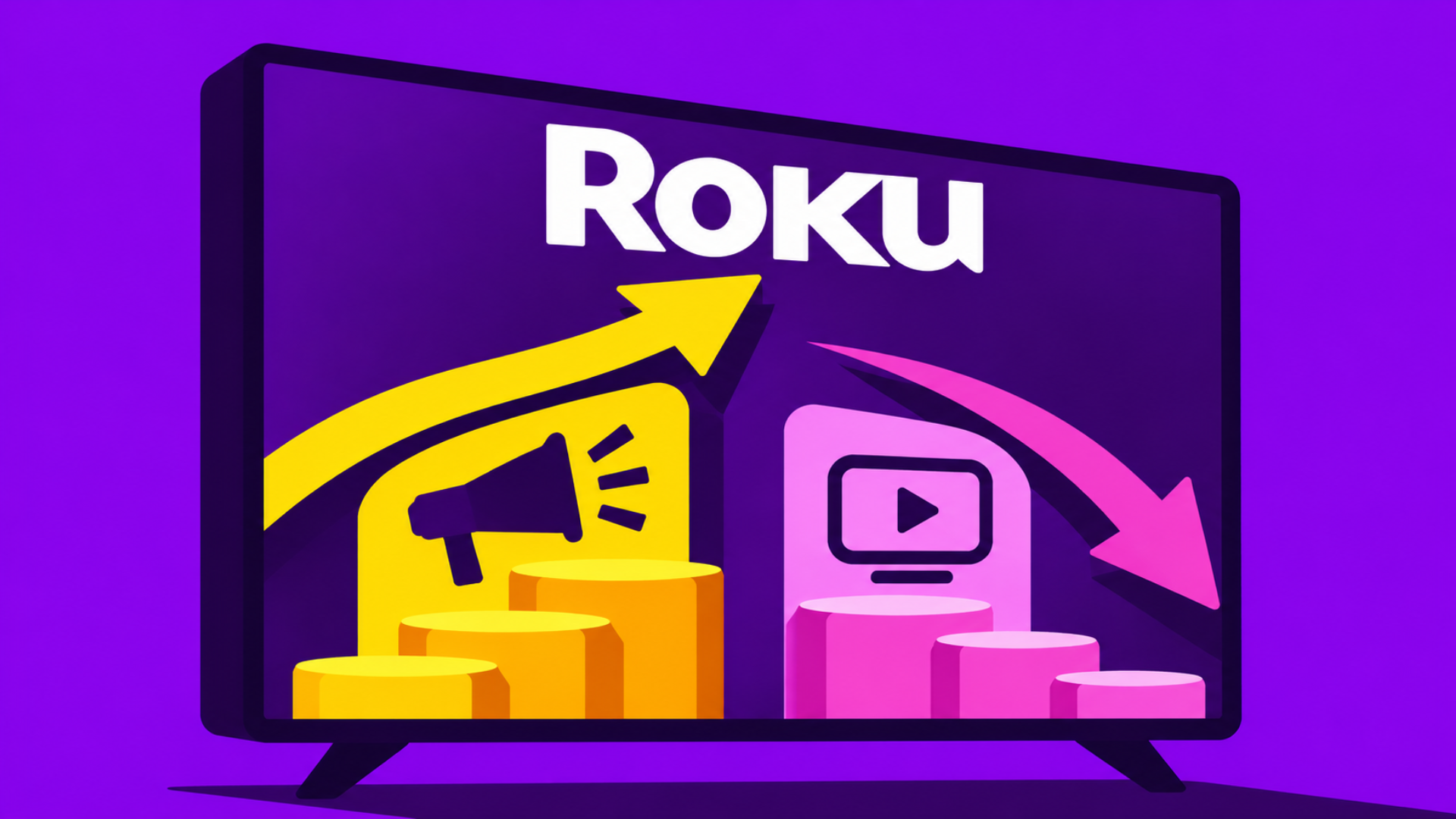
Roku’s Q3 results show where its incremental profit is coming from. Advertising generated $113.9 million of the company’s $149.3 million year-over-year increase in platform gross profit, accounting for roughly 76% of the gain. Advertising and subscription revenue each grew 23%, but subscription costs increased faster than sales, while Roku’s devices business recorded a $48.6 million gross loss. The divergence puts greater economic weight on advertising as Roku expands its subscription marketplace and prepares for its $22 billion acquisition by FOX.
Advertising Is Generating 76% of Roku’s Platform Profit Growth
Roku generated $727.4 million in advertising revenue during Q3, up 23% year over year. Advertising gross profit increased 33% to $459.4 million, while gross margin expanded 470 basis points to 63.2%.
Advertising cost of revenue increased just 9%, considerably slower than revenue growth. Roku attributed the margin improvement primarily to a shift toward higher-margin advertising products.
The underlying advertising metrics explain how Roku generated that growth. Video ad impressions increased 33% year over year, while average price per impression declined 7%, primarily because of changes in product and geographic mix.
Roku generated $113.9 million in additional advertising gross profit on $136.2 million in incremental advertising revenue. Subscription gross profit increased $35.5 million on $107.5 million in additional revenue.
Those results show how differently the two businesses convert revenue growth into gross profit.
Roku’s advertising expansion is increasingly supported by programmatic demand. More than 80% of in-stream video ad impressions were delivered programmatically during Q3, and the company continues to deepen integrations with third-party buying platforms, including Google DV360.
Media and entertainment advertising delivered its strongest year-over-year revenue growth in four years as streaming services and studios increased spending to promote their programming.
Roku is also testing a performance-based advertising unit on its Home Screen, giving media companies another opportunity to pay for promotion closer to the point of content discovery.
Those relationships give Roku several ways to monetize streaming demand. A media company can purchase advertising to attract viewers, distribute its service through Roku and pay for promotional placement when it needs additional attention.
Roku’s advertising business is capturing a growing share of the gross profit generated by those transactions.
Subscription Growth Is Adding Revenue Faster Than Gross Profit
Roku’s subscription business generated $580.9 million in revenue during Q3, also up 23% year over year. Gross profit increased 18% to $237.7 million, while gross margin declined 180 basis points to 40.9%.
Subscription cost of revenue increased 27%, compared with 23% revenue growth. Roku attributed the increase primarily to higher licensing and content costs, including expenses associated with its owned subscription service Howdy.
The company’s 10-Q shows subscription volume increased 7%, while average price per subscription increased 27%. Revenue growth is increasingly influenced by subscription pricing and mix alongside customer acquisition.
Roku identified the growing contribution from Premium Subscriptions as the largest factor behind the decline in subscription gross margin.
The company is expanding its subscription marketplace through discounted bundles, allowing viewers to purchase participating services directly through Roku’s discovery and billing infrastructure.
That expansion gives Roku additional recurring revenue opportunities, but selling subscriptions carries licensing, revenue-sharing and payment-processing costs.
Roku’s subscription marketplace is one example of a much bigger shift in streaming distribution. Our new Guide breaks down how bundling changes CAC, billing, activation, customer data, retention, and control of the subscriber.
Get the Free Guide →Roku’s subscription segment also includes owned services and other content distribution revenue. The reported gross margin therefore measures the broader business rather than Roku’s commission or take rate on individual third-party subscriptions.
The World Cup demonstrated the marketplace’s customer-acquisition potential. Roku’s tournament-wide Sports Experience generated more than 1 million subscription sign-ups across services including Peacock, Paramount+, FOX One and ViX.
Roku organized viewing options across participating services and directed fans toward subscription offers. The company could monetize demand for major sports programming without owning every underlying rights package.
Those sign-ups demonstrate Roku’s ability to generate paid transactions across competing streaming services. Roku hasn’t disclosed how many of those subscribers remained after the tournament or the lifetime value of the resulting relationships.
As subscription gross margins compress, retention becomes increasingly important. Roku says its redesigned Home Screen and improved recommendations have begun reducing Premium Subscription cancellations, although it hasn’t quantified the improvement.
The financial return from expanding the marketplace will depend on how much recurring gross profit Roku retains as subscription volume grows.
Hardware Costs Are Absorbing More of Roku’s Advertising Gains
Roku’s devices business recorded a $48.6 million gross loss during Q3, more than double the $22.9 million loss in the year-earlier quarter.
Devices revenue increased 33% to $193.7 million, but cost of revenue increased 43%. Gross margin deteriorated to negative 25.1%.
Roku attributed the pressure primarily to elevated memory costs.
Its 10-Q also shows device inventory provisions increased to $41.1 million from $17 million a year earlier, adding another notable cost to the hardware business.
The revenue increase came despite a 21% decline in the number of devices shipped. Average selling price rose 71%, reflecting a greater contribution from Roku-made TVs.
Roku’s own TVs approached 8% of U.S. TV unit sales during the quarter. Meanwhile, TV manufacturers licensing Roku’s operating system account for the largest share of Roku TV unit volume, with their hardware sales excluded from Roku’s Devices revenue.
That structure gives Roku two ways to expand its operating-system footprint. It can manufacture TVs and streaming players directly, accepting the associated component costs and inventory exposure, while also licensing its software to manufacturers responsible for producing their own hardware.
Roku has historically accepted weaker device margins to expand the number of households available for advertising and subscription monetization.
In Q3, the additional $25.7 million in device gross losses absorbed approximately 17% of the $149.3 million increase in platform gross profit. Total company gross profit increased $123.6 million to $648.5 million.
Roku’s expanding advertising profits were large enough to absorb the additional hardware losses while supporting companywide gross profit growth.
The strategy still depends on recovering those hardware economics through future advertising and subscription revenue. Higher memory costs increase the burden on Roku’s monetization businesses, particularly when subscription gross margins are also declining.
The Streaming Wars Take
FOX will inherit a measurable opportunity cost when deciding how Roku’s discovery and advertising inventory should promote FOX-owned services.
A prominent Home Screen placement can generate paid advertising revenue from a third-party streaming service. FOX could instead use that placement to promote FOX One or Tubi, potentially generating subscription revenue or additional advertising-supported viewing within its own portfolio.
The financial return from those uses won’t necessarily be equivalent.
Roku’s Q3 results show that advertising is generating substantially more incremental gross profit than subscriptions, while hardware costs are absorbing a larger portion of the company’s earnings.
FOX will need to evaluate promotional inventory against the advertising revenue it displaces and the incremental customer value it generates for its own services.
That decision also affects Roku’s relationships with competing streaming companies. Those companies contribute advertising demand, subscriptions and programming that support Roku’s monetization business.
FOX has committed to maintaining Roku as an open, partner-friendly platform. Preserving those commercial relationships supports the profitability of the operating system it’s acquiring.
The transaction received shareholder approvals in October but remains subject to antitrust clearance following the Justice Department’s September 8 Second Request. The companies continue to target closing in the first half of 2027.
The acquisition would give FOX control over Roku’s home-screen discovery, advertising and subscription infrastructure, creating opportunities to promote its own programming directly to Roku households.
Roku’s latest financial results put a higher economic cost on using that infrastructure primarily for FOX’s own distribution needs. Advertising generates most of Roku’s incremental platform gross profit, and that profitability depends on maintaining broad demand from advertisers and streaming partners.
FOX can use ownership to reduce its dependence on third-party distributors. It will still need those distributors’ customers, competitors and advertisers to keep paying Roku for access to the TV screen.
The Bundle Comes Back in Pieces
Roku can control discovery, signup, and billing while another company still operates the streaming service. A telco can fund the subscription. A retailer can put it inside a membership. A bank can use it to drive account activity.
The TSW Guide to Bundling, made possible with support from Bango, breaks down the economics, distribution models, and operating mechanics behind the Great Rebundling.
Download the free Guide →
https://mailchi.mp/29f88615a586/tsw-guide-to-bundling
The Streaming Wars is intentionally ad-free
We don’t run display ads. Not because we can’t, but because we don’t believe in them.
They interrupt the reading experience. They cheapen the work. And they burn advertisers’ money on impressions nobody actually wants.
So we chose a different model.
We say the things people in this industry are already thinking but don’t say out loud. We connect the dots beyond the headline and focus on explaining why things matter to the people working in this business.
If you believe industry coverage can exist without clutter and interruption, you can support it here → SUPPORT TSW.
Support is optional. But it directly funds research and continued coverage — and helps prove this model can work.
Support TSW →