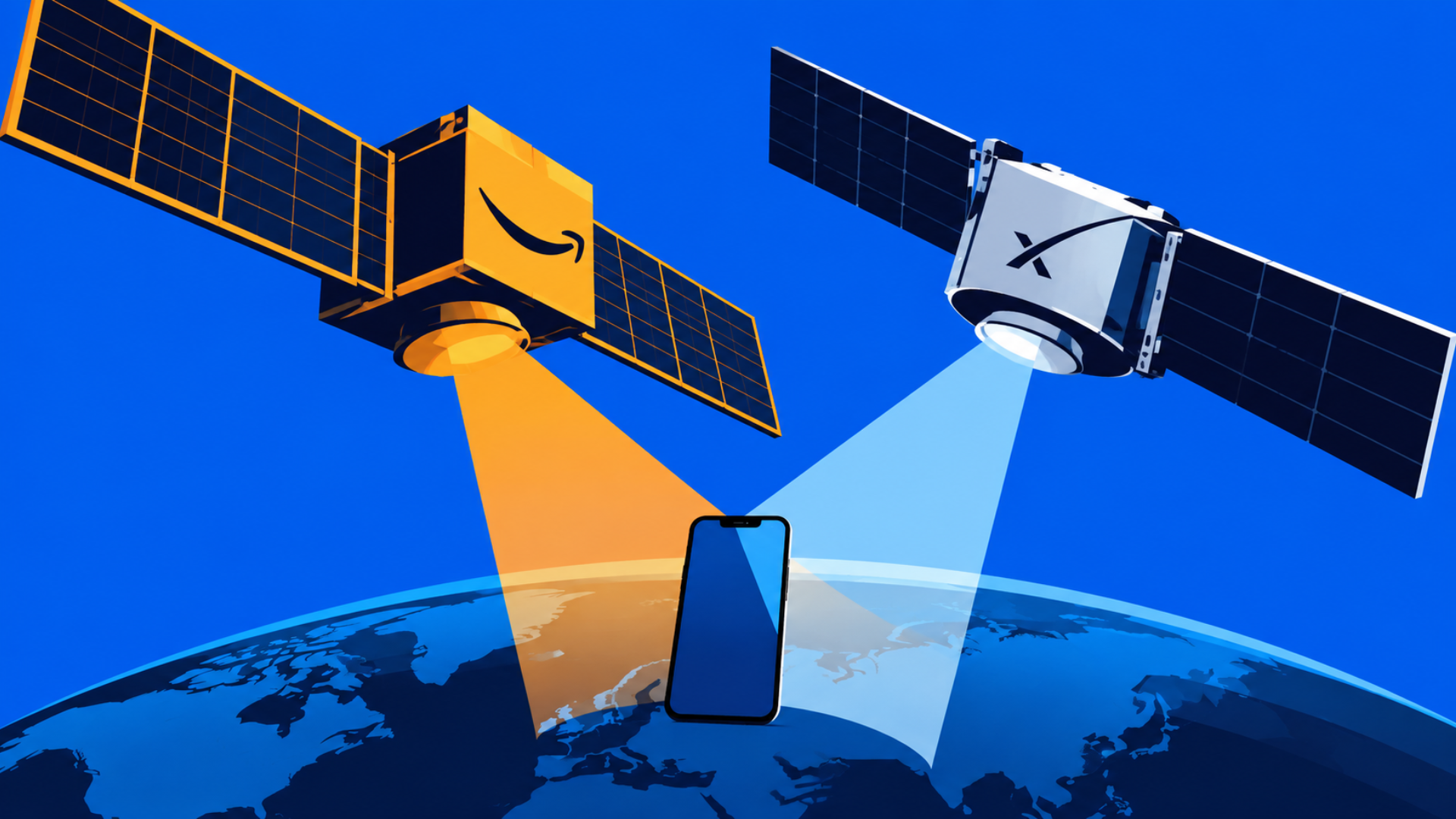
Amazon Leo, Amazon’s low-Earth-orbit satellite internet network formerly known as Project Kuiper, has cleared FCC review for its $11.5 billion acquisition of Globalstar, a satellite communications company that powers Apple’s Emergency SOS and other satellite features. The deal would give Amazon licensed mobile-satellite spectrum, operating infrastructure and an established Apple customer relationship, accelerating its expansion into direct-to-device connectivity while giving wireless carriers a potential alternative to Starlink as SpaceX moves toward competing directly for mobile subscribers.
The transaction still needs to close, with completion expected in 2027. Amazon plans to begin deploying its next-generation direct-to-device network in 2028.
Amazon Is Paying 42 Times Globalstar’s Annual Revenue for Spectrum, Raising Leo’s Expansion Burden
Globalstar generated $273 million in revenue and $7.4 million in operating income during 2025. The $11.5 billion transaction value represents approximately 42 times annual revenue, putting substantial weight on Amazon’s ability to expand the business beyond its existing satellite services.
Amazon would acquire Globalstar’s approximately 25 MHz of internationally harmonized mobile-satellite spectrum, its operating constellation, ground infrastructure and existing service authorizations.
Those assets address an expensive constraint on direct-to-device connectivity. Satellite broadband can use dedicated customer terminals, while direct-to-device systems must communicate with much smaller antennas inside ordinary phones. Those connections require appropriate spectrum, regulatory authorization, satellite capacity and compatible devices.
Globalstar has already developed much of that foundation.
The company operates roughly two dozen satellites and recently secured FCC authorization for its C-3 system, comprising 48 operational satellites and six orbital spares. Globalstar expects C-3 launches to begin in 2027.
Amazon has separately applied for authorization to operate up to 5,105 direct-to-device satellites, with that application still pending. Its planned system would operate alongside Globalstar’s existing and upcoming satellites and Amazon Leo’s broadband constellation.
The acquisition shortens Amazon’s path into licensed mobile-satellite service, but it doesn’t close Starlink’s substantial deployment advantage. SpaceX already operates thousands of satellites and has an established commercial broadband business.
Amazon will need to generate considerably more commercial demand from its acquired spectrum and infrastructure to support the purchase price. Apple’s existing business provides a starting point, while carrier contracts and expanded mobile services represent the larger potential revenue opportunity.
Apple Keeps Its Satellite Service as Amazon Inherits Revenue Concentration and Delivery Risk
Apple accounted for approximately 63% of Globalstar’s 2025 revenue, making its satellite agreement the financial foundation of the acquired business.
Apple also owns approximately 20% of Globalstar following its investment in the network. Amazon plans to acquire that stake as part of the transaction, while Apple remains a customer under a new connectivity agreement.
Amazon Leo will support satellite services for compatible iPhones and Apple Watches, including Emergency SOS, Messages, Find My and Roadside Assistance. Existing and planned Globalstar satellites will continue providing connectivity while Apple and Amazon collaborate on future services using the expanded Leo network.
Apple preserves continuity for its devices without maintaining its equity investment in the satellite operator. Amazon inherits a contracted customer relationship before its own direct-to-device network begins deployment.
That relationship also concentrates Amazon’s near-term commercial exposure.
Apple’s existing satellite features focus on safety, messaging and location services. Amazon’s planned direct-to-device system would support more advanced voice, messaging and data capabilities, creating an opportunity to serve additional use cases and customers.
Neither company has disclosed the financial terms of future Apple services over Leo. The agreement therefore establishes an important commercial relationship without revealing how much additional revenue Amazon could generate from Apple’s installed device base.
The transaction also carries operational obligations tied to Apple’s satellite requirements.
Globalstar’s merger prospectus describes potential payments to Apple if the company misses certain C-3 deployment milestones. At the time of that filing, the maximum potential payment stood at approximately $97 million, with any payment reducing the merger consideration received by Globalstar stockholders.
Apple has contractual protection against missed deployment commitments, while Amazon is acquiring a business whose largest customer depends on those satellites operating as planned.
Maintaining Apple’s service will be an immediate obligation. Expanding that relationship into higher-capacity services will depend on additional network deployment and commercial agreements.
Amazon Courts Wireless Carriers as Starlink Pursues Their Subscribers, Putting Wholesale Relationships Under Pressure
Amazon intends to sell direct-to-device connectivity through mobile network operators, giving carriers another route to extend coverage while retaining their existing customer relationships.
A wireless operator could purchase satellite capacity from Amazon and include expanded coverage in its own service plans. The carrier would continue managing the subscriber, mobile number, billing relationship and additional services sold through that account.
SpaceX is developing a different commercial opportunity alongside its existing wholesale partnerships.
Starlink already supplies satellite connectivity for T-Mobile’s T-Satellite offering. SpaceX is also acquiring nationwide wireless spectrum to support a broader mobile network that could compete directly with AT&T, Verizon and T-Mobile.
SpaceX’s spectrum agreements and proposed Starlink Mobile expansion give it a potential path to sell wireless subscriptions directly. That would allow SpaceX to control retail pricing, billing and customer retention while also operating as a supplier to incumbent carriers.
Those overlapping roles introduce new considerations into carrier negotiations.
An operator purchasing satellite connectivity from Starlink benefits from stronger coverage and potentially better retention. It also faces the prospect of its satellite supplier competing directly for the same wireless subscribers.
Amazon’s stated wholesale strategy offers a different commercial arrangement. Wireless carriers could buy Leo connectivity while maintaining control over their own subscription businesses.
That positioning could increase Amazon’s appeal as carriers evaluate their satellite partners, particularly when negotiating wholesale pricing, service availability, exclusivity and long-term capacity commitments.
Amazon still needs to demonstrate that it can deliver the coverage and capacity required for those agreements. Starlink has an established network and commercial relationships, while Amazon’s next-generation direct-to-device system won’t begin deployment until 2028.
Other operators, including AST SpaceMobile, are also pursuing carrier partnerships. Amazon will compete for those contracts on network performance, commercial terms and reliability.
The competitive opportunity is clear: a carrier with multiple credible satellite suppliers has greater negotiating flexibility than one dependent on a single network. Amazon’s ability to influence those negotiations will increase as its satellite capacity becomes operational.
Amazon’s Broadband Expansion Adds Competition for Household Connectivity Revenue, Pressuring Existing Distributors
Amazon Leo is also preparing to launch commercial satellite broadband service by the end of 2026, establishing a separate revenue opportunity before its next-generation phone network becomes available.
The broadband business targets households, businesses and government customers beyond the effective reach of terrestrial networks.
Amazon can sell broadband connections directly, while its mobile-satellite operation could eventually supply coverage through wireless carriers. Those distribution models address different customers and create different economics.
Direct broadband subscriptions would give Amazon a recurring relationship with households that currently depend on satellite, fixed wireless or other internet providers. Wholesale mobile service would allow Amazon to earn connectivity revenue without bearing the full cost of acquiring and retaining each wireless subscriber.
Those relationships also intersect with entertainment distribution.
Broadband and mobile operators increasingly package streaming subscriptions alongside connectivity to improve retention and increase revenue per household. Charter’s combination with Cox expanded its ability to distribute broadband, wireless and streaming services across a larger customer base.
More broadband competition can weaken the pricing power of incumbent providers in markets where customers have limited alternatives. Providers that package entertainment with connectivity also face pressure to make those bundles compelling enough to retain households.
Amazon already operates a substantial streaming distribution business through Prime Video, but it hasn’t announced plans to bundle Leo connectivity with its entertainment services.
For now, the immediate opportunity is the connectivity relationship itself. Amazon can pursue household broadband revenue directly and carrier wholesale revenue through the same broader satellite investment.
The Streaming Wars Take
Wireless carriers have a growing incentive to negotiate satellite contracts that protect their subscriber relationships. SpaceX’s pursuit of direct mobile service introduces potential competition between wholesale suppliers and the carriers purchasing their connectivity.
Amazon could benefit by offering carriers long-term satellite capacity without requiring them to surrender retail customer ownership. That commercial positioning would become more valuable if Starlink expands its standalone wireless offerings.
Those negotiations could affect more than coverage pricing. Exclusivity, network access, subscriber data, service guarantees and rights to package additional services all influence how much of the customer relationship remains with the carrier.
For streaming services, the consequences flow through those distribution relationships. A mobile operator that retains subscribers through better coverage also retains opportunities to distribute entertainment subscriptions, collect recurring payments and incorporate streaming benefits into wireless plans.
Amazon’s planned wholesale approach could reinforce those existing carrier relationships, while its direct broadband business would compete for household connectivity spending in underserved markets.
The financial pressure remains substantial. Amazon is committing $11.5 billion to a company with $273 million in annual revenue, and its most ambitious direct-to-device capabilities remain dependent on future deployment.
Starlink retains a major advantage in operational scale. Amazon has acquired a potential shortcut into licensed mobile connectivity, an established Apple customer relationship and a business model aligned with carriers concerned about SpaceX’s retail ambitions.
The competitive test now shifts to execution. Amazon must close the acquisition, meet Apple’s service commitments and turn licensed spectrum into capacity that wireless operators will purchase.
Starlink’s carrier relationships face meaningful pressure once Amazon can offer comparable coverage under wholesale terms that preserve the carriers’ customer ownership. That is the commercial opportunity Amazon is spending $11.5 billion to pursue.
The Streaming Wars is intentionally ad-free
We don’t run display ads. Not because we can’t, but because we don’t believe in them.
They interrupt the reading experience. They cheapen the work. And they burn advertisers’ money on impressions nobody actually wants.
So we chose a different model.
We say the things people in this industry are already thinking but don’t say out loud. We connect the dots beyond the headline and focus on explaining why things matter to the people working in this business.
If you believe industry coverage can exist without clutter and interruption, you can support it here → SUPPORT TSW.
Support is optional. But it directly funds research and continued coverage — and helps prove this model can work.
Support TSW →