

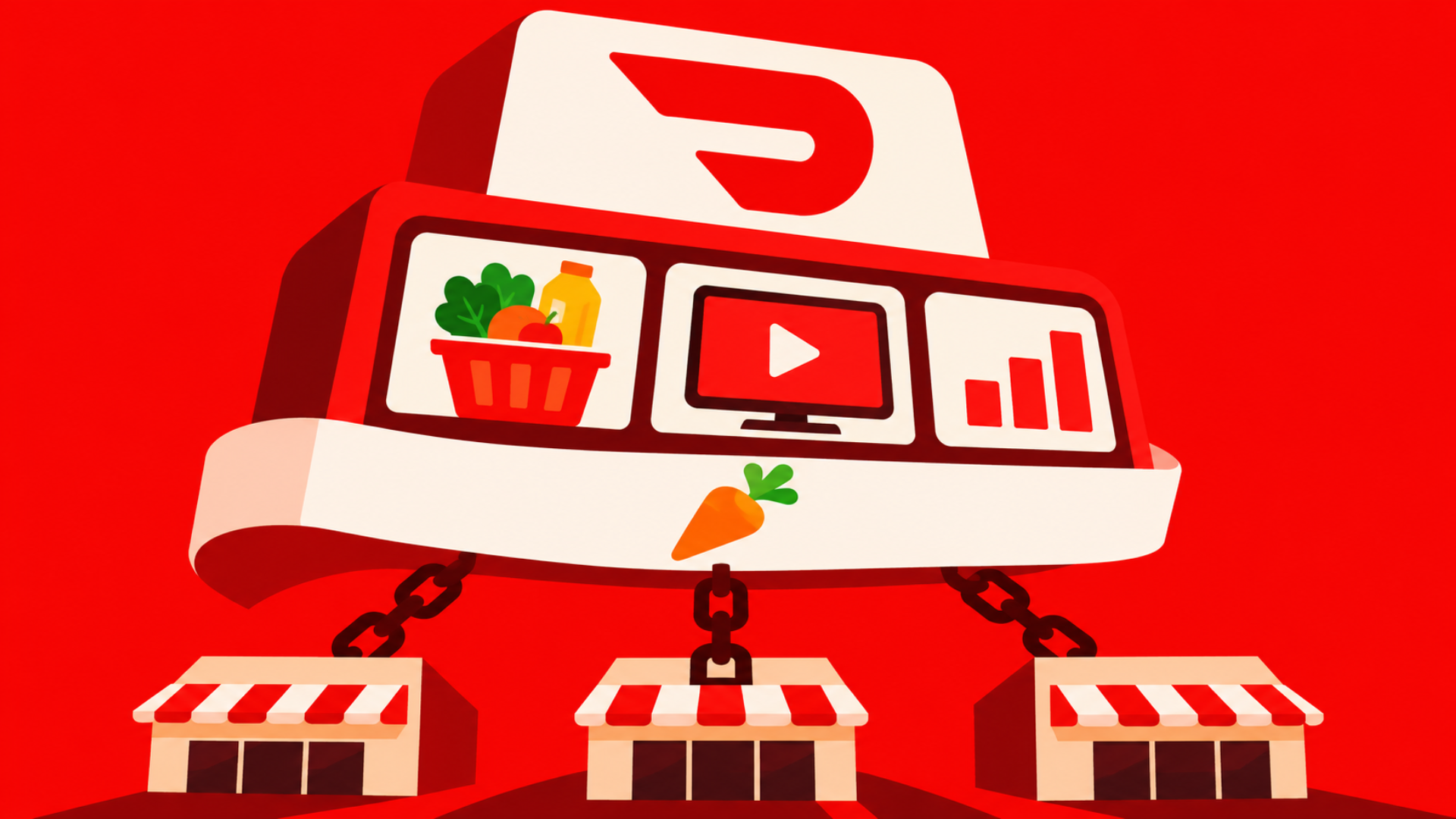
DoorDash has agreed to acquire Instacart for approximately $17 billion, combining its delivery network and commerce-media business with Instacart’s grocery technology, retailer relationships and purchase-linked advertising operation. The proposed acquisition would give brands a larger alternative to Amazon and Walmart for reaching shoppers and measuring sales, including through streaming TV, while increasing grocers’ dependence on one supplier for ecommerce, fulfillment and advertising.
DoorDash and Instacart Account for 77% of Tracked Delivery Retail-Media Impressions
Instacart generated $331 million in advertising and other revenue during the third quarter of 2026, up 23% year over year and representing 30% of its $1.095 billion in total revenue. DoorDash has been expanding its own advertising operation, including offsite campaigns handled by Symbiosys.
In Sensor Tower’s tracked delivery retail-media networks, Instacart accounted for 49% of advertising impressions in 2026 year to date, while DoorDash accounted for 28%. Together, the companies represented 77% of measured impressions within that segment. The figure measures advertising volume across the tracked delivery networks, rather than revenue share or the broader retail-media market.
Instacart concentrates heavily on consumer packaged goods, while DoorDash attracts a broader mix of advertisers across restaurants, financial services and other categories. Combining those relationships could let brands coordinate grocery placements, restaurant promotions and offsite campaigns through fewer buying relationships.
That scale would give DoorDash a stronger position in negotiations with advertisers seeking access to consumers close to a purchase. It could also consolidate more campaign measurement and advertising spending with one intermediary. The companies haven’t announced unified ad products, pricing or customer-data systems, leaving those opportunities dependent on integration after closing.
Amazon and Walmart already connect advertising to transactions within their retail businesses. DoorDash could offer a similar connection across grocery chains and local merchants it doesn’t own, provided it maintains access to the retailers’ purchase data and advertising inventory.
Instacart’s Purchase Data Would Extend DoorDash’s Reach Into Streaming Advertising
Instacart already supplies purchase-based audiences and campaign measurement through partners including Roku, NBCUniversal and The Trade Desk.
NBCUniversal named Instacart its exclusive consumer packaged goods outcomes partner for its Performance Insights Hub, which connects campaign delivery, audience insights and performance measurement across linear TV and streaming.
The existing relationship allows advertisers to combine NBCUniversal’s viewing audiences with Instacart’s shopping data for targeting and closed-loop measurement. Brands can evaluate whether consumers exposed to advertising subsequently purchased their products through Instacart’s retail network.
Streaming TV represented 23% of Instacart’s offsite advertising impressions and 15% of DoorDash’s in Sensor Tower’s 2026 Retail Media Report. Those figures measure the distribution of each company’s offsite impressions, rather than their shares of overall CTV advertising.
DoorDash could expand the range of commerce signals available to streaming advertisers by connecting Instacart’s grocery purchasing data with its broader restaurant and retail activity. The companies haven’t disclosed plans to combine those datasets or launch a joint CTV advertising product.
Amazon’s AI-managed advertising campaigns already allocate spending across sponsored products, video and streaming TV based on commerce goals. Walmart’s Vizio strategy connects TV audiences with retail transactions through infrastructure the company owns.
A combined DoorDash and Instacart could give streaming publishers another source of retail-data partnerships and advertising demand. Advertisers selling through independent grocers would have another way to connect video campaigns with transactions without routing those campaigns through Amazon or Walmart.
That opportunity introduces a commercial dependency for publishers. The retailer supplying purchase data can influence how an impression is matched to a transaction, which outcomes appear in campaign reporting and what the measurement costs.
As purchase-based attribution becomes more influential in streaming advertising, those terms will affect publishers’ margins, advertiser relationships and ability to demonstrate campaign performance independently.
Grocers Would Gain Technology Scale While Relying on One Supplier for More of Their Digital Business
Instacart partners with more than 2,200 retail banners representing nearly 100,000 stores. Its technology supports online storefronts, fulfillment operations, advertising and in-store retail systems.
DoorDash would add its delivery network, consumer reach and growing grocery operation.
During the third quarter, DoorDash’s U.S. grocery and retail gross order value grew at more than twice the year-over-year rate of its U.S. restaurant business. Combining the companies’ order volume could improve delivery density, reduce fulfillment costs and make their technology more economical for participating grocers.
Independent retailers could access capabilities that Amazon and Walmart finance through their own operations without making comparable investments in software, logistics and advertising infrastructure.
A retailer using the combined company for ecommerce, delivery and retail-media sales would also tie multiple revenue streams to one commercial relationship.
Changes to merchant fees, product placement, advertising revenue shares or access to customer records could affect the retailer’s margins across several parts of its digital operation. Switching providers could become more expensive when storefront technology, fulfillment and advertising systems operate together.
DoorDash has promised that grocers will remain free to work with competing delivery services. That commitment preserves an important form of commercial choice.
Retailers will still need to establish contractual rights covering customer-data portability, advertising measurement, revenue sharing and access to competing technology providers.
The economic value of switching suppliers depends on whether retailers can retain customer relationships and move the information needed to operate their digital businesses.
One Membership Would Put More Pressure on Order Frequency and Advertising Revenue
DoorDash intends to combine DashPass and Instacart+ under one membership fee, potentially saving customers approximately $100 million annually. Instacart customers could also gain access to more than 50,000 additional stores through DoorDash.
A membership spanning restaurant delivery, groceries and local retail would give households more reasons to use the combined services throughout the week.
Higher order frequency could improve delivery-network utilization and increase the number of shopping sessions available for advertising. Brands would gain more opportunities to reach customers across different purchasing occasions, while DoorDash could generate additional advertising revenue from members already paying for delivery benefits.
The economics depend on how the company prices the combined subscription and funds its benefits.
Customers currently paying for both services would no longer need two separate memberships. DoorDash would need additional orders, advertising revenue or fulfillment savings to offset the resulting reduction in subscription payments.
The companies haven’t disclosed the future membership price, participating merchants or how delivery discounts will be financed.
For retailers, membership economics will also depend on whether additional orders generate enough contribution margin to justify promotional and fulfillment costs.
DoorDash’s $500 Million Synergy Target Depends on Lower Grocery Fulfillment Costs
DoorDash expects a multiyear path to at least $500 million in annual synergies, net of investments, from the acquisition.
The company plans to reinvest more than 100% of expected synergies during the first year after closing and anticipates positive net synergies beginning in year two.
Grocery fulfillment is central to that target.
DoorDash says its inventory-managed grocery operations achieve fulfillment accuracy above 99% and complete deliveries more than 10 minutes faster on average than other grocery orders in U.S. markets with active DashMart facilities.
Managing inventory in dedicated facilities requires fixed investment in warehouses, staffing and technology. Higher order volume can spread those costs across more transactions, lowering the cost of fulfilling each order.
Instacart’s grocery volume and retailer relationships could improve utilization of DoorDash’s fulfillment network. Lower operating costs would give DoorDash more flexibility to reduce delivery charges, improve membership benefits or fund additional grocery expansion.
The companies haven’t provided a detailed breakdown of how much of the projected synergy target depends on expense reductions versus incremental revenue.
The acquisition’s financing also adds pressure to deliver those benefits. DoorDash will pay $65 per Instacart share, a 26% premium to the October 22 closing price, with at least 75% of the consideration funded in cash.
DoorDash expects to finance the cash portion through existing resources and debt. The actual cost of that financing and the pace of integration will affect the financial return on the transaction.
Regulatory Review Will Determine How Much Delivery and Retail-Media Power DoorDash Can Combine
The transaction requires approval from Instacart shareholders and regulatory clearances in the United States, Canada and Israel. The companies expect closing near the end of 2027 or during the first half of 2028.
Regulators may examine how combining two major delivery businesses changes competition for retailers, consumers and delivery workers. The review could also consider Instacart’s role in supplying ecommerce software and advertising technology to merchants that use competing delivery services.
DoorDash’s commitment to eliminate grocery exclusivity addresses one potential competitive concern. Retailers would remain able to contract with other delivery companies.
The combined owner would nevertheless have a larger role in supplying the software, advertising services and fulfillment operations those retailers use.
DoorDash plans to retain Instacart’s name, app and enterprise products. The companies will operate independently until the transaction closes.
After closing, separate consumer apps would share a corporate owner responsible for the commercial strategy behind delivery, ecommerce technology and advertising. Regulators will have to consider the effects of that common ownership on competition and retailers’ access to alternative providers.
The Streaming Wars Take
Streaming publishers have a stronger incentive to negotiate purchase-measurement rights that remain usable across buying systems and retail partners.
A campaign report showing attributed purchases can help secure advertising spending, but sales attributed to an ad don’t automatically establish how many purchases the campaign caused. Independent incrementality testing and comparable reporting become more important when advertisers allocate budgets toward measurable commerce outcomes.
Publishers relying on one retail-media network for attribution may have limited ability to verify results or compare them with sales activity at competing retailers. Agreements covering data matching, attribution windows, reporting detail, measurement fees and audit rights will affect their negotiating position with advertisers and technology partners.
Grocers face a related contractual decision. Delivery nonexclusivity provides limited commercial flexibility if ecommerce technology, advertising histories and customer information cannot move between suppliers. Retailers that preserve those rights can maintain meaningful alternatives when negotiating fulfillment, advertising and software agreements.
The transaction could expand the retail advertising budgets available to independent streaming publishers while giving DoorDash greater influence over the purchase data used to evaluate their inventory.
The resulting economics will depend on who controls campaign measurement, who receives the advertising revenue and whether retailers and publishers can change partners without losing access to the customer and transaction information supporting their businesses.
The Streaming Wars is intentionally ad-free
We don’t run display ads. Not because we can’t, but because we don’t believe in them.
They interrupt the reading experience. They cheapen the work. And they burn advertisers’ money on impressions nobody actually wants.
So we chose a different model.
We say the things people in this industry are already thinking but don’t say out loud. We connect the dots beyond the headline and focus on explaining why things matter to the people working in this business.
If you believe industry coverage can exist without clutter and interruption, you can support it here → SUPPORT TSW.
Support is optional. But it directly funds research and continued coverage — and helps prove this model can work.
Support TSW →