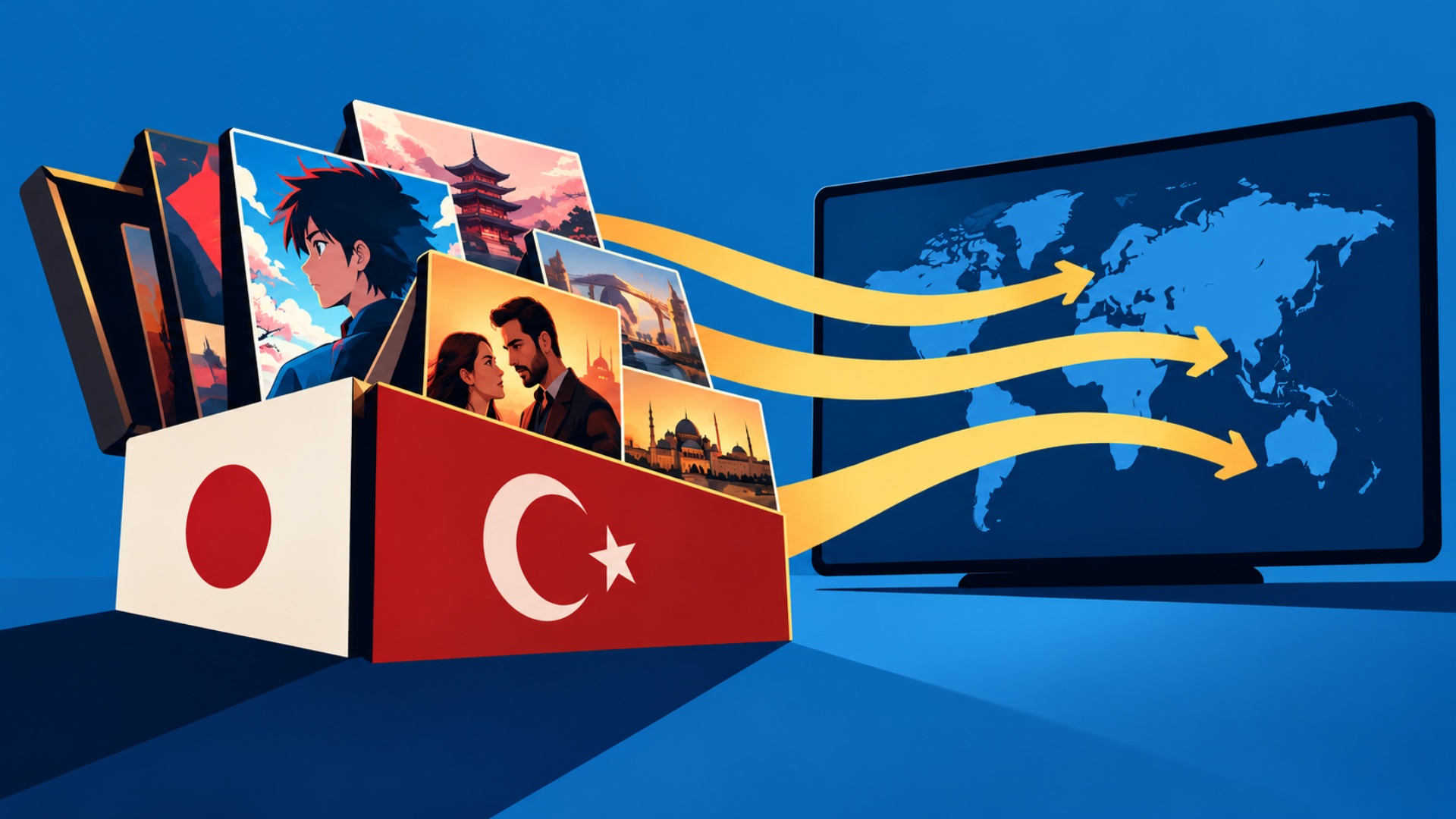
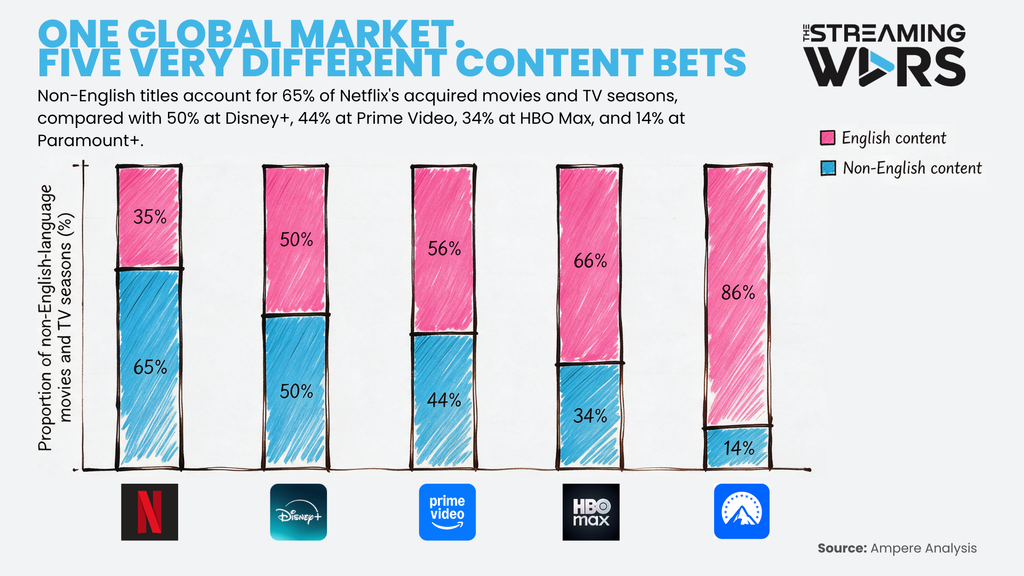
Non-English-language titles account for 65% of Netflix’s acquired content and 50% of Disney+’s, according to new research from Ampere Analysis. Yet 60% of Japanese VoD content and 70% of Turkish content remain unavailable internationally. Global streaming services have the distribution infrastructure and subscriber relationships to monetize finished programming across multiple markets. Local rights owners control the inventory, giving them opportunities to generate additional revenue from productions that have already been financed.
Global Demand Has Outgrown International Distribution
English-language content is already distributed internationally at enormous scale. Just 5% remains exclusive to its country of origin, according to Ampere.
The gap elsewhere is substantial. Only 40% of Japanese VoD content is available internationally, compared with 55% of South Korean content, 30% of Turkish content, and 76% of French content.
Ampere identifies licensing opportunities by comparing title popularity with international availability. Japan has room to expand in France and Germany, where anime and other Japanese genres have established audiences. South Korean romance has potential in the Middle East and Southeast Asia, while Turkish drama remains underrepresented in Saudi Arabia, the UAE, and Egypt.
France’s more developed distribution business offers narrower opportunities, particularly for films in Italy, Austria, and Switzerland.
For streaming services, finished programming provides a way to expand regional catalogs without financing the original production. Licensing fees, localization, and marketing still determine whether those acquisitions generate sufficient returns.
As of September 2026, non-English titles accounted for 44% of Prime Video’s acquired content, 34% of HBO Max’s, and 14% of Paramount+’s. These figures measure title counts, rather than spending or viewing.
The commercial opportunity depends on individual markets and genres. A Turkish romance with demonstrated demand in Saudi Arabia can command different licensing terms from the same title in Germany. Japanese anime with established German audiences can justify distribution investments that wouldn’t make sense for less familiar programming.
Domestic availability doesn’t automatically translate into licensable inventory. Existing agreements, music rights, underlying IP restrictions, and localization requirements can prevent international distribution. Buyers still need to establish which rights are available and whether the expected audience can support the acquisition cost.
Netflix’s Anime Success Is Giving Japanese Rights Owners More Leverage
In 2025, Japanese titles accounted for 20% of acquired TV seasons available on Netflix, second only to English-language programming at 43%. Anime represented 67% of those Japanese acquisitions.
Meanwhile, Japanese-language titles accounted for just 4% of Netflix’s Original TV season releases, and the service released only four Original animated Japanese TV seasons.
Netflix has expanded its international production operation, with non-English-language titles reaching 52% of Original TV releases in 2025. Japan remains a market where third-party acquisitions play an unusually important role.
Audience behavior supports that investment. Netflix disclosed in July that more than half of its members had watched at least one anime title. Non-English programming also accounted for more than one-third of total viewing during the first half of 2026.
Netflix is expanding direct relationships to secure future supply. Its January partnership with MAPPA includes worldwide exclusive streaming of new anime productions, with both companies collaborating on projects from development through merchandising.
The arrangement gives Netflix earlier access to programming and control over exclusive release windows, while MAPPA maintains its position as an independent studio developing the underlying content.
Other distributors are making similar commitments. HIDIVE’s exclusive output agreement with Mainichi Broadcasting System gives AMC’s specialized anime service access to upcoming programming that competing services cannot carry in covered territories.
These arrangements create different commercial options for Japanese rights owners. Global services offer distribution scale, while specialist services can justify targeted investments in programming that attracts a concentrated subscriber base.
When multiple buyers pursue the same titles, studios gain opportunities to negotiate exclusivity, territory coverage, and production commitments against competing offers.
Turkish Drama Can Sell the Same Hit More Than Once
Türkiye has one of the largest gaps between domestic content availability and international distribution.
Only 30% of Turkish VoD programming travels internationally, with fewer than 1,000 titles exported. Romance accounts for 43% of the country’s 100 most internationally portable titles.
On October 5, Eccho Rights announced deals licensing My Home My Destiny to Disney+ across the Middle East and North Africa and Golden Boy to Disney-owned STAR Life in Portugal.
Two days later, Eccho Rights announced another agreement bringing four Turkish dramas to Pasiones, a Spanish-language TV network serving U.S. audiences. The package included both My Home My Destiny and Golden Boy.
That structure allows rights owners to preserve selling opportunities that would disappear under a worldwide exclusive agreement. A single production can generate licensing revenue through regional streaming services, international broadcasters, and subsequent distribution windows, subject to the rights available under each contract.
South Korea is pursuing larger licensing packages. CJ ENM’s July agreement with Prime Video India covers more than 100 Korean titles over two years, including 26 new series. New releases will feature English subtitles alongside Hindi, Tamil, and Telugu dubbing.
For distributors with established libraries, these agreements provide ways to increase revenue from existing productions. They also create opportunities to diversify distribution relationships, although managing multiple buyers introduces additional rights administration and servicing costs.
Viewing Data Gives Streamers the Edge at Renewal
Subtitling, dubbing, technical delivery, rights clearances, and marketing all affect the economics of bringing an existing title into a new territory. Strong domestic performance doesn’t guarantee enough international viewing to cover those costs.
Global streaming services have an advantage in assessing this risk. Netflix and Disney+ can evaluate viewing behavior across their subscriber bases, identify regional genre preferences, and promote acquired programming through personalized recommendations.
Rights owners need enough visibility into performance to determine what their programming is worth when licenses expire.
A Turkish drama that develops a substantial audience in Saudi Arabia may warrant different renewal terms from one whose viewing remains modest. The same applies to Japanese anime in Germany or Korean romance in India.
Streaming services hold detailed internal engagement data, while content owners may lack comparable territory-level information unless their agreements provide access to it.
That information imbalance can influence negotiations. Buyers know how programming performs within their services and can assess its contribution to viewing and retention. Sellers must determine whether competing offers or alternative distribution arrangements provide better returns.
Localization has already helped build international businesses around content underserved by conventional distributors. As more finished programming travels internationally, ownership and reuse of dubbed and subtitled versions can affect the economics of subsequent licenses.
The Streaming Wars Take
Worldwide exclusivity removes a rights owner’s ability to reprice individual territories when demand develops during the contract. That foregone opportunity belongs in the original license negotiation.
A global agreement may still produce the best financial return. It provides a committed buyer, reduces the cost of managing multiple contracts, and can cover markets where separate deals would be uneconomic. Territory-specific licensing offers more chances to sell the same production, but those additional agreements carry distribution, localization, and servicing costs. The relevant comparison is net revenue across available deals.
Performance reporting can make renewal talks less one-sided. Streaming services know how individual titles perform across their subscriber bases. Rights owners that negotiate territory-level viewing data, clearly defined rights reversions, and reuse rights for dubbed and subtitled assets can make better decisions about future licenses.
Netflix, Disney+, Prime Video, and specialist services have different reasons to pursue exclusive programming. A broad release may justify worldwide rights for one buyer, while a specialist may pay more relative to audience size for a narrower package. Owners with multiple credible bidders can use those differences to negotiate terms that reflect each territory’s value.
For a streaming service, paying for global coverage only makes financial sense when the extra markets generate enough engagement or retention to justify the rights cost. For a content owner, worldwide exclusivity should command a price that reflects the regional deals it prevents the company from making elsewhere.
The Streaming Wars is intentionally ad-free
We don’t run display ads. Not because we can’t, but because we don’t believe in them.
They interrupt the reading experience. They cheapen the work. And they burn advertisers’ money on impressions nobody actually wants.
So we chose a different model.
We say the things people in this industry are already thinking but don’t say out loud. We connect the dots beyond the headline and focus on explaining why things matter to the people working in this business.
If you believe industry coverage can exist without clutter and interruption, you can support it here → SUPPORT TSW.
Support is optional. But it directly funds research and continued coverage — and helps prove this model can work.
Support TSW →