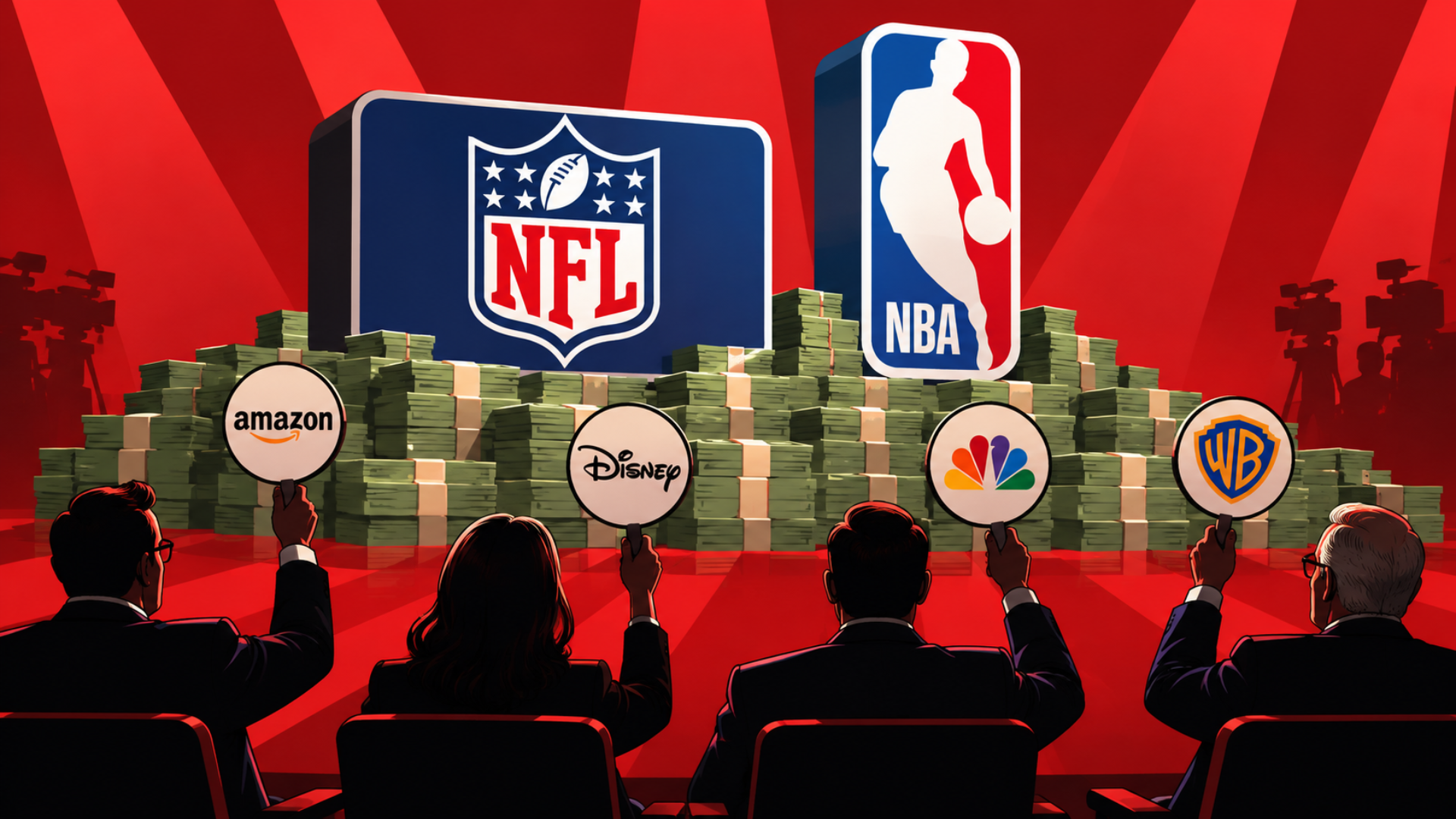
The United States now accounts for 53.9% of the world’s $65.82 billion sports media-rights market, giving it approximately $35.5 billion in annual rights value. The NFL and NBA alone represent 30% of the global total, concentrating nearly $20 billion in two leagues whose games attract bids from broadcasters, streaming services and technology companies with multiple ways to recover their investments.
The U.S. share has climbed from 46% in 2022, according to the SportBusiness Global Media Report 2026. The concentration strengthens the bargaining position of major American leagues while favoring buyers that can support sports spending through advertising, subscriptions, distribution fees and broader customer relationships.
Amazon, Disney and NBCUniversal can generate revenue from the same rights across several businesses. A sports-only streaming service has fewer ways to absorb the cost of competing with them.
The World Cup and Olympics Lifted the Record, but Long-Term League Contracts Sustain Spending
Global sports media-rights value increased 15% from 2025, helped by the FIFA World Cup in North America and the Winter Olympics.
SportBusiness expects the market to decline to $62.2 billion in 2027 before recovering to approximately $66.3 billion in 2028. The 2026 total also represents roughly 5% growth from 2024, when the Paris Summer Olympics helped push the market to $62.4 billion.
Major international events produce substantial swings in annual rights value. Multiyear league agreements establish a more durable spending commitment.
The NFL’s principal U.S. media contracts run into the 2030s, while the NBA’s latest agreements extend through the 2035-36 season. Those commitments remain in place when the World Cup and Olympics leave the calendar.
The NFL and NBA’s combined 30% share translates to approximately $19.7 billion in annual global rights value. Those leagues have secured agreements that commit major media companies to billions in recurring spending regardless of the industry’s year-to-year event schedule.
Their ability to attract multiple large bidders also gives them opportunities to increase fees when additional packages become available or existing agreements return to market.
Amazon’s $3.8 Billion Sports Budget Raises the Competitive Pressure on DAZN
Amazon is projected to spend $3.8 billion on sports rights in 2026, representing 27% of the $14.2 billion global streaming sports-rights market measured by Ampere Analysis.
That spending puts Prime Video ahead of DAZN as the largest sports-rights buyer among streaming services.
The shift reflects a broader change in the companies financing live sports. Generalist streaming services are expected to account for 44% of global streaming sports-rights spending in 2026, up from 31% in 2025.
Amazon’s portfolio includes NFL Thursday Night Football, the NBA and UEFA Champions League rights in several European markets. Those properties provide live programming across much of the year, giving Prime Video recurring opportunities to attract viewers, sell advertising and support membership retention.
Amazon can evaluate a rights agreement against the economics of Prime membership and its advertising business. It can also distribute third-party subscriptions and connect viewers with other services sold through Prime Video.
DAZN depends more directly on revenue from sports subscriptions, advertising and distribution partnerships. Its ability to compete for expensive rights therefore depends more heavily on the audience and revenue attributable to those properties.
The implications are visible in Amazon’s move ahead of DAZN in global sports-rights spending.
When two buyers calculate the value of the same game using different businesses, their maximum affordable bids can diverge substantially. Amazon can justify spending partly through the value of keeping customers inside Prime, even when the direct revenue from a particular game covers only part of its cost.
The NBA’s Distribution Reset Moved Advertising Revenue and Programming Costs Between Buyers
The NBA’s 11-year media agreements with Disney, NBCUniversal and Amazon demonstrate how premium leagues can increase competition for rights by dividing their inventory among companies with different distribution models.
ABC and ESPN retain major national packages. NBC combines broadcast distribution with Peacock, while Amazon carries exclusive games through Prime Video and distributes NBA League Pass subscriptions.
The agreements also substantially increase national broadcast exposure, with approximately 75 regular-season games appearing on broadcast TV annually, compared with a previous minimum of 15.
Advertisers followed the new distribution.
Guideline estimates the NBA generated a record $2.1 billion in advertising spending during the 2025-26 season, with streaming capturing 41% of measured spending.
That shift in NBA advertising spending toward streaming gave Amazon and NBCUniversal additional inventory to monetize through their advertising businesses.
Warner Bros. Discovery’s results reveal the financial exposure on the other side of the transaction.
WBD’s Global Linear Networks advertising revenue declined 27% in the second quarter of 2026. The company said the NBA’s absence reduced its year-over-year advertising revenue growth rate by 20 percentage points.
Losing the games also eliminated substantial programming costs. WBD said the absence of NBA expenses improved its Global Linear Networks cost-of-revenue comparison by 30 percentage points.
The NBA therefore illustrates both the revenue that premium sports can attract and the expense required to keep those audiences.
Disney, NBCUniversal and Amazon gained valuable live inventory, but they also accepted long-term financial commitments. Their returns depend on how effectively they convert those games into advertising revenue, subscription activity and distribution economics.
Europe’s Smaller National Rights Markets Limit Its Ability to Match U.S. Fees
Europe’s five largest sports media-rights markets combined are worth approximately one-third of the U.S. market, equivalent to roughly $11.8 billion against America’s $35.5 billion.
The English Premier League accounts for 7.8% of worldwide sports-rights value, approximately $5.1 billion. That’s less than one-third of the NFL and NBA’s combined share.
The Premier League generates substantial international rights revenue and remains the most valuable domestic soccer league. Its global audience, however, is monetized through agreements with broadcasters and streaming services operating across many separate territories.
American leagues can secure enormous domestic commitments from distributors competing for the same national audience and advertising market.
The U.S. has a combination of large media companies, valuable national advertising inventory and subscription businesses capable of financing expensive sports packages.
European leagues must assemble more of their revenue through separate domestic and international negotiations. The commercial strength of individual broadcasters and streaming services varies substantially across those territories.
That structure creates greater exposure for leagues that depend on a small number of local broadcasters or lack the international demand needed to offset weaker domestic contracts.
The pressure extends beyond Europe.
Smaller American leagues and regional sports properties also face limits on how much distributors can recover from advertising, subscriptions and carriage fees. Dedicated local audiences can support valuable programming without producing the national scale required for multibillion-dollar agreements.
As large buyers concentrate spending on properties that deliver broad reach and recurring engagement, smaller rights holders face harder decisions about exclusivity, production costs and guaranteed fees.
The Streaming Wars Take
The growing concentration of sports-rights spending makes contract structure increasingly important for properties outside the NFL and NBA’s tier.
A smaller league or team can pursue a guaranteed payment from an exclusive distributor, preserve free-TV exposure to support sponsors, or sell a dedicated subscription product that generates recurring revenue from its most committed fans.
Each arrangement assigns different costs, customer relationships and commercial risks to the rights holder and distributor.
Amazon’s expansion into local NHL streaming distribution illustrates how those choices are developing. Some teams include games within Prime membership, while others sell separate team subscriptions through Prime Video. Teams can also preserve free-TV or traditional pay-TV distribution alongside streaming.
The commercial negotiations extend beyond the rights fee to billing, promotion, production responsibilities and control of the subscriber relationship.
Premium national leagues can attract multiple companies prepared to make long-term financial guarantees. Smaller properties may need to accept a greater share of operating risk or give distribution partners more control over their customers.
The expected decline in global rights value in 2027 doesn’t change the multiyear commitments already supporting the largest American leagues. It leaves the rest of the market competing for buyers whose budgets increasingly reflect how many businesses a sports property can support.
For those rights holders, the highest upfront guarantee isn’t automatically the most valuable deal. Exclusivity can reduce audience reach, limit sponsorship exposure and transfer control of subscribers to a distributor.
Those costs can leave a league with less bargaining power when its next rights negotiation begins.
The Streaming Wars is intentionally ad-free
We don’t run display ads. Not because we can’t, but because we don’t believe in them.
They interrupt the reading experience. They cheapen the work. And they burn advertisers’ money on impressions nobody actually wants.
So we chose a different model.
We say the things people in this industry are already thinking but don’t say out loud. We connect the dots beyond the headline and focus on explaining why things matter to the people working in this business.
If you believe industry coverage can exist without clutter and interruption, you can support it here → SUPPORT TSW.
Support is optional. But it directly funds research and continued coverage — and helps prove this model can work.
Support TSW →