When Viki emerged from beta in December 2010, it attacked one of the more expensive problems in global video distribution: making local-language programming usable in markets where conventional localization economics didn’t justify the investment.
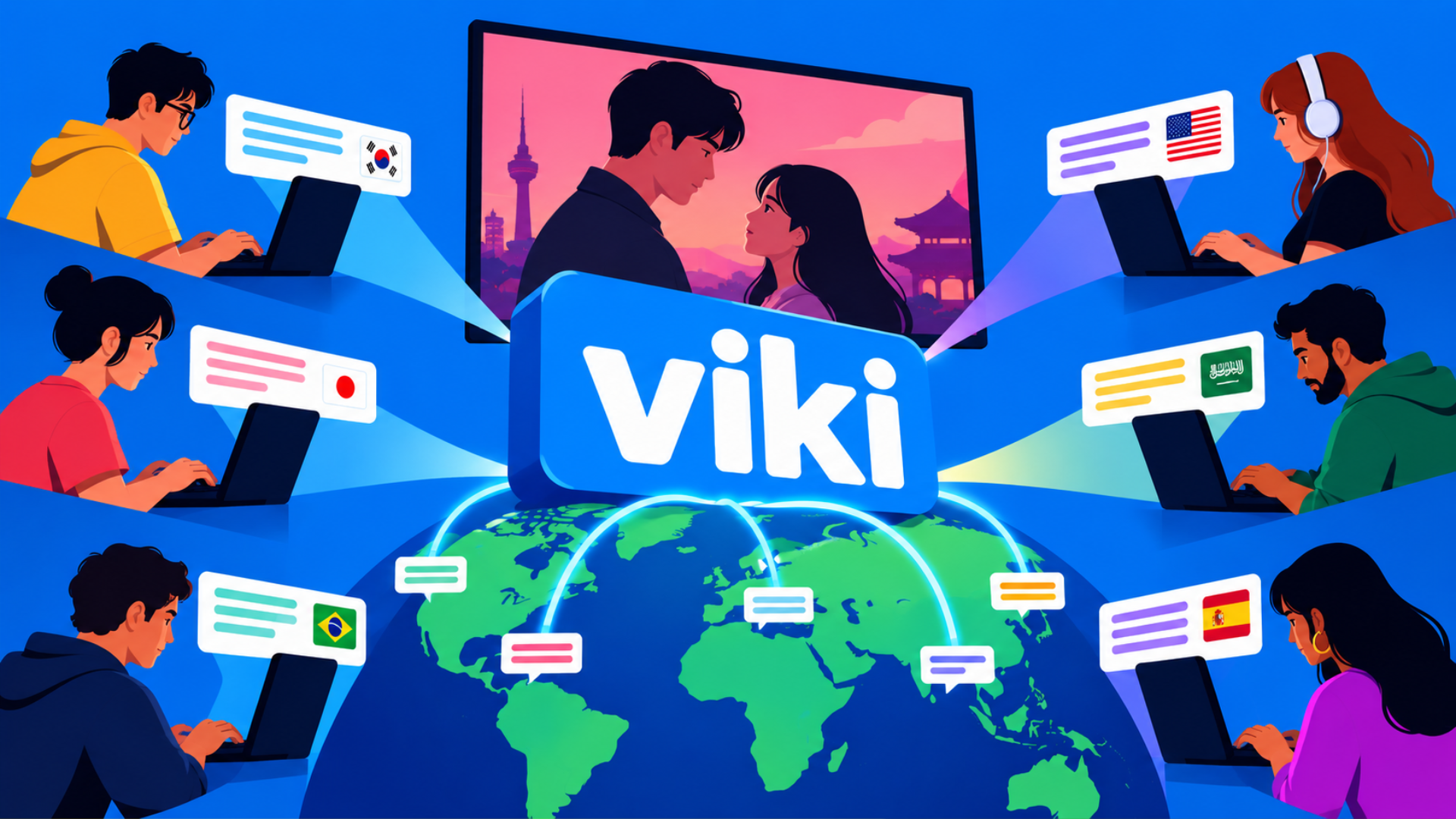
Viki licensed TV shows and films, then gave viewers collaborative tools to subtitle them. Popular programming could accumulate subtitles in roughly 20 languages within its first day, with more languages following as contributor communities organized around a title. By its public launch, Viki said users had already translated 100 million words across 143 languages. Localization became part of the product and part of the distribution system.
That structure changed the economics of niche international programming. A Korean drama didn’t need enough forecast demand in France, Brazil, or Romania to justify a full professional localization order before viewers could discover it. Audience participation could reveal where demand existed while helping make the programming accessible there.
Viki Made Localization a Distribution Function
Traditional localization requires distributors to make several decisions before they know whether a title will travel. They acquire the programming, select target territories, commission subtitles or dubbing, wait for delivery, distribute the title, then see whether viewers care.
Viki compressed that sequence. It acquired legal rights, published programming, and let contributor communities organize around the titles they wanted to translate. In 2011, roughly 5% of viewers were contributing to subtitling, representing more than 100,000 participants in a typical month. By that October, the service had 8.5 million monthly unique visitors, more than 5,000 hours of content, and 150 million translated words across 160 languages.
Every additional subtitle language expanded the potential audience for the same licensed asset without requiring Viki to place a conventional localization bet on every territory first.
Contributor activity also produced information. A title attracting Spanish, Portuguese, Romanian, Arabic, or Turkish volunteers showed where fandom was forming. Viki could observe language demand through behavior rather than relying only on advance forecasts.
Localization therefore did two jobs. It made content usable, and it generated evidence about where content could travel.
Fans Helped Rights Owners Monetize Markets They Hadn’t Built For
Asian programming already had global audiences online, but piracy captured much of that demand without returning meaningful revenue to rights holders.
Viki offered licensed distribution supported by advertising and revenue-sharing arrangements with content owners. Fans received faster legal access to programming they wanted, while broadcasters could reach audiences outside territories where they had established distribution.
Viki wasn’t alone in exposing the size of that opportunity. DramaFever was building a parallel legal market for Korean and other Asian dramas, proving that international fandom could support ad-supported and subscription streaming businesses around programming traditional U.S. distribution often treated as niche.
Viki added a different economic ingredient: the audience participated directly in preparing the product for additional markets.
Community translation could also produce a different editorial result from commodity subtitles. Contributor teams worked through idioms, honorifics, jokes, cultural references, terminology, and timing. A literal translation might communicate the words while missing the social context that made a scene work.
That involvement gave the service something difficult to purchase through a standard localization vendor: groups of people who understood both the language and why a particular audience cared about the show.
Rakuten Bought Distribution Infrastructure Built Around Fandom
Rakuten acquired Viki in September 2013. At the time, Viki had more than 22 million users, more than 14,000 hours of programming, and a community that had translated over 400 million words into more than 160 languages.
Viki had created a system that could license programming in one market, surface demand somewhere else, localize the title through community participation, and monetize the resulting audience through advertising. Rakuten specifically highlighted Viki’s global footprint, language analytics, and community-driven model when announcing the acquisition.
Subscription revenue added another layer. By 2014, Viki Pass offered ad-free HD viewing for roughly $3.99 per month while the free service continued providing broad access.
That hybrid structure let free viewing maximize discovery, advertising monetize casual audiences, and subscriptions convert higher-intent users. The community localization model made the catalog more useful in additional markets without requiring Viki to fund every language expansion through the same centralized cost structure.
Rakuten kept that community integrated into the service instead of replacing it with a conventional localization department.
Faster Releases Changed the Volunteer Bargain
The model becomes harder to manage when a commercial streaming service derives value from work supplied in substantial part by unpaid contributors.
Participation has to deliver something meaningful to the people doing the work. Viki contributors received community status, creative involvement, relationships with other fans, and the ability to make programming accessible to viewers who otherwise couldn’t watch it.
In 2024, Viki said all dramas would arrive pre-subbed in English, then expanded pre-subbing to Portuguese. English and Portuguese contributors were encouraged to transition toward editing, while Viki increased rewards for translation editors and emphasized their role in checking cultural references, terminology, names, and consistency.
That shift reduces the need for volunteers to build every subtitle track from scratch. It also changes what contribution means. Creating a translation for a community offers a different sense of ownership from reviewing and correcting a subtitle that already exists.
The economic advantage survives only if the community continues to find value in the new role.
Cheaper Translation Makes Cultural Quality More Valuable
Streaming localization is moving toward faster and more automated production. AI-assisted tools can reduce the cost of transcription, first-pass translation, dubbing, and other repetitive work, while humans increasingly handle quality control, cultural judgment, and exception management.
The broader streaming market is already moving in that direction. Netflix has expanded the full range of available subtitle and dubbing languages on TV devices as international programming occupies a larger share of viewing and production. In 2025, more than half of Netflix’s original TV seasons were produced in languages other than English.
Lower translation costs don’t eliminate the harder questions Viki organized its community around. Services still need to decide which titles should travel, which languages justify support, whether a translation sounds natural, how cultural references should be handled, and whether viewers in a particular market are actually responding.
The business also remains substantial. Rakuten reported 127.3 million registered Viki users at the end of June 2026, up 16.2% year over year. Viki also produced revenue and profit growth during the quarter, driven by subscriber expansion and pricing changes.
The volunteer subtitling system that defined Viki in 2010 has changed considerably. The underlying connection between community activity and global distribution hasn’t.
The Streaming Wars Take
Cheaper localization lets rights owners test more titles in more territories with less upfront spending. As that cost falls, competitive pressure moves toward rights access, release speed, cultural quality, audience intelligence, and the ability to identify which programming deserves broader distribution.
That structure is harder to replicate than the original subtitling tool. Software can create another translation. A distributor still needs viewers who understand the programming, care enough to improve how it travels, and generate behavioral signals about where demand exists.
The risk sits in the commercial bargain. Pre-subbing can make Viki’s localization workflow more efficient while reducing the creative role that helped make contribution attractive in the first place. If passionate fans increasingly function as an invisible quality-control workforce, the participation model that made Viki unusual becomes harder to sustain.
A better version uses automation for speed while preserving meaningful community authority over nuance, terminology, cultural context, and language quality.
Viki’s contribution to streaming economics was never simply free subtitles. It connected localization spending to observable audience demand and turned international fandom into part of the distribution infrastructure.
AI can make translation cheaper. Viki’s harder problem remains the one streaming services still have to solve: knowing which stories can travel, where they can travel, and how to make them feel local once they arrive.
The Streaming Wars is intentionally ad-free
We don’t run display ads. Not because we can’t, but because we don’t believe in them.
They interrupt the reading experience. They cheapen the work. And they burn advertisers’ money on impressions nobody actually wants.
So we chose a different model.
We say the things people in this industry are already thinking but don’t say out loud. We connect the dots beyond the headline and focus on explaining why things matter to the people working in this business.
If you believe industry coverage can exist without clutter and interruption, you can support it here → SUPPORT TSW.
Support is optional. But it directly funds research and continued coverage — and helps prove this model can work.
Support TSW →