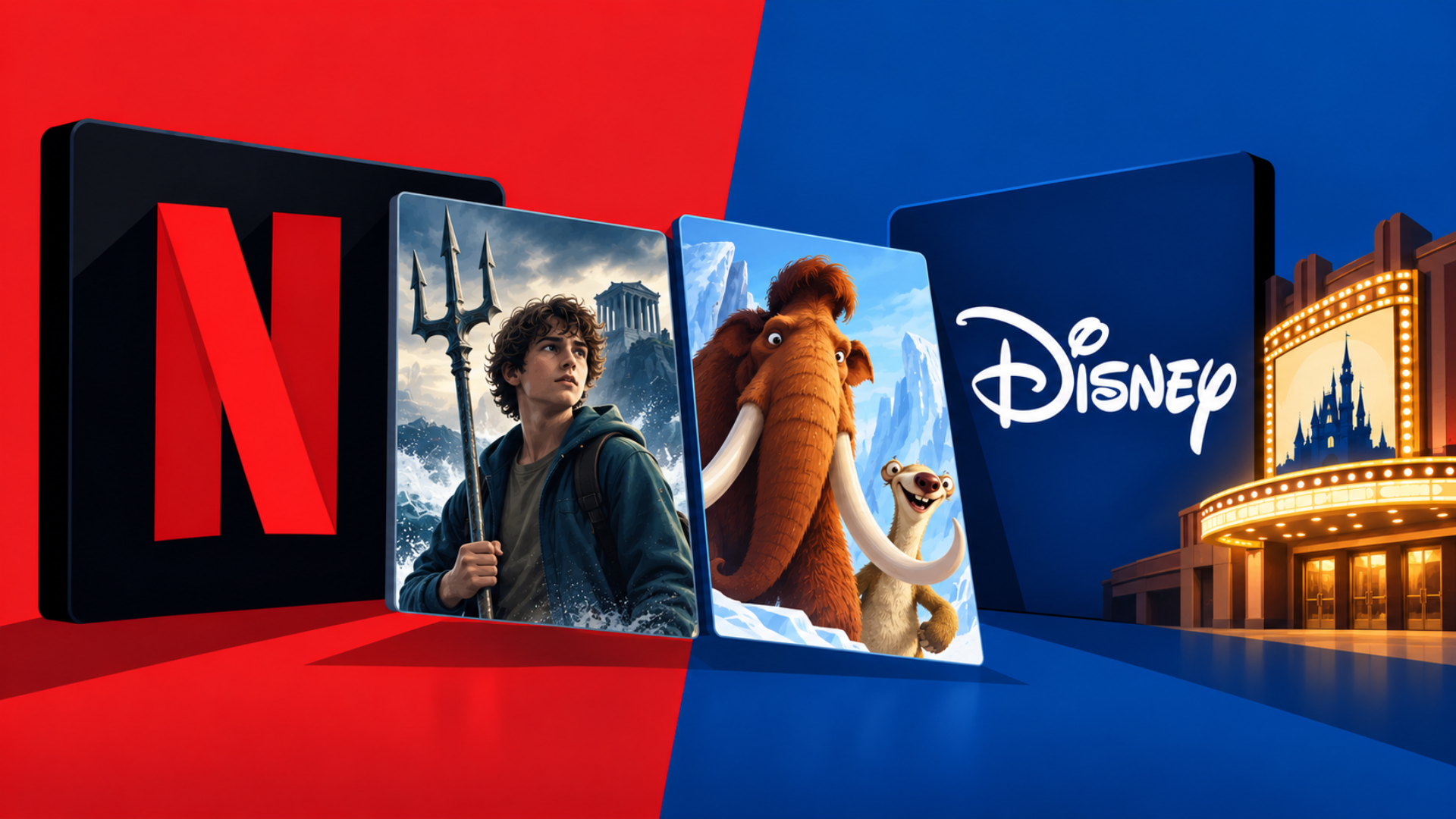
Disney is licensing the first two seasons of Percy Jackson and the Olympians to Netflix globally for three months beginning October 4, then keeping Season 3 on Disney+ when it premieres November 20. The company is using the same structure with all five Ice Age films ahead of Ice Age: Boiling Point in theaters February 5. Disney gets licensing revenue from Netflix while keeping the next release, and the monetization tied to it, under its own control.
The License Turns Earlier Installments Into Acquisition Inventory
Netflix gets 47 days with the first two seasons of Percy Jackson before Season 3 arrives on Disney+, and the license remains active after the new season begins. Disney can put two completed seasons in front of Netflix’s audience without giving Netflix the installment carrying the immediate subscription opportunity.
They can continue generating viewing on Disney+ while producing licensing revenue and introducing the series to households that haven’t watched it there.
Netflix has repeatedly demonstrated that licensed programming can find substantial new audiences after moving onto the service. Older series have generated major viewing increases after reaching Netflix, giving rights owners a distribution channel capable of creating fresh demand from programming that has already completed its original release cycle.
Ice Age applies the same mechanism to theatrical conversion. The five existing films arrive on Netflix October 4 for three months, placing the franchise back into household viewing ahead of the sixth theatrical release. Netflix pays for access to finished movies with established recognition, while Disney keeps the box office transaction attached to the new film.
Short Windows Put Licensing on the Release Calendar
The deal uses different terms depending on what Disney wants a title to do. Percy Jackson and Ice Age get short promotional windows. Will Trent Seasons 1–4 arrive globally on Netflix November 3 ahead of Season 5 on ABC in early 2027. Shifting Gears Seasons 1–2 reach Netflix beginning December 1 in the U.S., with international availability following ahead of Season 3.
Tracker uses a different structure. Seasons 1–3 reach Netflix outside the U.S. in February 2027 under a multiyear license. Disney is also licensing films including Soul, Elio and Raya and the Last Dragon, along with library series including Felicity, Revenge, Army Wives, Fresh Off the Boat and This Is Us, with availability varying by territory.
Those variations turn the catalog into a collection of commercial windows rather than a single exclusivity decision. Streaming rights can be segmented by time, territory and business model, allowing an owner to keep one set of rights while selling another.
Amazon MGM has used similar sequencing with three-month Netflix windows for James Bond films. Ownership gives the rights holder control over when exclusivity supports its own service and when third-party distribution can generate additional revenue or reach.
Disney can now apply that scheduling logic directly to its release calendar. A title heading toward a new season can receive wider distribution before the premiere, while a library show without an immediate Disney+ acquisition role can support a longer licensing term.
Netflix Gets Finished Programming Without Taking Production Risk
Netflix gets recognizable franchises, multiple seasons of completed TV and established films without financing their development or production. Those titles can generate viewing and retention while filling programming needs across multiple territories.
It doesn’t need permanent access to Percy Jackson for the series to produce several months of viewing. The value comes from having recognizable programming available when Netflix expects its members to watch it.
Every hour spent watching Percy Jackson on Netflix is an hour that could have occurred on Disney+, and Netflix controls how prominently the series appears in its own interface. The announced deal terms cover availability, timing and territory. They don’t establish guaranteed Netflix merchandising or a direct conversion path into Disney+.
Netflix can finish the first two seasons and immediately recommend another Netflix title. Disney has to turn interest in the characters into a separate consumer action on another service.
Disney Owns the Conversion Risk
The licensing fee is contract revenue. The promotional upside depends on whether Netflix exposure produces incremental demand for something Disney still controls.
A strong Netflix ranking would establish reach. Disney+ starts, reactivations and Season 3 viewing would show whether that reach converts into activity on Disney’s service. For Ice Age, the comparable signal is theatrical demand after five franchise films cycle through Netflix. If those releases outperform Disney’s normal launch patterns, the licensing window becomes more valuable than the fee alone.
A short license tied to an upcoming release has potential economic value beyond the fee itself. The earlier installment can function as paid inventory for Netflix and acquisition inventory for Disney at the same time.
The timing of the window, the amount of catalog included and the distance between Netflix availability and the next monetization event become variables alongside the license price.
The Streaming Wars Take
If temporary Netflix exposure produces measurable Disney+ acquisition, reactivation or box office demand, licensing calendars move closer to customer acquisition planning. Disney could value a window using both the guaranteed licensing payment and the downstream economics created by putting earlier installments in front of another service’s audience.
Disney doesn’t need to maximize the amount of content it licenses. It needs enough programming on Netflix to create familiarity and completion while keeping the release that carries the highest immediate value inside Disney’s own commercial relationship.
Netflix gets programming with known demand and no production bill. Disney gets paid before it knows whether the audience converts.
Until Disney can tie Netflix exposure to Disney+ or box office behavior, the guaranteed license fee remains the only directly measurable return. Evidence of downstream conversion would give Disney a second variable to price into future short-term windows.
The Streaming Wars is intentionally ad-free
We don’t run display ads. Not because we can’t, but because we don’t believe in them.
They interrupt the reading experience. They cheapen the work. And they burn advertisers’ money on impressions nobody actually wants.
So we chose a different model.
We say the things people in this industry are already thinking but don’t say out loud. We connect the dots beyond the headline and focus on explaining why things matter to the people working in this business.
If you believe industry coverage can exist without clutter and interruption, you can support it here → SUPPORT TSW.
Support is optional. But it directly funds research and continued coverage — and helps prove this model can work.
Support TSW →