
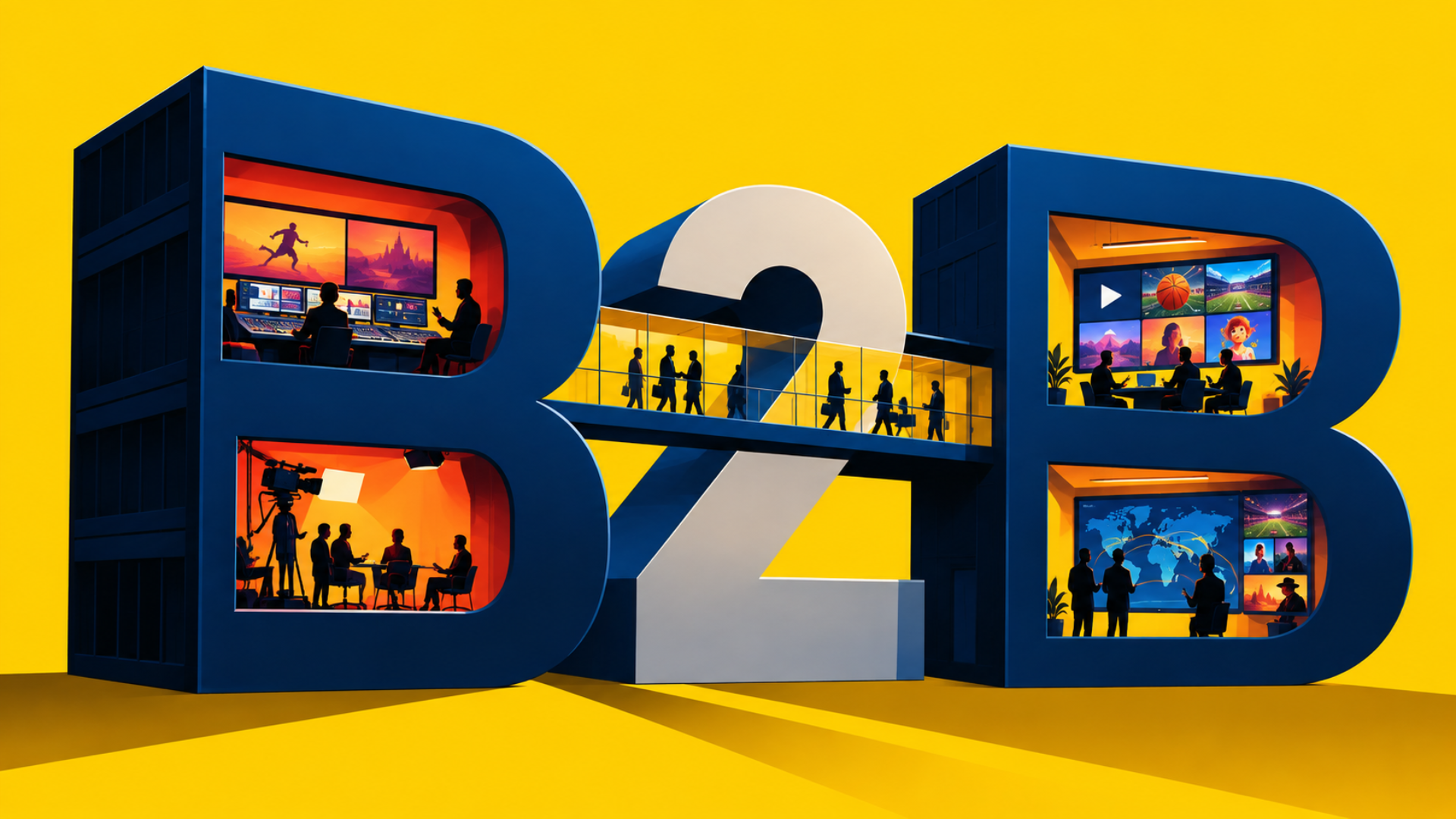
Skydance is looking for at least $6 billion in annual cost savings after acquiring Warner Bros. Discovery. Deltatre now owns Endeavor Streaming. Bending Spoons has Brightcove and Vimeo. Meanwhile, media companies are leaning further into bundles, wholesale distribution, and finding ways to operate with fewer people and less technology overhead.
If you’re selling technology or services into the media and entertainment industry, there’s a lot to think about.
Your customers are consolidating. Your competitors are getting bigger. Some of the companies that historically bought technology directly may no longer need to own or operate as much of it themselves.
And the companies that do need your technology are going to have some pretty tough questions about what they’re paying for.
There’s opportunity in all of this, too. Potentially a lot of it.
But I’ve been hearing something from media-company buyers for years that should make every B2B tech company uncomfortable.
They can’t tell half the vendors apart.
They’re trying to put together shortlists, and everybody seems to offer the same thing. Same capabilities. Same promises. Same descriptions of what makes their technology so special.
Now put those vendors into an industry where buyers are being told to reduce costs and eliminate overlapping contracts.
You can probably see where this is going.
M&A Turns Your Contract Into a Cost-Cutting Target
On October 6, Paramount completed its acquisition of Warner Bros. Discovery, creating Skydance.
The combined company now has Paramount+, HBO Max, two major studios, news networks, sports rights, and a whole lot of technology and operational infrastructure under one roof.
Skydance is targeting at least $6 billion in annualized savings within three years, with technology, integration, and procurement among the areas expected to contribute.
That’s a lot of money to take out of a business.
And you can bet somebody’s going to start looking at vendor contracts.
Think about it. Two organizations that previously had their own tech stacks, their own procurement teams, and their own preferred suppliers now have to figure out what stays and what goes.
Why keep paying for two products that do essentially the same thing? Why maintain separate systems when one could handle the combined operation? Why renew a contract when another supplier already has a relationship with the other side of the business?
Those are reasonable questions.
They’re also terrifying questions if you’re the vendor whose contract is suddenly under review.
But there’s an interesting opportunity here.
Consolidating technology is a lot easier to talk about in an investor presentation than it is to actually execute.
Somebody has to migrate the data, connect the systems, rebuild integrations, transition workflows, and make sure nothing important breaks along the way.
Media companies can’t just shut down systems that support millions of subscribers, advertising operations, and content distribution without a plan.
That’s where technology and services companies can make a compelling case.
If you can help a media company consolidate its operations faster, eliminate redundant infrastructure, or reduce the cost and risk of migration, there’s money on the table.
The challenge is understanding whether your company is helping solve the consolidation problem or whether you’re part of the cost they’re trying to eliminate.
Wholesale Distribution Is Moving the Checkbook
The industry’s growing dependence on bundles and wholesale distribution creates another interesting challenge.
Look at NBCUniversal’s agreement with YouTube. Beginning in early 2027, Peacock Premium will be included with YouTube Premium, giving Peacock access to millions of existing YouTube subscribers.
That’s a pretty significant distribution opportunity.
And it raises questions about just how much tech media companies need to build and operate themselves as more of their business moves through distribution partners.
Peacock isn’t abandoning its own streaming service. But when media companies distribute content through someone else’s customer relationship, parts of the technology equation change.
Depending on the arrangement, the distributor may handle discovery, billing, merchandising, and the consumer interface.
If more of your business comes through those relationships, you may not need the same technology investment you would’ve made to acquire, bill, and manage every subscriber directly.
That’s worth thinking about if your company makes its money building and maintaining standalone streaming applications.
Some customers may decide they don’t need as much of that infrastructure. Others may shift spending toward wholesale distribution partners or larger technology providers.
Of course, all that content still needs to get somewhere.
Rights management, entitlements, metadata, delivery, ad integrations, and revenue reconciliation don’t magically disappear because a consumer subscribes through a bundle.
In some cases, managing all those relationships makes the technical work even more complicated.
So there’s an opportunity for vendors that help content owners and distributors connect the pieces.
But you may find yourself selling to a different customer than you were five years ago.
And if your entire go-to-market strategy depends on the traditional DTC buyer, that’s something I’d be looking at pretty closely.
Your Customer’s Cost Center Could Be Your Next Contract
Here’s something I think deserves more attention.
On October 14, Netflix told employees it was cutting roughly 1,000 jobs, or 6% of its workforce, with the biggest reductions hitting product, technology, legal, and HR.
Even Netflix, one of the most profitable businesses in streaming, is taking a hard look at where it’s spending money internally.
When companies start looking for ways to reduce costs, they inevitably have to decide which capabilities they really need to build and maintain themselves.
Netflix has plenty of reasons to keep certain technology proprietary. Recommendations, subscriber relationships, customer data, and core monetization systems all influence its competitive position.
But there are other functions where the business case for building and maintaining everything internally may be harder to justify.
Content processing. Localization. Quality assurance. Metadata operations. Certain analytics workflows. App maintenance.
All of those functions require people, infrastructure, and ongoing investment.
If a technology supplier can deliver the same capability at a lower total cost, with less operational complexity, that’s a conversation worth having.
I’m not suggesting Netflix is about to outsource every function affected by its layoffs, but the pressure to justify internal spending is creating an opening for companies that can do the work more efficiently.
And I think B2B technology companies should be spending more time understanding where those opportunities exist.
Instead of walking into a meeting and talking about all the features you’ve built, find out what the customer is spending money on that they’d rather not be managing themselves.
Can you eliminate the need for an internal workflow? Reduce the staffing required to support a particular operation? Take over a process that doesn’t make sense for the customer to maintain?
Can you actually prove the savings after implementation, integration, and support costs?
That’s a far more interesting conversation than another presentation about how scalable and flexible your technology is.
Bending Spoons Has the Balance Sheet. What’s Your Edge?
Bending Spoons is another company I’d be watching very closely if I were running a B2B media tech business.
It owns both Brightcove and Vimeo, giving it a significant presence across enterprise video, video infrastructure, and content management.
And it has serious financial backing.
Berkshire Hathaway recently agreed to invest another $330 million in the company, bringing its total investment commitment to $930 million.
Bending Spoons can potentially spread engineering resources, proprietary technology, and AI investments across multiple businesses.
That’s a pretty powerful advantage when you’re competing against companies that have to fund those investments independently.
It can also pursue acquisitions to expand its portfolio rather than building every capability from scratch.
Deltatre’s acquisition of Endeavor Streaming is another example of how suppliers are combining products, expertise, and customer relationships under larger organizations.
For buyers, working with a larger supplier can simplify procurement and reduce the number of vendors they need to manage.
So where does that leave everyone else?
For starters, I wouldn’t assume bigger automatically means better.
Enterprise customers care about reliability, support, integrations, product direction, and having confidence that the company they depend on is going to be there when something goes wrong.
Those are areas where a more specialized vendor might have an advantage.
Bending Spoons has also been restructuring acquired businesses, including workforce reductions at Vimeo. That creates legitimate questions for customers evaluating service continuity and long-term product commitments, even as Bending Spoons invests in product improvements.
If you’re competing with a company like that, you have an opportunity to make a case around service, specialization, stability, and technical expertise.
But you’ve got to back it up.
Saying you’re more customer-focused isn’t going to cut it.
What does that actually look like? How responsive is your support team? How often do you improve the product? What happens when there’s a problem during a major live event? How much control does a customer have over the roadmap?
Those things have financial value when a media company is trusting you with critical infrastructure.
And if your company is genuinely better at something, there’s no reason to bury that advantage under the same generic messaging everybody else is using.
If Buyers Can’t Tell You Apart, Price Wins
This is the part that really drives me fucking nuts.
I’ve talked with buyers at media companies who are genuinely confused about which vendors they should be considering.
They’re trying to understand the market, figure out which companies belong on their shortlists, and determine who actually specializes in what.
And so many companies sound exactly the same.
Everybody has an end-to-end solution.
Everybody offers seamless integration.
Everybody is scalable, flexible, innovative, and committed to helping customers maximize monetization.
Wonderful.
What the hell do you actually do?
And now AI has made the situation even worse.
Companies are putting AI into every product description, capabilities deck, and positioning statement they can get their hands on.
I’m all for using AI when it makes a product better. But saying you offer an AI-powered media solution tells me almost nothing about what that product actually does.
Are you automating metadata? Improving search? Generating captions? Creating highlights? Helping with advertising decisions?
Those are completely different problems.
Calling yourself an AI company doesn’t tell buyers what problem you’re solving, how much money you can save them, or why they should choose you over the next vendor.
The more companies rely on the same broad claims, the harder they make it for buyers to understand their differences.
And here’s where consolidation makes that problem especially expensive.
When a buyer has 15 vendors to evaluate and only needs to shortlist five, they aren’t going to spend hours trying to decode everyone’s marketing language.
They’re going to gravitate toward the companies they understand, the ones they already know, or the ones that can clearly demonstrate why they’re worth considering.
If the buyer can’t understand why you’re different, you’ve made it incredibly easy to leave you off the list.
And your tech might actually be better than the competition.
That’s the frustrating part.
Nobody Gives a Shit About Your Feature List
If there’s one thing I’d be telling B2B companies to work on right now, it’s their narrative and positioning.
And I mean really work on it.
I’m not talking about a messaging exercise where everybody gets in a room and comes up with a bunch of adjectives for the website.
I’m talking about digging deep into the business and figuring out what actually makes you different.
Why do your customers hire you?
What problem are you better equipped to solve than the competition?
What does your company understand about the industry that others don’t?
What can you do that would be difficult, expensive, or risky for a customer to replace?
And most importantly, WHY should anyone give a shit?
Because simply being different doesn’t mean anybody cares.
You might have built some incredible technology. You might have a unique technical architecture or a team with decades of experience.
Cool story.
How does that help somebody who’s trying to reduce operating costs, launch a streaming service, improve monetization, or simplify their media supply chain?
That’s the connection companies need to make.
Maybe you’re particularly good at handling the complexity of live sports. Maybe you help content owners reduce the time it takes to prepare and distribute assets. Maybe you have specialized expertise that lets a media company eliminate an entire internal workflow.
Whatever that advantage is, find it. Understand it. And figure out how to communicate it in a way that makes somebody immediately understand why they should care.
I’d also be talking to existing customers.
Ask them why they chose you. Ask what they value most about working with you. Ask what they would miss if they had to replace your company tomorrow.
You might find that the thing customers value most isn’t even the thing your sales team spends the most time promoting.
I’ve seen companies get so caught up in describing everything they offer that they completely bury the one thing that actually makes them worth hiring.
You don’t have to be everything to everybody.
And with larger suppliers offering increasingly broad portfolios, trying to compete on the size of your feature list might be a losing strategy anyway.
Find where you’re genuinely different and where that difference has real commercial value.
Then make sure the story is consistent everywhere somebody might encounter your company.
Your website, sales materials, conference presentations, thought leadership, and even how your leadership talks about the business.
A good narrative should make your company easier to understand, easier to remember, and easier for someone inside a media organization to recommend.
Because that person may eventually have to explain to their boss why your company deserves a contract.
You want to give them a pretty damn good answer, right?
You Can’t Make the Shortlist If Nobody Knows You Exist
There’s also the issue of discoverability.
Some companies have genuinely strong products and capabilities but aren’t particularly visible to the people who might need them.
Others are well known in one corner of the industry but barely understood outside it.
That’s part of the reason I built the TSW Industry Directory.
I want media and entertainment companies to have a better way to discover the technology and service providers operating across the industry, understand their capabilities, and identify potential partners.
And we I B2B companies to have a place where they can clearly explain what they do and why it matters.
If your company isn’t listed, I’d encourage you to email us.
The Streaming Wars Take
I’d be taking a hard look at where my company fits into the industry right now if I were running a B2B technology business.
Start with your customers.
Are they likely to consolidate with another company? Are they centralizing technology decisions? Are they moving more of their business through distribution partners? Are they looking to outsource functions they’ve historically handled internally?
Then look at your competition.
Are larger suppliers moving into your category? Are your customers being offered bundled capabilities that overlap with your products? Can you demonstrate a reason someone should choose your company even when a larger provider offers something similar?
Those answers should influence what you build, who you sell to, and how you position the business.
There’s a real opportunity for technology and services companies that understand how the economics of their customers are changing.
Some will find opportunities helping media companies consolidate infrastructure. Others may benefit from outsourcing, wholesale distribution, or partnerships with larger technology providers.
Some may even become attractive acquisition targets because they solve a specialized problem that a larger company would rather buy than build.
But all of those opportunities become harder to pursue when your company can’t clearly explain where it fits.
And I think too many businesses are underestimating how much their narrative is holding them back.
For companies struggling to define or communicate their competitive position, I work with B2B media technology businesses to clarify their narrative, establish differentiation, and connect their capabilities to the problems buyers need solved.
I’d argue it’s becoming one of the more important things a company can invest time in right now.
Because consolidation is going to force some difficult decisions across this industry.
Media companies are going to look at their tech stacks, their contracts, and their operating expenses and decide what they really need.
Some vendors will become more valuable. Others will be replaced or consolidated into broader relationships.
And plenty of those decisions will happen in meetings where the vendors themselves aren’t even in the room.
When somebody asks why your contract should survive, you better hope the person defending it knows exactly what to say.
The Streaming Wars is intentionally ad-free
We don’t run display ads. Not because we can’t, but because we don’t believe in them.
They interrupt the reading experience. They cheapen the work. And they burn advertisers’ money on impressions nobody actually wants.
So we chose a different model.
We say the things people in this industry are already thinking but don’t say out loud. We connect the dots beyond the headline and focus on explaining why things matter to the people working in this business.
If you believe industry coverage can exist without clutter and interruption, you can support it here → SUPPORT TSW.
Support is optional. But it directly funds research and continued coverage — and helps prove this model can work.
Support TSW →