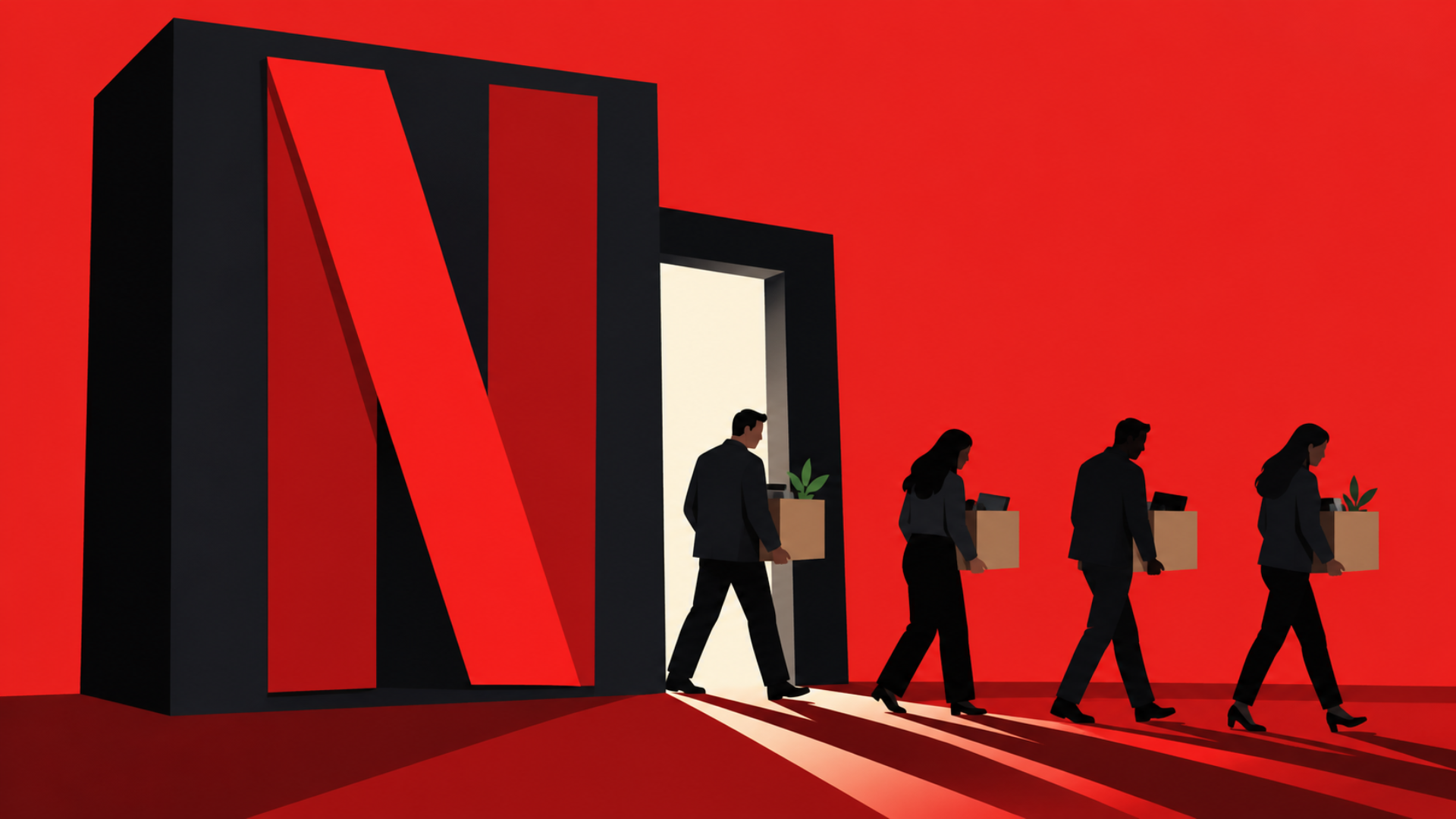
Netflix is eliminating roughly 1,000 jobs, or 6% of its global workforce, as slower revenue growth and mounting competition increase pressure on how the streaming service allocates resources. The cuts, concentrated in product, technology, legal, and human resources, come as Netflix expands into advertising, live programming, creator content, and gaming. The company is asking a smaller organization to support a broader entertainment business while producing more revenue from its existing audience.
Netflix Is Growing Revenue Much Faster Than Viewing Time
Netflix remains highly profitable. Second-quarter 2026 revenue increased 13% year over year to $12.6 billion, with operating margin reaching 33.4%. The company maintained its full-year revenue forecast of $51 billion to $51.4 billion and its projected operating margin of 31.5%.
Revenue growth has moderated from the 16.2% recorded in the first quarter. Meanwhile, Netflix members watched more than 97 billion hours during the first half of 2026, an increase of 2% year over year.
Netflix is generating revenue growth well above the rate of viewing-hour growth through membership gains, pricing, and advertising. Those mechanisms allow the company to increase revenue without requiring comparable increases in audience consumption.
Advertising is becoming increasingly important to that equation. Netflix expects approximately $3 billion in advertising revenue this year, roughly double its 2025 total.
The economic opportunity is substantial because the company can generate additional advertising revenue from viewing that already occurs inside its service. However, higher revenue per viewer requires effective ad pricing, targeting, inventory management, and advertiser demand.
As ad-supported pricing becomes a central part of streaming monetization, Netflix has to balance subscription revenue, ad yield, and retention rather than relying primarily on subscriber additions.
Netflix’s Expanding Entertainment Offering Requires More From Smaller Teams
The layoffs hit product and technology operations while Netflix continues expanding the range of entertainment available through its service.
The company has added video podcasts, programming from digital creators, cloud-based TV games, and new live events. It’s also investing in AI-assisted discovery, personalized recommendations, and advertising technology.
Each additional business introduces development, integration, operational support, and measurement requirements. Live events require reliable delivery at concentrated moments of demand. Advertising needs targeting, measurement, and buying infrastructure. Games and interactive experiences require specialized technology and ongoing product support.
Netflix’s expansion into shorter, more habitual viewing formats reflects its effort to capture more viewing occasions beyond traditional series and films. Creator programming and digital publisher content can increase viewing frequency, particularly during periods when subscribers aren’t looking for long-form entertainment.
Those initiatives compete internally for engineering capacity and operating resources.
Reducing headcount raises the importance of prioritization. Netflix has to decide which features and services deliver enough incremental acquisition, retention, advertising revenue, or operational savings to justify their ongoing development costs.
Live Programming Complicates the Economics of Workforce Efficiency
Netflix’s own engagement data illustrates why business priorities can’t depend exclusively on viewing hours.
The company expects live programming to account for slightly more than 5% of content spending in 2026 while producing approximately 1% of viewing hours. Yet live events generated six of Netflix’s 10 biggest new-member signup days over the previous five years.
An event can justify substantial spending through subscriber acquisition even when it contributes relatively little to total consumption.
That gives Netflix a different framework for allocating capital across entertainment categories. Scripted programming, live sports, creator content, and games contribute to the business through different combinations of acquisition, retention, engagement, and monetization.
The same reasoning applies to the teams supporting those categories. Product investments that improve conversion, reduce churn, or expand advertiser participation can generate returns that aren’t immediately visible in viewing-hour totals.
But a wider range of investments also means more competition for internal resources. Projects with uncertain commercial returns become harder to justify when the company is simultaneously reducing operating headcount.
Netflix’s Cuts Reinforce the Repricing of Media Employment
The reduction in corporate and technical positions fits a broader shift in how media companies evaluate organizational costs.
The TSW Guide to the Future of Media Jobs examines how margin discipline, productivity expectations, and increasingly measurable work are changing which roles remain durable across media organizations.
Netflix presents a particularly relevant case because its workforce reduction comes during a period of substantial profitability.
Cost discipline is extending beyond businesses experiencing financial distress. Profitable companies are examining whether existing staffing structures match their investment priorities and expected returns.
That scrutiny reaches product and technology functions alongside traditional corporate support departments. Those teams can contribute materially to growth, but individual projects and operating structures still compete for funding.
Automation adds another consideration. Netflix disclosed in July that generative AI workflows had been used in roughly 300 titles during 2026, primarily in post-production. The company has also expanded AI-powered advertising tools and automated portions of the buying process.
Netflix hasn’t established that automation caused the current layoffs. Its technology investments do, however, demonstrate a growing emphasis on increasing output while reducing manual work across production and advertising operations.
For employees and managers, revenue contribution, operational efficiency, and the ability to support multiple functions are becoming more consequential considerations in workforce planning.
For Netflix, the challenge is retaining enough technical and organizational capacity to execute its growth priorities while removing costs from activities that leadership expects to generate lower returns.
The Streaming Wars Take
Reducing product and technical headcount increases the opportunity cost of every new initiative Netflix pursues.
Its advertising business needs better targeting, measurement, and programmatic infrastructure. Live programming requires specialized engineering and operational support. Games, personalization, and creator-led content each introduce additional demands on product teams.
Netflix will face stronger incentives to standardize internal systems, simplify overlapping workflows, and rely on external partners where proprietary development provides limited differentiation.
That could expand opportunities for technology suppliers and production partners capable of delivering measurable savings or faster execution. Netflix will still have strong reasons to retain direct control over the systems governing recommendations, subscriber relationships, advertising monetization, and customer data.
The financial tradeoff is straightforward. A smaller workforce can protect operating margins, but weaker execution can undermine the subscription and advertising revenue that Netflix expects its expanding entertainment offering to generate.
The company’s ability to protect margins while increasing revenue per viewer will ultimately depend on which investments survive its tighter allocation of people and resources. Netflix has reached a scale where expanding the business no longer guarantees expanding the organization.
The Streaming Wars is intentionally ad-free
We don’t run display ads. Not because we can’t, but because we don’t believe in them.
They interrupt the reading experience. They cheapen the work. And they burn advertisers’ money on impressions nobody actually wants.
So we chose a different model.
We say the things people in this industry are already thinking but don’t say out loud. We connect the dots beyond the headline and focus on explaining why things matter to the people working in this business.
If you believe industry coverage can exist without clutter and interruption, you can support it here → SUPPORT TSW.
Support is optional. But it directly funds research and continued coverage — and helps prove this model can work.
Support TSW →