
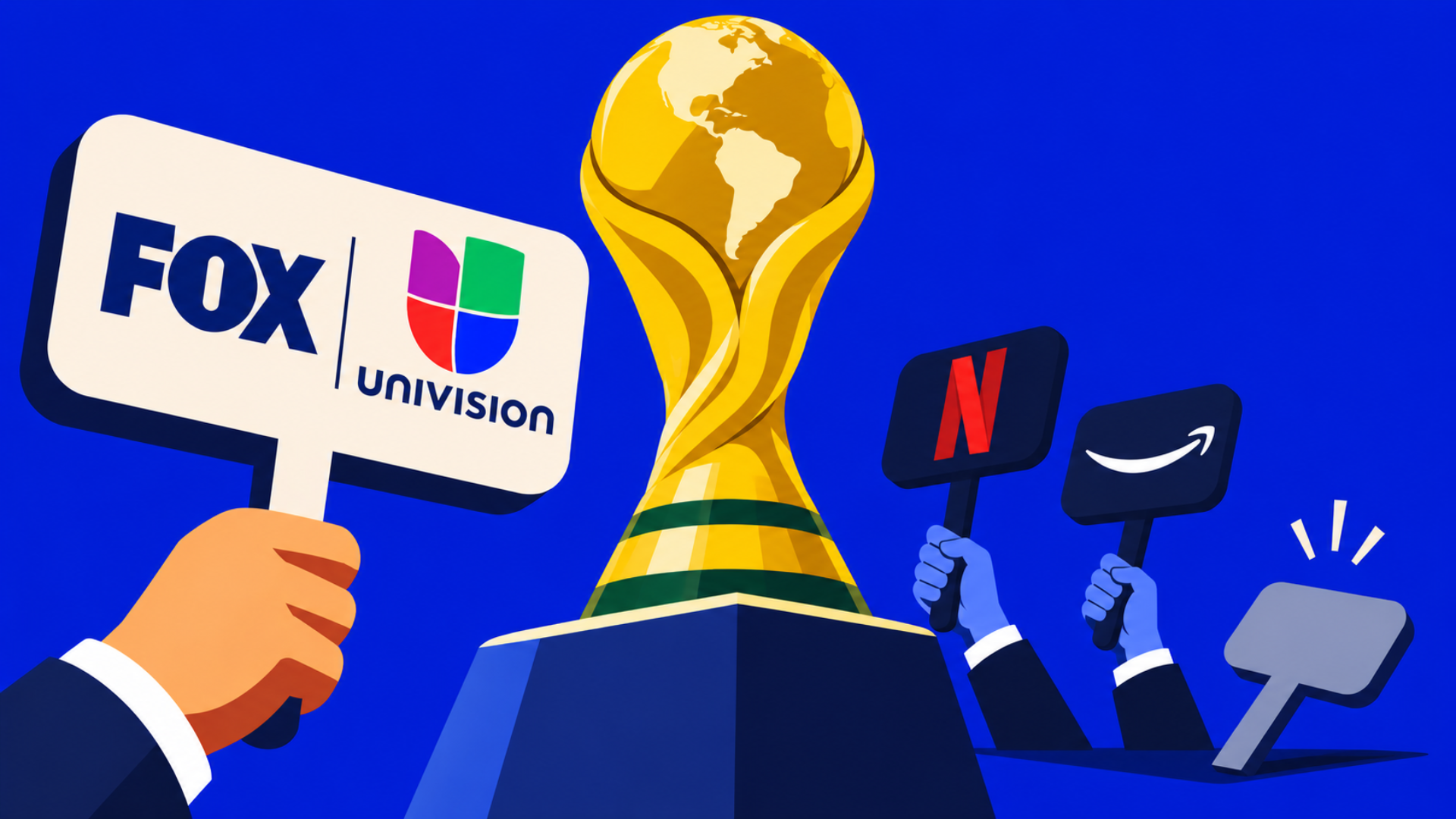
Fox and Univision have reportedly submitted the only traditional-TV bid for the U.S. rights to the 2030 men’s World Cup, consolidating broadcast competition as several major media companies decline to pursue the tournament at the anticipated price.
YouTube reportedly decided against bidding, joining NBCUniversal, Disney, Apple and Skydance on the sidelines. Netflix and Amazon submitted offers, although FIFA hasn’t disclosed the final bidding field.
FIFA’s preference for a single buyer controlling English- and Spanish-language coverage prompted Fox to partner with Univision. The companies can now offer national TV and streaming distribution in both languages while sharing the financial burden of the rights.
The withdrawals leave FIFA more dependent on streaming bids to secure the higher rights fee it wants. Fox and Univision face fewer competing broadcasters, while Netflix and Amazon can evaluate the tournament against subscription and advertising economics that extend beyond traditional TV.
One TV Bid Weakens FIFA’s Hand
Fox needed Univision to compete for FIFA’s preferred bilingual package.
Its broadcast network, FS1 and Fox One provide national English-language distribution, but Fox Deportes lacks the reach of the established Spanish-language broadcasters.
Univision fills that gap through Univision, UniMás, TUDN and ViX.
The partnership lets Fox defend its English-language World Cup franchise without building a larger Spanish-language operation. Univision gets an opportunity to return to the tournament after losing the rights to Telemundo following 2014.
NBCU could have assembled a similar bilingual offer internally. Telemundo already held the Spanish-language rights, while NBC, USA Network and Peacock could support English-language coverage.
Its withdrawal eliminates the only incumbent capable of combining both language feeds within an existing corporate operation.
Disney also declined after evaluating the anticipated fee against ESPN’s sports commitments and upcoming renewals. Apple and Skydance stayed out, while YouTube’s withdrawal removed another prospective buyer with substantial distribution and advertising capabilities.
Media companies have modeled potential rights fees of $1.5 billion to $2 billion per tournament. Those are industry estimates, not an official FIFA asking price.
FIFA still has credible alternatives in Netflix and Amazon. But the decision by several prospective buyers to sit out reduces the number of companies competing to establish a higher valuation.
The combined-language rights structure already increased the cost of Fox’s World Cup defense. The Univision partnership addresses that requirement while leaving the companies to determine how much additional revenue they can generate together.
Univision Changes Fox’s Economics
Fox and Univision enter the partnership with different financial incentives.
Fox is defending an established business that generated substantial advertising revenue and streaming subscriptions during the 2026 tournament.
Its fiscal first-quarter 2027 advertising revenue increased 47% companywide, driven primarily by the World Cup alongside political advertising and continued growth at Tubi.
Losing the tournament would remove a major source of live advertising inventory and subscriber acquisition from Fox’s sports operation.
Univision is pursuing revenue that shifted to Telemundo after 2014.
Telemundo and Peacock averaged 6.3 million viewers across the 2026 World Cup. The final attracted 23.9 million viewers across their Spanish-language coverage.
TelevisaUnivision already serves soccer audiences through Liga MX, the Mexican national team, CONCACAF competitions, South American club tournaments and European matches.
The World Cup would expand that portfolio while supplying ViX with another major subscription and advertising event.
The companies haven’t disclosed how they would divide the rights fee, production expenses, advertising inventory or streaming revenue.
Fox must calculate how much it can afford to spend protecting an existing franchise. Univision must determine how much incremental revenue justifies returning to the tournament.
Combining their distribution also creates opportunities to sell sponsorships across both audiences, although advertisers already purchasing English- and Spanish-language coverage could consolidate those commitments.
The economics of selling World Cup advertising across both languages depend on generating new spending rather than combining existing budgets.
A joint bid spreads the financial obligation across two companies. It still has to satisfy two investment decisions, and neither partner has disclosed the incremental revenue it expects from the arrangement.
2030 Loses Prime Time
The 2026 World Cup averaged 13.5 million U.S. viewers per match across TV and streaming. The final attracted 63 million, the largest audience for a soccer match in American history.
North American host countries and favorable kickoff times helped broadcasters convert that demand into record advertising revenue.
The 2030 tournament will take place primarily in Spain, Portugal and Morocco, with three anniversary matches in South America.
Most European and North African matches will air earlier in the American day, reducing opportunities to capture the same prime-time advertising demand that supported 2026.
The rights package also differs from previous agreements, which included additional FIFA properties. Netflix already controls the U.S. rights to the 2027 and 2031 Women’s World Cups.
A higher fee would therefore require broadcasters to recover more money from a men’s tournament with less favorable U.S. viewing hours and a narrower collection of programming rights than the historical agreements.
FIFA also invited bidders to pursue the 2034 World Cup in Saudi Arabia, although most prospective buyers reportedly focused on 2030.
Committing to 2034 introduces additional uncertainty because the schedule remains unresolved. A potential late-year tournament could compete with the NFL, college football and the NBA for American audiences and advertising spending.
Those conditions give bidders reasons to resist valuations based on the exceptional commercial performance of 2026.
YouTube Can Sell Without Buying
YouTube’s withdrawal highlights how distributors can participate in World Cup economics without acquiring the underlying rights.
Antenna estimates that Fox One generated 2.8 million sign-ups during June 2026.
YouTube Primetime Channels accounted for 15% of those additions, while Amazon Channels contributed another 19%.
Together, the two distributors generated approximately one-third of Fox One’s June gross sign-ups while Fox financed the rights and supplied the programming.
Distributing Fox One gave those companies a way to participate in subscription transactions without assuming the financial obligations of owning the tournament.
Acquiring the rights would give either company greater control over advertising inventory, programming access and the customer relationship. It would also require a substantially larger investment.
YouTube has declined that commitment.
Amazon remains a reported bidder, while Netflix already owns U.S. rights to the 2027 and 2031 Women’s World Cups and the complete 2030 men’s tournament in Spain and Andorra.
Both companies can evaluate the men’s tournament against advertising sales, subscription acquisition and engagement across their existing businesses.
The challenge is determining how much additional revenue ownership produces.
Fox One’s 2.8 million June sign-ups demonstrate the World Cup’s subscriber acquisition potential. They don’t establish how many customers remained after the tournament or how much revenue Fox retained through third-party distributors.
The financial return on Fox One’s World Cup subscriber growth depends on retention, acquisition costs and distribution arrangements.
Netflix and Amazon can incorporate those considerations into their bids. Whether either company values complete ownership substantially above the remaining broadcast partnership will determine how much pricing leverage FIFA retains.
A Streamer Could Resell TV Access
A streaming winner could acquire the complete U.S. World Cup package and subsequently negotiate selected broadcast rights with Fox and Univision.
FIFA’s official tender allows it to select one rights holder or multiple companies. Although the organization prefers a consolidated bilingual agreement, it has retained flexibility over the final structure.
Netflix’s 2030 agreement in Spain demonstrates how complete streaming coverage and national broadcast distribution can coexist.
Netflix will carry all 104 matches in Spain and Andorra. Its agreement also requires one match per matchday to be available free in Spain, with Spain’s matches, the semifinals and final made available through a national free-to-air broadcaster.
FIFA hasn’t announced an equivalent U.S. broadcast obligation.
A streaming rights holder could therefore evaluate sublicensing selected matches against the revenue available from keeping them exclusive, subject to the terms of its agreement with FIFA.
Selling games to Fox and Univision could generate additional revenue and expand distribution through established broadcast networks.
Retaining exclusivity would preserve advertising inventory and subscription incentives tied to those matches.
For Fox and Univision, a limited sublicense could preserve World Cup programming at a lower financial commitment than financing the complete tournament.
That alternative isn’t guaranteed. A streaming winner could decide that exclusive coverage produces more value than selling selected matches to broadcasters.
The rights agreement will determine whether Fox and Univision have another opportunity to participate and which company controls the price of that access.
The Streaming Wars Take
Fox and Univision’s partnership gives the companies two potential routes to the 2030 World Cup: win the complete bilingual package or pursue selected broadcast rights if a streaming company acquires the tournament and makes a sublicense available.
The second route could preserve valuable programming at a substantially lower financial commitment. It would also leave the streaming rights holder in control of which matches become available and how much broadcast access costs.
That possibility complicates FIFA’s negotiations.
A streaming bidder may be willing to pay more for unrestricted exclusivity because it can retain the entire tournament or recover part of its investment through a subsequent sublicense.
Fox and Univision must weigh that prospect against the risk of losing the tournament completely.
The partnership can negotiate the full-package fee knowing it is the only reported traditional-TV bidder. A streaming winner could subsequently approach the same partnership as a potential customer for broadcast rights.
FIFA has to account for that potential secondary market before awarding the package.
If the organization wants guaranteed national broadcast distribution, those requirements need to be reflected in the original rights agreement. Leaving the decision entirely to a streaming winner transfers control over subsequent broadcast access to that company.
With NBCU, Disney, Apple, Skydance and YouTube out of the reported bidding field, FIFA has fewer prospective buyers to support its anticipated rights premium.
Netflix and Amazon could still deliver the higher fee. Their offers will establish whether exclusive streaming ownership commands enough additional value to offset the loss of traditional broadcast competition.
Fox and Univision have already consolidated the market for a complete bilingual TV bid.
If a streamer wins without broadcast obligations, the next negotiation over traditional TV access will take place with the rights holder rather than FIFA.
FIFA’s remaining leverage lies in the guaranteed fee and distribution terms it can secure before handing over that control.
The Streaming Wars is intentionally ad-free
We don’t run display ads. Not because we can’t, but because we don’t believe in them.
They interrupt the reading experience. They cheapen the work. And they burn advertisers’ money on impressions nobody actually wants.
So we chose a different model.
We say the things people in this industry are already thinking but don’t say out loud. We connect the dots beyond the headline and focus on explaining why things matter to the people working in this business.
If you believe industry coverage can exist without clutter and interruption, you can support it here → SUPPORT TSW.
Support is optional. But it directly funds research and continued coverage — and helps prove this model can work.
Support TSW →