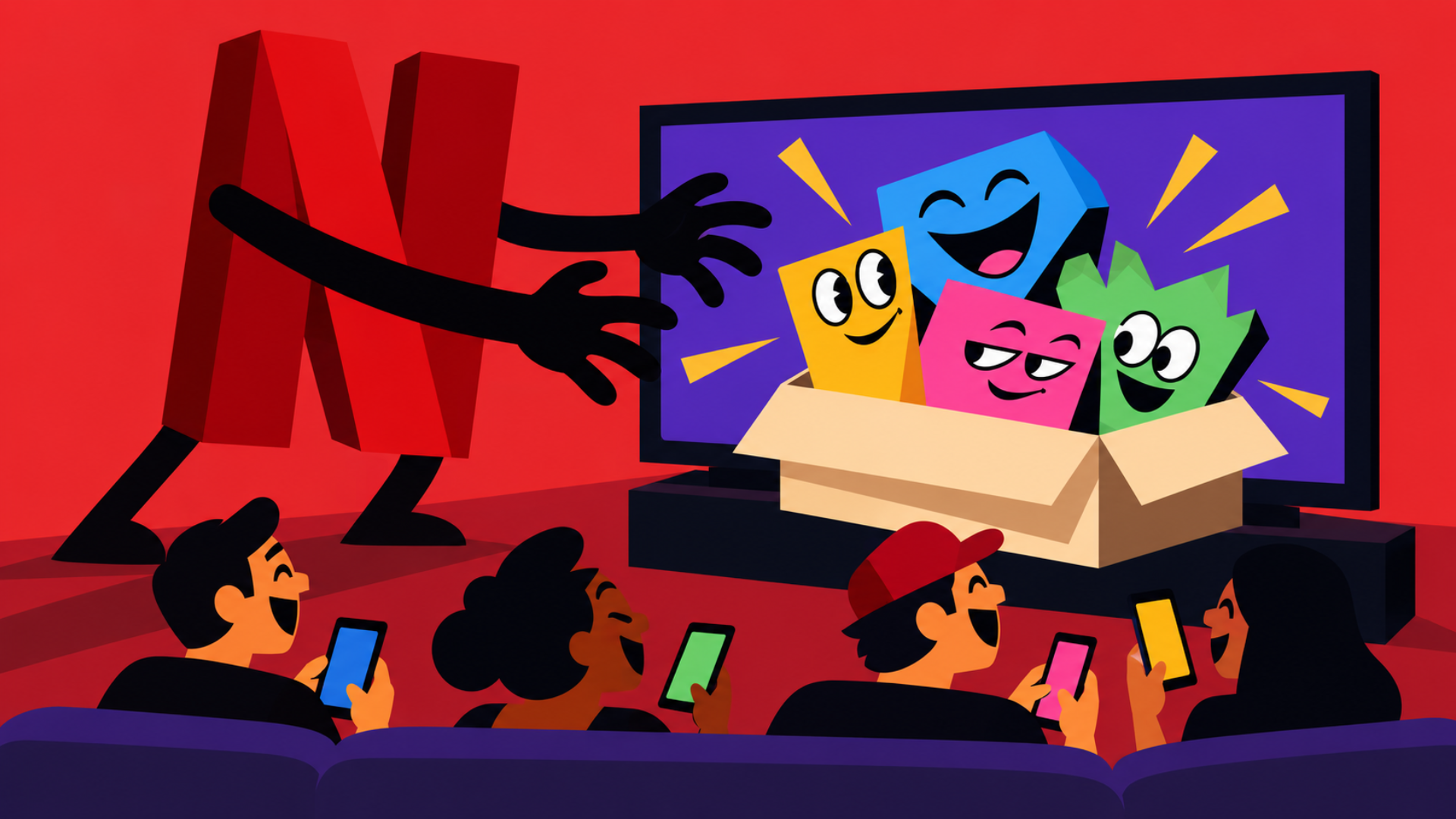
Every time Netflix talks about turning your phone into a controller and getting people to play games together on the TV, I can’t help but to think:
Y’all know Jackbox already figured this out, right?
And apparently Netflix does know. It added Drawful 2, Fibbage 4 and Quiplash 3 as The Jackbox Party Essentials in April, which means some of the best party games ever made are now sitting inside the same app people were already opening to watch Stranger Things.
Which raises the question: Why doesn’t Netflix just buy Jackbox?
There’s a pretty good case for it. Jackbox has the catalog, the brand, the multiplayer format and, most importantly, the exact kind of low-friction living room behavior Netflix wants from games. There’s no console required, no pile of controllers and barely any gaming literacy. Someone puts the game on the TV, everybody pulls out a phone, and five minutes later somebody’s uncle is typing something wildly inappropriate into Quiplash.
That is a very Netflix version of gaming.
The problem is that Netflix has also spent the last couple of years showing exactly how much it wants to own a bunch of game studios.
Which is to say: considerably less than it used to.
Netflix Is Basically Building Jackbox With Extra Steps
Look at where Netflix gaming has landed after five years of experimentation.
The company now concentrates on four categories: narrative, kids, mainstream, and party and puzzle games. Its living-room party strategy uses the TV as the shared screen and phones as controllers.
Netflix has Boggle. Pictionary. LEGO Party. Tetris. Party Crashers. Mini golf. Overcooked. It built a FIFA game around the World Cup. Now it has three Jackbox games.
The common thread is accessibility. Netflix doesn’t need hundreds of millions of households to suddenly become hardcore gamers. It needs games that work for people who already have Netflix, already have a TV and already have a phone within arm’s reach.
Jackbox built its modern business around exactly that setup.
Using phones as controllers solved one of the dumbest problems with local multiplayer: nobody owns six controllers. It also solved another one, which is that half the people in the room probably don’t play games and have no desire to learn what every button does.
Scan a code. Type a name. Start playing.
Netflix has been working toward that level of simplicity since it began testing cloud gaming on TVs. The company says its cloud TV games are showing promising traction, and its own data indicates gameplay can have a positive impact on retention.
That fits Netflix’s broader push to create more reasons to open the service. A game night creates another session without requiring Netflix to find another movie or series everyone in the room wants to watch.
Buying Jackbox Means Buying the People Who Know How to Make This Stuff
It’s easy to look at Jackbox and see a pile of funny little games.
The more valuable asset is the studio that keeps making them.
As of June, Jackbox had developed 62 unique games across 27 products and grown to roughly 90 employees. Its production machine covers trivia, drawing, bluffing, social deduction, comedy and other formats designed around groups of people sharing one screen.
That’s a weirdly specific creative skill.
Plenty of developers can build a trivia game. Building one that still works after the 40th session, with six people yelling over one another while somebody else is ordering pizza, takes a different kind of design discipline.
The rules have to make sense immediately. Rounds have to move. The funniest person in the room needs room to be funny, while the person who barely understands what’s happening still needs to participate. The TV has to entertain the whole group while individual inputs stay private on phones.
Jackbox has been refining some version of that formula since You Don’t Know Jack arrived in the 1990s, and the Party Pack format has been running since 2014.
The back catalog helps too. Jackbox doesn’t need every new game to carry the business. CEO Mike Bilder has described the catalog as a source of stability that allows the studio to keep individual releases from becoming make-or-break bets. Jackbox has also avoided significant layoffs for more than a decade while much of the games business has gone through repeated cuts.
Netflix could commission party games from a rotating group of developers. Ownership would give it a team that has already spent years solving the specific creative problem Netflix now cares about.
Then there’s the IP library.
Love Is Blind fits. Too Hot to Handle fits. Squid Game fits. WWE fits. Glass Onion fits. Black Mirror fits. Netflix doesn’t need a giant AAA game built around every franchise. Some properties are better suited to eight people on a couch lying to each other.
Jackbox knows how to build that.
Jackbox Is Becoming More Valuable on Its Own
The acquisition case gets stronger as Jackbox removes more friction from its own business.
Jackbox is already testing a cloud-streamed service that turns compatible smart TVs into the console. The current beta runs on compatible Google TV and Fire TV devices, with a smaller collection available free with advertising and a broader subscription product planned as the service develops.
The TV runs the game. Phones remain the controllers. The console disappears.
Jackbox execs have described Netflix as a way to reach casual TV viewers who may not own gaming hardware or even consider themselves gamers. The company sees services like Netflix as a sampling layer that can introduce those viewers to Jackbox before some of them move deeper into its catalog.
That setup gives Jackbox several ways to make money from the same underlying library.
It can keep selling Party Packs through Steam, PlayStation, Xbox, Nintendo and other storefronts. It has expanded into third-party publishing. It can distribute individual titles through Netflix. Its own smart TV service can eventually support advertising and subscriptions.
The company has also been growing instead of retrenching. Jackbox doubled in size over the five years leading into this summer, and its publishing expansion gives that team more products to work on without forcing the company to crank out additional Party Packs that could compete with one another.
There isn’t an obvious distressed-seller angle here. Jackbox has a durable catalog, a stable audience and more distribution options than it had a few years ago.
Netflix would be buying a company whose alternatives are getting better.
Netflix Is Also Helping Jackbox Build Its Funnel
The Netflix relationship creates an interesting little tension.
Someone who discovers Fibbage through Netflix has also discovered Fibbage.
Jackbox gets access to an enormous pool of households that might never search a console storefront for a Party Pack. Netflix gets a recognizable game that can create another evening of engagement.
Jackbox now has somewhere to take those people next.
Its own streaming service can offer more games. A Jackbox account can maintain the customer relationship across sessions and devices. Free games can feed advertising inventory. A subscription can turn a catalog that historically relied heavily on individual purchases into recurring revenue.
That gives Jackbox a direct path from discovery to monetization.
Control of the customer relationship becomes more valuable when discovery can lead directly to payment. Jackbox can promote new releases, surface older games and learn which formats get groups to come back.
Netflix is simultaneously teaching households that the TV can double as a game console.
If that behavior sticks, owning Jackbox would give Netflix control over one of the brands best positioned to benefit from it.
Netflix Just Spent Two Years Going the Other Direction
Netflix already tried owning a collection of game studios.
It acquired Night School Studio in 2021, then added Next Games, Boss Fight Entertainment and Spry Fox in 2022. It also built internal development teams and hired experienced game execs as its ambitions expanded.
Then the strategy tightened.
Netflix closed its high-end internal studio in 2024. Boss Fight shut down in 2025. Spry Fox returned to independence. In August, Netflix closed Night School Studio and Moonloot and cut additional gaming roles as it concentrated resources around its current gaming priorities.
Next Games is now the remaining studio from that acquisition wave.
Netflix still wants games. But its behavior shows much less appetite for carrying the fixed costs, development risk and management overhead that come with owning a collection of studios.
Jackbox would also bring businesses that don’t fit neatly inside Netflix.
The company sells games across competing hardware and storefronts. It’s building a third-party publishing operation. It has its own smart TV product. Its economics depend on distributing Jackbox IP broadly rather than treating Netflix as the only destination.
An acquisition would force Netflix to make decisions it currently gets to avoid.
Keeping Jackbox broadly distributed preserves sales and reach, but reduces the exclusivity Netflix gets from ownership. Making the catalog exclusive to Netflix would sacrifice existing distribution and potentially weaken the business Netflix just paid to acquire.
Licensing leaves that whole headache with Jackbox.
Netflix Can Buy the Part It Wants
This is the biggest reason the deal probably doesn’t happen.
Netflix already gets a lot of Jackbox without owning Jackbox.
It has Drawful 2, Fibbage 4 and Quiplash 3 today. More catalog games can be licensed if usage supports the investment. Netflix could pay for exclusives, commission original titles or have Jackbox build party games around Netflix franchises.
Netflix gets the games. Jackbox keeps the employees, publishing operation, storefront relationships, development risk and direct-to-consumer experiment.
Netflix also preserves the ability to change its mind.
That flexibility has real value after the amount of change inside its gaming strategy the past few years. Netflix began with downloadable mobile games, bought studios, invested in internal development, shut projects down, expanded cloud delivery and narrowed its priorities around the categories that fit the service best.
Netflix can get to the same place through ownership, licensing or partnerships, and it has shown a willingness to shift between those models depending on where the economics look best.
Jackbox gives it a textbook opportunity to do exactly that.
If party games produce enough engagement and retention, Netflix can buy more of them. If a specific Netflix franchise fits the format, it can fund something custom. If usage disappoints, Netflix can spend less without having to restructure another studio.
Jackbox Might Not Want to Sell Either
Jackbox appears to like being Jackbox.
The company has stayed relatively disciplined with headcount, relied on its back catalog to absorb the risk of individual releases and avoided the boom-and-bust hiring cycle that has wrecked a lot of game studios.
Now it’s adding distribution and revenue streams without abandoning the Party Pack business that got it here.
Netflix gives Jackbox something incredibly valuable without requiring Jackbox to give up control: distribution to casual TV households at enormous scale.
Jackbox can put three recognizable games inside Netflix, let Netflix teach people how phone-controlled TV gaming works, and still own the rest of the catalog and customer relationship.
Selling the company would put all of those decisions inside a gaming operation that has already changed direction several times.
Staying independent keeps the options open.
The Streaming Wars Take
Jackbox’s direct TV service will determine how much leverage the company can build on top of its Netflix distribution.
If the free product generates repeat play, advertising can subsidize customer acquisition. If enough of those players eventually pay for the broader catalog, Jackbox gains a recurring-revenue business alongside Party Pack sales, publishing and licensing. Netflix would then be licensing games from a company with its own growing relationship with the same living-room audience.
That would make Jackbox more expensive to partner with and more expensive to acquire.
For now, Netflix can let Jackbox take the development risk, keep three proven games inside its service and expand the relationship whenever the economics justify it. That structure fits a gaming strategy increasingly built around focus rather than ownership.
Netflix should buy Jackbox if it decides game night is important enough that it needs to control the brand, catalog and creative team behind one of the category’s defining products.
Netflix hasn’t reached that point.
Apparently, they know Jack pretty well after all.
The Streaming Wars is intentionally ad-free
We don’t run display ads. Not because we can’t, but because we don’t believe in them.
They interrupt the reading experience. They cheapen the work. And they burn advertisers’ money on impressions nobody actually wants.
So we chose a different model.
We say the things people in this industry are already thinking but don’t say out loud. We connect the dots beyond the headline and focus on explaining why things matter to the people working in this business.
If you believe industry coverage can exist without clutter and interruption, you can support it here → SUPPORT TSW.
Support is optional. But it directly funds research and continued coverage — and helps prove this model can work.
Support TSW →