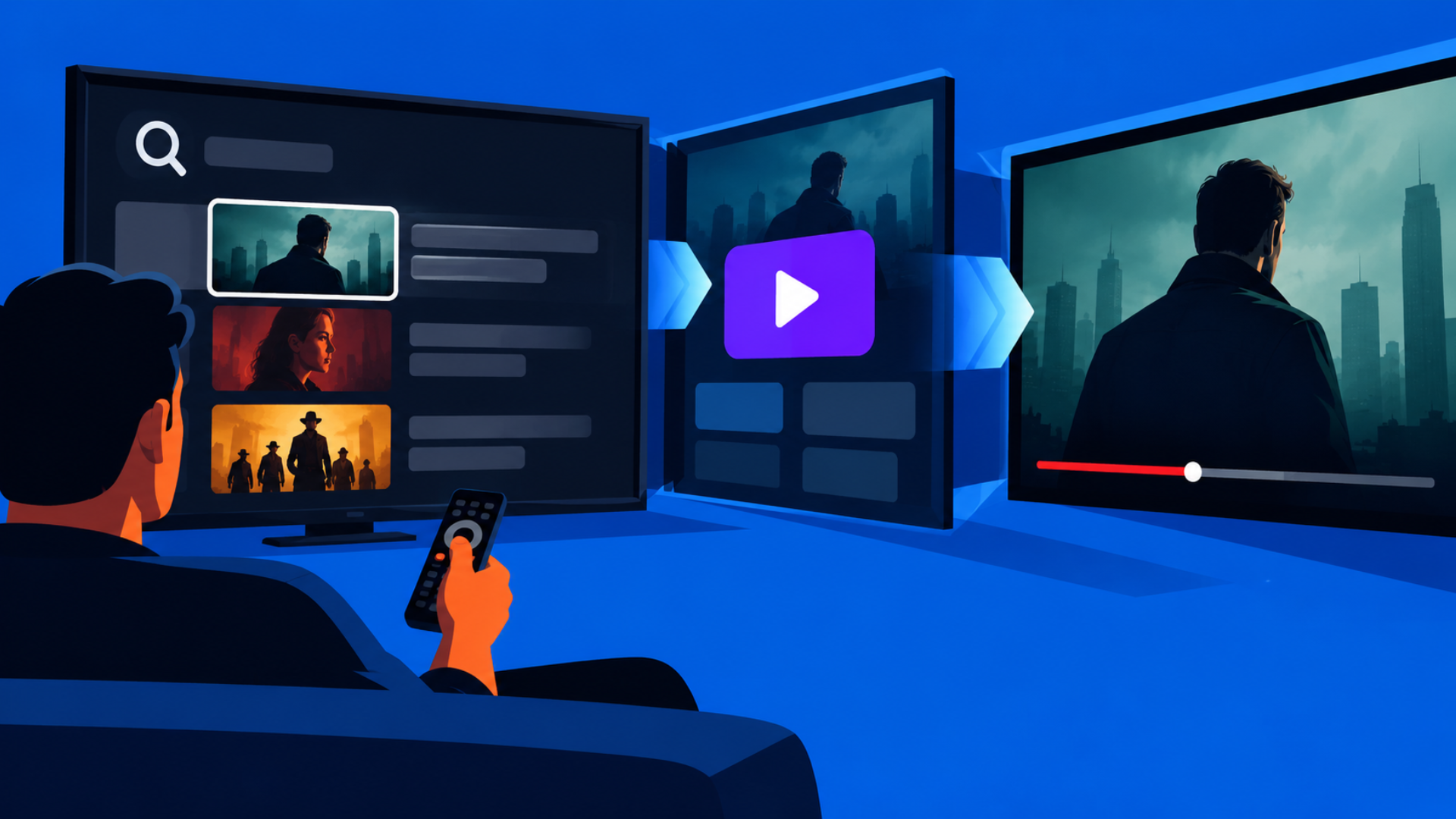
When someone clicks a TV search result, the operating system needs to send that viewer into the correct streaming app, identify the exact content they selected, and initiate playback. Getting there requires several systems to agree on what the viewer wants, where it lives, and whether they can watch it.
The transaction runs through content metadata, universal-search feeds, deep links, application launch logic, authentication, entitlement verification, and video delivery. Every handoff introduces another potential failure.
A title can appear correctly in Roku Search or Fire TV, then open the wrong episode, land on an app homepage, demand a subscription the viewer already has, or reveal that the content is no longer available.
For streaming services, those failures carry a cost. The viewer has already expressed intent to watch a specific title. The TV operating system has delivered that opportunity. A broken handoff can turn it into an abandoned session before a single frame plays.
The Search Result Starts With a Content Record
Consider a viewer using Roku to find a crime drama. They locate the series, navigate to season two, select episode four, and choose a streaming service’s Watch option.
The work required to make that selection function began well before the viewer picked up the remote.
Inside the streaming service’s content management system (CMS), episode four exists as a structured record. That record identifies the series, season, episode, title, synopsis, artwork, release date, and the internal identifier connecting it to a playable asset.
Additional systems govern whether that episode should be available to a particular audience. Rights-management and publishing rules may specify when distribution begins and ends, which territories are permitted, and which commercial offers apply.
The service needs to assemble this information into a record that external discovery systems can understand.
That introduces an important operational dependency. A CMS can accurately describe an episode while an external search system still has an older version of the record.
Imagine that episode four was originally assigned one asset identifier, but the streaming service changed its internal catalog structure during an application update. The episode remains available inside the app, yet its search feed still references the previous identifier.
The viewer can find the right episode, but the downstream application may no longer recognize the instruction to play it.
Content identity has to survive changes across multiple systems. A metadata update that looks harmless inside the CMS can break the path from discovery to playback if the associated identifiers aren’t maintained.
Every TV Operating System Needs Its Own Version of the Catalog
The viewer’s Roku search result exists because the streaming service supplied structured metadata that Roku could ingest and index.
Participating services provide search feeds containing the information needed to identify and display their programming. The operating system can then match queries against its indexed catalog and present viewing options from eligible services.
The technical requirements vary.
Roku Search uses JSON feeds containing content metadata, identifiers, licensing details, and availability information. Fire TV uses catalog ingestion, with Amazon’s newer EMBER XML schema replacing its legacy Catalog Data Format and supporting content relationships, offers, launch destinations, and entitlement policies. Google TV uses JSON media actions feeds to connect programming with discovery surfaces and playback destinations.
The same episode must be represented in formats that satisfy different platform requirements.
For episode four, those feeds need to preserve its relationship to the correct series and season, identify the streaming service offering it, and supply the information necessary to open the appropriate content.
Identifiers are especially important.
Roku’s search specification requires a playId that maps to the corresponding contentId inside the streaming app. When someone selects the episode, Roku uses that identifier to tell the application what to play.
If the identifier in the search feed doesn’t match the identifier recognized by the app, the transaction can fail even when the title, artwork, and episode description look perfect.
The operating system also needs accurate information about availability. A subscription-only episode should have the appropriate licensing information. Geographic restrictions and distribution windows must reflect where and when the content can be watched.
A service operating across several TV ecosystems needs to maintain these relationships separately, including validation, feed submissions, platform-specific requirements, and ongoing updates.
Getting indexed successfully establishes that the catalog was accepted. It doesn’t guarantee the information will remain accurate as programming, application code, and distribution rights change.
The Deep Link Has to Survive the App Launch
Our viewer has found episode four and selected Watch.
Now the operating system needs to open the streaming app and direct it to the exact episode.
A deep link carries that instruction.
On Roku, the operating system passes parameters including contentId and mediaType to the application. The content identifier tells the app which asset the viewer selected. The media type determines how the app should handle the request.
For an individual episode, Roku requires the application to launch the selected episode directly into playback, using saved viewing progress to determine the appropriate starting position.
A series-level selection can involve different behavior, such as using viewing history to determine which episode should start.
The application needs to interpret those instructions correctly whether it’s launching from a closed state or receiving a new request while already running.
Suppose the search feed identifies episode four as drama-s02e04, but the app’s latest catalog recognizes it only as episode-204.
Roku sends the identifier from the search feed. The application can’t match it to a playable asset.
Depending on the application’s error handling, the viewer might see an error or arrive at the homepage instead of the selected episode. A homepage fallback may be appropriate for an invalid deep link, but it still forces the viewer to start navigating again.
Fire TV follows a comparable handoff through its launcher integration. The launcher passes the content identifier supplied through catalog integration, and the app handles the resulting playback or sign-in instruction. Amazon’s guidance calls for direct playback without routing viewers through unnecessary application screens, with exceptions for authentication and certain profile-selection scenarios.
Installation adds another dependency.
If the viewer doesn’t have the streaming app installed, Roku can prompt them to install it before continuing the deep-link journey. If the viewer subsequently needs to authenticate, the application must retain the original content request and process it after sign-in.
Otherwise, a viewer who searched for episode four, installed the app, and logged into their account may end up on the homepage with no episode playing.
That creates unnecessary friction at the moment the streaming service has already earned the viewer’s attention.
Authentication and Entitlement Checks Determine Whether the Viewer Can Watch
Assume episode four opens correctly.
The application still needs to establish whether the viewer has permission to play it.
Authentication identifies the account. Entitlement determines what that account can access.
A streaming service may offer multiple subscription tiers, transactional purchases, add-on packages, or content available only through specific distributors. The app needs to verify that the viewer’s account includes the required access.
In our example, the viewer has an active subscription that includes episode four. The application recognizes the account, checks the subscription against its entitlement rules, and permits playback.
If the viewer is signed out, the app may need to initiate authentication and return to the requested episode afterward. If the account lacks the required entitlement, the app may present an appropriate purchase or subscription option.
TV operating systems can incorporate some of this information into discovery.
Fire TV’s launcher integration supports subscription-status information that can affect the viewing options shown to customers. Google TV supports entitlement sharing through integrations such as its Engage SDK, allowing participating services to communicate subscription and access information.
These integrations help the operating system present relevant options, but the streaming service remains responsible for enforcing access when the viewer attempts playback.
Synchronization problems create another failure point.
The operating system might present a Watch option based on subscription information that has become outdated. The viewer selects it, only to encounter a subscription prompt or access-denied message inside the app.
The reverse can also happen. A valid subscriber may be shown an unnecessary purchase path because the discovery environment doesn’t have current entitlement information.
Territorial rights, blackout rules, and licensing windows can impose additional restrictions even after the account has been authenticated.
A deep link can reach the correct asset, identify the correct customer, and still fail when the final access decision is made.
Playback Has Another Set of Dependencies
Once the application authorizes the viewer, the player needs to obtain the video.
For a typical adaptive streaming session, the application retrieves a playback URL pointing to a manifest. The manifest describes the available media streams and segments, allowing the player to select an appropriate version for the device and network conditions.
The player requests those segments through the content delivery infrastructure. For DRM-protected programming, it also needs the necessary license to decrypt the video.
Only after the player has received, decoded, and rendered the media does the viewer actually see episode four.
Problems at this stage can erase all the work that came before.
A playback authorization token might be invalid or expired. A stream URL might point to an unavailable asset. A DRM license request might fail. The player might encounter a delivery or decoding error.
The search result was correct. The deep link worked. The subscriber had permission to watch. The video still didn’t start.
This is why a successful application launch offers limited evidence of whether universal search delivered value.
Even a playback-start request can overstate success if the player never renders the first frame.
For a viewer who selected a specific episode, the meaningful outcome is straightforward: the requested programming begins playing.
Stale Availability Can Turn Discovery Into a Dead End
Now consider the same episode when its distribution rights expire.
The streaming service’s rights to episode four end at midnight. Its internal publishing system correctly disables the content, but Roku still has an older version of the search feed indexed.
At 12:05 a.m., someone searches for the episode and selects Watch.
The OS presents a viewing option that the streaming service can no longer fulfill.
The app may launch correctly and recognize the content identifier. Its rights or playback systems then refuse access because the episode has passed its authorized viewing window.
Feed timing makes this a practical operational concern.
Roku’s documentation specifies that changes to a search feed must be resubmitted for processing and may take up to 24 hours to propagate. Its feed specification also supports availability start and end times, allowing known viewing windows to be represented in the metadata.
Those mechanisms require coordination between the service’s publishing schedule and the information supplied to Roku.
Amazon identifies a related problem in its Fire TV launcher documentation. When the content catalog and actual playable inventory become unsynchronized, viewers selecting unavailable programming can encounter a black screen with no clear navigation path. Amazon recommends error handling that explains the problem and redirects the viewer appropriately.
The mismatch can also occur in the opposite direction.
A streaming service may publish an upcoming episode into discovery before the corresponding playable asset is available. Someone finds the episode, clicks Watch, and encounters content that hasn’t been activated.
Scheduled premieres, expiring licensing agreements, regional changes, and catalog migrations all create opportunities for discovery information to diverge from the service’s playable inventory.
The response requires coordination across systems.
Known rights windows should be reflected in feed availability rules. Catalog identifiers need to remain synchronized with the application. Feed updates need validation and appropriate submission timing. Applications need to handle unavailable content without leaving viewers trapped in an error state.
A well-maintained search integration reduces these failures. Application-level checks remain necessary because no external index can guarantee that every upstream change has already propagated.
App Installs and Search Visibility Don’t Measure Completed Viewing Sessions
TV operating systems already exercise considerable influence over which streaming services viewers discover through universal search. The viewer’s actual experience depends on what happens after the operating system hands control to the application.
That journey crosses a measurement boundary.
The OS provider controls much of the upstream search experience, including result presentation and selection. The streaming service controls the application, authentication, and playback telemetry.
Neither side necessarily has complete visibility into the entire transaction.
A service might observe additional app installations following its inclusion in universal search. Those installations can look encouraging in acquisition reporting even if viewers frequently encounter broken deep links or fail to reach playback.
A better operational measurement approach tracks the handoffs that the service and its distribution partners can observe: search selections where OS reporting is available, incoming deep-link requests, successful content resolution, authentication and entitlement outcomes, playback initialization, and first-frame rendering.
Those events should be segmented by device ecosystem, application version, content identifier, and error category where practical.
That separation helps distinguish different problems.
If a device family generates deep-link requests that consistently fail content resolution, identifier mapping or application routing may be responsible. If episodes open correctly but playback fails for paying subscribers, entitlement or video-delivery systems deserve closer inspection.
The commercial consequences vary by business model.
Ad-supported services lose viewing sessions that could have generated advertising inventory. Subscription services lose engagement that contributes to perceived value and renewal decisions. Transactional services risk losing a rental or purchase when a viewer can’t reach the selected offer or content.
Broken handoffs can also distort content-performance analysis. Low viewing hours for a title may reflect technical failures rather than weak audience interest.
Diagnosing those failures requires more than counting search impressions, installations, or app launches.
The Companies Connecting Catalogs, Search, and TV Apps
The search-to-play workflow spans several different technology functions. Content management systems establish and maintain the published catalog, search-integration services translate that information into the formats TV operating systems require, and connected TV application infrastructure handles the viewer’s destination and playback experience.
Three companies in the TSW Industry Directory illustrate those responsibilities.
Zype provides API-based video content management and publishing infrastructure, including metadata management, catalog organization, publishing schedules, and content rules. These capabilities help services maintain the underlying records and publication controls that downstream discovery systems depend on, reducing the operational burden of keeping content information current across distribution workflows.
USAND operates specifically in the universal-search integration layer, handling metadata extraction, normalization, platform-specific feed management, deep-link coordination, onboarding, quality control, and ongoing maintenance. Its role addresses the recurring work required to keep streaming catalogs compatible with different TV operating systems as content, availability, and application identifiers change. USAND also works directly within the Roku Search integration ecosystem, where Roku identifies it as a third-party option for outsourced feed ingestion and metadata delivery.
Foxxum builds and maintains connected TV applications across multiple device ecosystems. Its application offerings include TV-oriented interfaces, sign-in functionality, monetization, and playback experiences, while Core App Plus supports platform-level catalog and deep-link integrations on supported systems. These capabilities become relevant when the operating system passes the selected content to the app and the viewer needs to reach the intended viewing experience.
Together, these companies illustrate the division of responsibility across the transaction. The CMS supplies the content record, search integration translates and maintains its relationship with the OS, and the application handles the destination, account experience, and playback. A change in one layer can require coordinated updates in the others.
For a deeper look at the companies building the future of streaming technology, visit our Industry Directory, which spotlights the operators driving the next phase of streaming.
Want your company listed in the TSW Industry Directory? Email us to learn more about eligibility, profile options, and how to get included.
The Streaming Wars Take
Universal-search distribution agreements should carry clearer operational responsibilities alongside visibility and placement terms.
A streaming service can secure valuable search exposure while having limited access to the data needed to determine whether that exposure produces playback. The operating-system provider controls upstream discovery, the streaming service controls much of the downstream experience, and specialized vendors may manage the systems connecting them.
That fragmentation complicates accountability when viewing sessions fail.
Distribution and technology agreements can address the problem through defined feed-update procedures, stable identifier requirements, application deep-link testing, entitlement synchronization, incident escalation, and responsibilities for resolving catalog mismatches.
Testing should cover the situations most likely to break the transaction: cold app launches, already-running apps, first-time installations, unauthenticated users, different subscription tiers, expired content, and recently changed catalog identifiers. These tests need to run against actual device environments and relevant application releases, not only against a feed validator.
Measurement deserves equal attention. Where upstream search-selection reporting is available, combining it with downstream playback telemetry provides a clearer view of search-to-play conversion. Where it isn’t, services can still monitor deep-link success, content resolution, entitlement failures, and first-frame performance by device and content type.
That evidence can influence how media companies evaluate distribution opportunities, prioritize engineering work, and negotiate technical support with operating-system partners.
A streaming service paying for greater discovery exposure should know whether its existing search traffic successfully reaches playback. Otherwise, additional placement may send more viewers through the same broken handoffs.
The commercial value of universal search ultimately depends on the number of viewers who make it from a search result into a working viewing session. Making that journey measurable gives distributors, streaming services, and their technology providers a concrete basis for improving the experience and determining who is responsible when it fails.
The Streaming Wars is intentionally ad-free
We don’t run display ads. Not because we can’t, but because we don’t believe in them.
They interrupt the reading experience. They cheapen the work. And they burn advertisers’ money on impressions nobody actually wants.
So we chose a different model.
We say the things people in this industry are already thinking but don’t say out loud. We connect the dots beyond the headline and focus on explaining why things matter to the people working in this business.
If you believe industry coverage can exist without clutter and interruption, you can support it here → SUPPORT TSW.
Support is optional. But it directly funds research and continued coverage — and helps prove this model can work.
Support TSW →