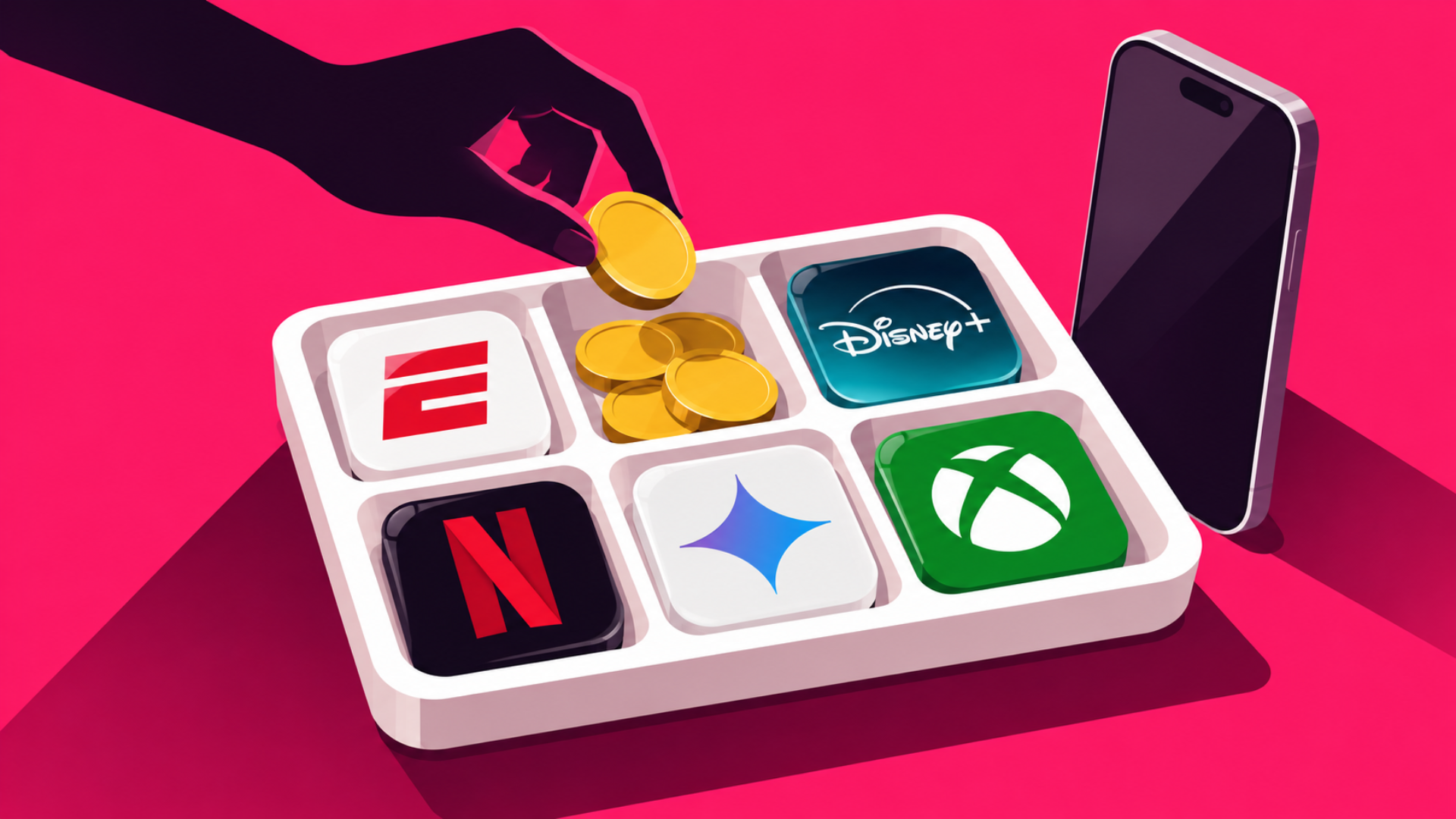
T-Mobile is making Netflix, ESPN Unlimited, Google Gemini and phone promotions compete for the same limited allowance inside its new T-Mix wireless plans. The carrier controls how many Picks each benefit costs, when customers can change their selections and which services make the menu. Streaming partners gain access to T-Mobile’s wireless customers, but their share of that distribution now depends on how consumers allocate a budget that also covers gaming, AI, food delivery and new phones.
Launching in November, T-Mix replaces fixed subscription bundles with three plans. Standard starts at $55 per month for one line and includes one Pick, More costs $75 with two Picks, and Loaded costs $95 with three. Prices require AutoPay and exclude taxes and fees. Additional lines increase the account’s shared Pick allowance.
T-Mobile can now direct more of its bundled spending toward the benefits customers choose while keeping the wireless relationship intact. Streaming services have to compete for an allocation that customers can reassign without canceling their phone plan.
T-Mobile Prices Netflix Premium and ESPN at Four Picks, Pushing Premium Streaming Toward Family Accounts
T-Mobile assigns different Pick costs to different services, creating a competitive price structure inside the wireless bundle.
Netflix Standard with ads, Hulu with ads, Paramount+ Essential and Apple TV each require one Pick. Google AI Pro, YouTube Premium and Xbox Game Pass Premium require two. Netflix Standard and Xbox Game Pass Ultimate cost three, while Netflix Premium and ESPN Unlimited require four.
The highest-priced streaming options exceed the entire allowance of every single-line T-Mix plan. Even Loaded provides only three Picks for one line.
Customers need a multi-line account to access a four-Pick subscription through the included allowance.
That gives T-Mobile another way to make larger wireless accounts attractive. A four-line More account receives seven Picks, enough for ESPN Unlimited and three additional one-Pick benefits. A four-line Standard account receives four, meaning ESPN would consume the entire allowance.
The comparison becomes more difficult for expensive streaming tiers when customers can spend the same Picks across unrelated categories.
ESPN Unlimited has a standalone subscription price of $31.99 per month. Inside T-Mix, a household choosing ESPN gives up the ability to use those four Picks on four lower-cost services.
Netflix Premium faces the same tradeoff against Netflix’s ad-supported tier, Hulu, Paramount+ and competing non-entertainment benefits.
Those Pick prices don’t establish what T-Mobile pays each partner. Wholesale agreements remain private, and services with identical Pick costs may have different economics.
The pricing does establish which services consume more of the customer’s available allowance. Premium streaming must justify that larger allocation every time a household reconsiders its selections.
T-Mobile’s Phone Promotions Can Hold Picks for 36 Months, Cutting Into Streaming Budgets
T-Mobile is putting device subsidies and subscription benefits into the same spending pool.
A customer who keeps an existing phone can direct more Picks toward streaming, music, gaming or AI. When that customer upgrades, the same allowance can support a device promotion.
T-Mobile Chief Marketing Officer Allan Samson outlined examples in which an iPhone promotion requires two Picks and an iPhone Pro promotion requires three. The specific cost depends on the device offer.
Phone promotions also operate on longer commitments than most subscription benefits. Device financing commonly runs 36 months, and the Picks assigned to a promotion remain committed throughout its term.
Consider a four-line More account with seven Picks.
Two regular iPhone promotions could consume four Picks, leaving three for other benefits. The household could still choose Netflix Standard or three one-Pick services, but it wouldn’t have enough remaining Picks for ESPN Unlimited or Netflix Premium.
A family upgrading more devices could have even less capacity for subscription benefits.
The phone promotion creates a longer-term claim on the customer’s Pick allowance. A streaming benefit might receive three months of funding before the customer can reconsider it. A device promotion can occupy the same allocation for three years.
T-Mobile can use that tradeoff to support device upgrades without giving every customer the same combination of phone discounts and subscriptions.
Streaming partners now have exposure to another part of the wireless customer’s spending cycle. A service can lose its plan allocation when a household upgrades devices, even if the customer remains interested in watching its programming.
T-Mobile Guarantees Partners Three Months of Revenue, Then Opens Their Picks to Competition
T-Mobile is giving participating services a minimum revenue commitment while allowing customers to reconsider their selections periodically.
Samson said the carrier guarantees partners at least three months of revenue on each selected Pick. The arrangement provides some protection against customers activating a subscription and immediately replacing it.
Customers can remix partner benefits four times annually, through three change windows and an Annual Remix period.
Selections generally continue unless customers change them, and certain benefits follow different rules. Wireless features such as T-Satellite can change at any time, while device promotions retain their Picks for the promotion period. Changing a partner benefit outside an approved window may carry a fee.
Those rules establish a retention cycle for subscription partners.
An entertainment service that attracts customers during a major release can remain in the bundle beyond that initial demand. It also faces the possibility that customers redirect their Picks once they have finished watching.
Sports subscriptions have a particularly clear exposure. ESPN Unlimited could gain selections during football season and lose them when demand falls. Gaming subscriptions may experience similar shifts around major releases.
Netflix enters with an advantage. It was the most popular benefit during T-Mobile’s October pilot, while music and AI subscriptions also attracted interest. Xbox performed well among younger customers.
T-Mobile hasn’t published detailed selection rates or retention figures from the pilot.
The commercial value of those activations will depend on how many customers maintain the benefit across subsequent change windows. Initial popularity establishes demand for a service, while repeated selection determines how durable its place in the bundle becomes.
T-Mobile Can Reprice Picks Without Raising Wireless Bills, Increasing Its Bargaining Power With Streamers
T-Mobile retains control over the catalog and the Pick cost of each benefit.
The carrier’s terms allow it to change available services and the number of Picks they require. Changes affecting active benefits take effect in the next quarter.
That gives T-Mobile flexibility in managing the economics of its subscription agreements.
A service could require more Picks after a pricing change, consuming a larger share of the customer’s allowance. Another service could enter the catalog at a lower Pick cost and compete for the same allocation.
T-Mobile can make those adjustments without necessarily changing the advertised monthly price of Standard, More or Loaded.
The carrier also controls what happens to unused capacity. Picks have no cash value, don’t roll over and can’t be refunded. Customers who leave Picks unused continue paying the same wireless bill.
The financial effect depends on T-Mobile’s undisclosed partner agreements, including whether payments are tied to activations, fixed commitments or other commercial terms.
For streaming services, carrier distribution now involves two separate competitive decisions.
First, a service needs T-Mobile to offer it on commercially acceptable terms. Then it needs the customer to allocate enough Picks to activate and maintain the subscription.
T-Mobile manages the selection interface, the account relationship and the alternatives presented alongside each service.
The carrier can also expand the catalog. Additional AI, gaming, entertainment, travel or commerce partners increase the options competing for the same finite allowance.
More choice makes T-Mix useful to a broader range of wireless customers, while increasing the competition that established subscription partners face inside the bundle.
T-Mobile Uses Included Perks to Defend Wireless Revenue, Forcing Streamers to Justify Their Subsidy
Verizon already offers customizable benefits through myPlan and myHome, with streaming subscriptions and other services sold as separately priced add-ons.
Its earlier shift from +play toward benefits integrated with its core wireless and broadband products established how carriers could use subscription aggregation to support their primary customer relationships.
T-Mobile is taking a different pricing approach by including a selectable allowance inside the monthly wireless plan.
That changes how customers encounter the cost.
A Verizon customer can add a streaming perk and see a separate monthly charge. A T-Mix customer selecting Netflix uses part of an allowance already included in the wireless bill.
T-Mobile can therefore make the broader range of benefits part of the justification for purchasing a higher-tier plan. Moving from Standard to More costs another $20 per month for one line and provides another Pick alongside additional wireless features. Loaded costs another $20 and supplies a third Pick with further network and travel benefits.
The incremental price covers more than subscription access, making the complete wireless package the product T-Mobile needs to sell and retain.
That changes the carrier’s return on a streaming partnership.
A subscription doesn’t have to produce a standalone profit for T-Mobile if its inclusion helps attract a household, supports a higher-priced plan or reduces wireless cancellations.
The streaming partner has a different financial calculation. It gains distribution through an existing customer relationship but may receive less revenue than it would from a direct retail subscription.
It also has to keep customers engaged enough to preserve its allocation of Picks.
The carrier can retain the entire wireless account when an individual subscription loses its place. The streaming provider loses that distribution until the customer selects it again.
The Streaming Wars Take
T-Mix makes ad-supported subscription tiers more consequential in carrier distribution negotiations.
Netflix Standard with ads costs one Pick, while Netflix Premium costs four. A lower-Pick tier can reach customers who would otherwise spend their allowance on several competing benefits. The service may also generate advertising revenue from those viewers, giving it another source of monetization alongside the distribution agreement.
That creates a different profitability calculation from selling an ad-free premium subscription directly.
Streaming partners have to weigh wholesale compensation, advertising revenue, usage and the likelihood of retaining each selection against the number of Picks their offer consumes.
A lower Pick cost could increase distribution but also require more favorable economics for T-Mobile. Premium tiers may deliver greater revenue per subscriber while reaching fewer eligible wireless households.
The next commercial pressure point is partner pricing.
T-Mobile will be able to observe which benefits customers select, replace and retain across remix windows. Those decisions can inform future negotiations over wholesale costs, package tiers and promotions, although the carrier hasn’t disclosed what selection data it will share with partners.
For streaming services, gross activations through T-Mobile will provide only part of the picture. Retention across change windows, the revenue earned per selected benefit and the displacement caused by competing services will determine the value of the relationship.
The same applies to ESPN, which must justify a four-Pick allocation against multiple lower-cost services, and Netflix, which must defend its position against both competing subscriptions and device promotions.
T-Mobile can use that competition to manage its benefit spending while preserving the wireless bill. Streaming partners will have to price their offers for a distributor that controls the customer allowance, the available alternatives and the rules governing when those customers can change their minds.
The Streaming Wars is intentionally ad-free
We don’t run display ads. Not because we can’t, but because we don’t believe in them.
They interrupt the reading experience. They cheapen the work. And they burn advertisers’ money on impressions nobody actually wants.
So we chose a different model.
We say the things people in this industry are already thinking but don’t say out loud. We connect the dots beyond the headline and focus on explaining why things matter to the people working in this business.
If you believe industry coverage can exist without clutter and interruption, you can support it here → SUPPORT TSW.
Support is optional. But it directly funds research and continued coverage — and helps prove this model can work.
Support TSW →