
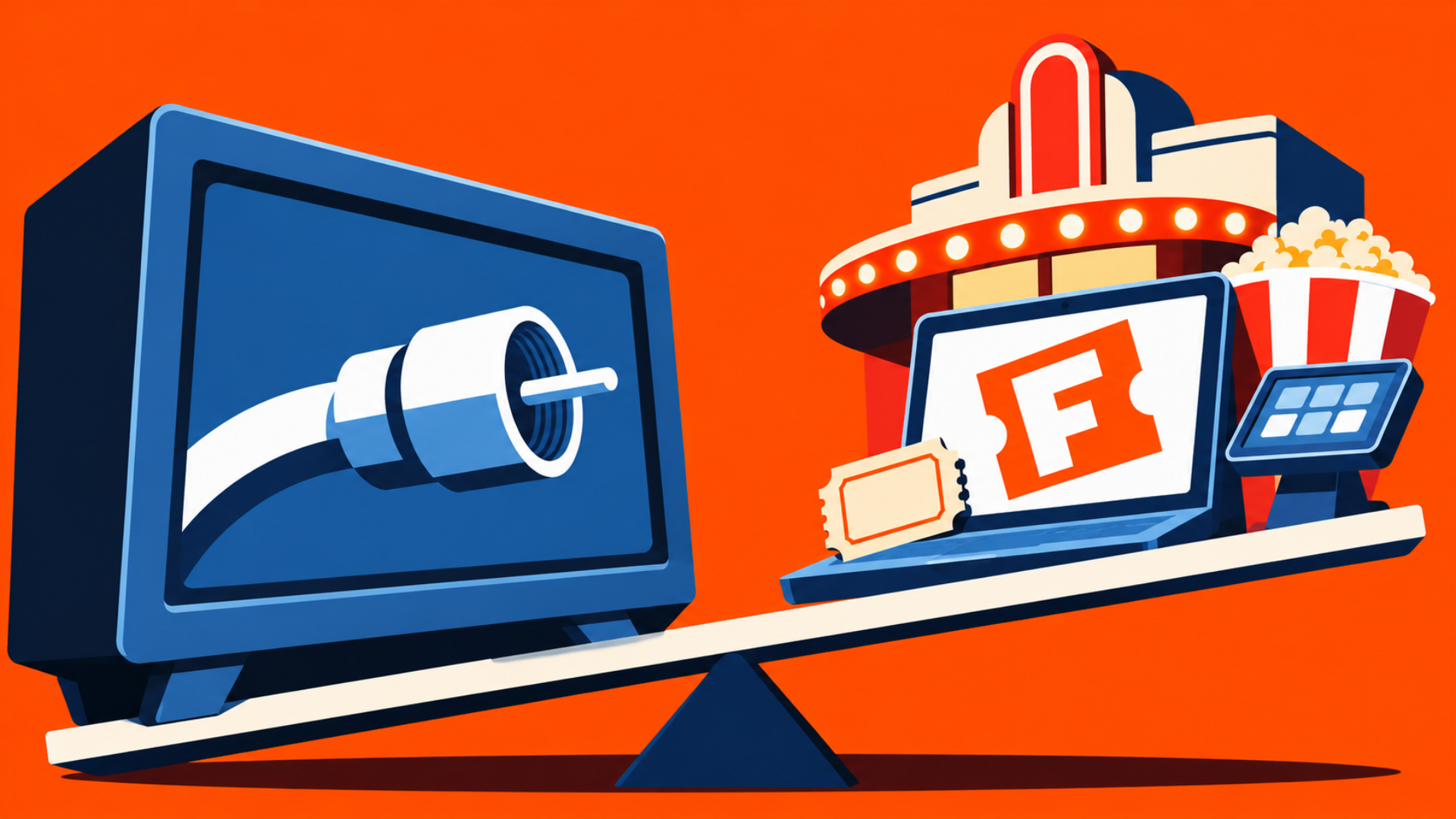
Versant’s comparable platform businesses added $33 million in third-quarter revenue while linear distribution lost $57 million. Fandango drove the largest share of platform growth, led by ticketing, as Fandango1 expanded its reach into the software cinemas use to sell tickets, manage concessions and run loyalty programs. Those theater relationships offer Versant additional revenue opportunities while the pay-TV bundle that funds much of its business keeps shrinking.
The $24M Gap
Platform revenue increased 17.4%, from $189 million to $222 million, on a comparison excluding SportsEngine, which Versant sold in the second quarter, and Full Swing, which it acquired in the third. Reported platform revenue grew 9.6%, or $21 million, to $245 million. Linear distribution fell 5.8%, from $992 million to $935 million.
The comparable $33 million platform gain left a $24 million shortfall against the cable decline. Total revenue dropped 4.2% to $1.59 billion, with advertising down another $21 million and content licensing and other revenue down $13 million. The Ryder Cup comparison affected advertising, while licensing deal timing contributed to the other decline. Subscriber losses remain the recurring pressure on distribution revenue.
Own the Register
Fandango sells tickets across approximately 31,000 U.S. movie screens and has relationships with nearly 3,000 U.S. cinema partners. Versant acquired INDY Cinema Group in December 2025 and brought its cloud-based operating software under Fandango, with the business now developing as Fandango1.
INDY combines ticketing, point-of-sale, concessions, digital ordering, loyalty and reporting. Its website says the software serves more than 350 cinemas across the U.K., North America and Asia-Pacific. That worldwide software customer count measures something different from Fandango’s U.S. ticketing partnerships, so it can’t be treated as a conversion rate.
Selling software to an existing ticketing partner lets Fandango compete for a larger share of the exhibitor’s technology budget. Theater operating systems can generate ongoing service revenue and embed a supplier in daily transactions. They also require integrations and operational changes that make them harder to sell and harder to replace. Fandango’s distribution relationships provide access to prospective buyers; they don’t guarantee software contracts.
The Release-Calendar Problem
Fandango recorded its strongest quarterly ticket sales since the pandemic, and management said it gained box-office share. Home-entertainment sales and Fandango1 also contributed, but ticketing was the principal growth driver.
A strong theatrical slate lifts transaction revenue without establishing how much software income would persist between major releases. Theater operations can support ongoing fees, while payments and concessions activity still move with attendance. Versant doesn’t disclose Fandango1 revenue, installations or margins separately, leaving the contribution from ongoing software services difficult to measure.
GolfNow offers an operating precedent. Versant already sells tee times to golfers while supplying software and transaction services to courses. With Fandango1, it can pursue a broader commercial relationship with the exhibitor as well as the moviegoer.
Cable Buys Time
Linear distribution generated approximately 59% of Versant’s quarterly revenue. The company completed four major pay-TV renewals in 2026, putting 75% of its network subscribers under contracts extending into 2028 or later. Those agreements secure distribution relationships and pricing terms, while contractual rate increases continue to offset only part of subscriber erosion.
Versant is also building direct businesses around its news networks. MS NOW Membership, priced at $7.99 a month or $79.99 a year, expanded its full live network feed to connected TVs on November 2 without requiring a cable subscription. CNBC expects to introduce its own direct product in early 2027. Direct billing gives Versant more control over customer relationships, while acquisition and retention costs move onto its own books. The economics of MS NOW’s paid membership depend on converting existing audience reach into durable subscriptions.
Buybacks Compete With Growth
Versant generated $302 million in third-quarter free cash flow and expects to exceed its previous full-year forecast of $1 billion to $1.2 billion. It ended September with approximately $1.05 billion in cash and $2.93 billion in debt, and recorded $53 million in quarterly interest expense.
Management paid $536 million for Full Swing in August and has returned $457 million to shareholders this year through dividends and repurchases. Versant completed a $100 million accelerated share repurchase during the third quarter and announced another $100 million repurchase for the fourth.
The software strategy competes for capital with acquisitions, debt obligations and shareholder distributions. New theater installations require selling, integration and support before their returns become visible. Without separate Fandango1 revenue and profitability measures, investors can’t assess those returns against other uses of Versant’s cash.
The Streaming Wars Take
Selling cinema operating software alongside ticket distribution opens a new way for Fandango to negotiate with exhibitors. Versant CEO Mark Lazarus described how GolfNow can adjust course-technology fees in exchange for a larger share of tee-time transactions. Fandango1 could offer similar flexibility across theater software charges, ticketing and payments. Versant hasn’t disclosed whether it has adopted that structure in cinema contracts.
Exhibitors would have to evaluate the combined cost of software, transaction fees and payments, alongside access to customer data and the freedom to work with competing ticket sellers. A single technology supplier can simplify theater operations, but deeper integration can also increase the cost of switching providers and strengthen that supplier’s bargaining position.
Fandango’s existing partnerships give it a sales opening. Winning operating-system contracts at attractive economics will depend on how much control theaters are willing to give a company that already participates in their ticket sales. Pricing, data rights and channel flexibility will determine how far Versant can extend its position inside the cinema transaction.
The Streaming Wars is intentionally ad-free
We don’t run display ads. Not because we can’t, but because we don’t believe in them.
They interrupt the reading experience. They cheapen the work. And they burn advertisers’ money on impressions nobody actually wants.
So we chose a different model.
We say the things people in this industry are already thinking but don’t say out loud. We connect the dots beyond the headline and focus on explaining why things matter to the people working in this business.
If you believe industry coverage can exist without clutter and interruption, you can support it here → SUPPORT TSW.
Support is optional. But it directly funds research and continued coverage — and helps prove this model can work.
Support TSW →