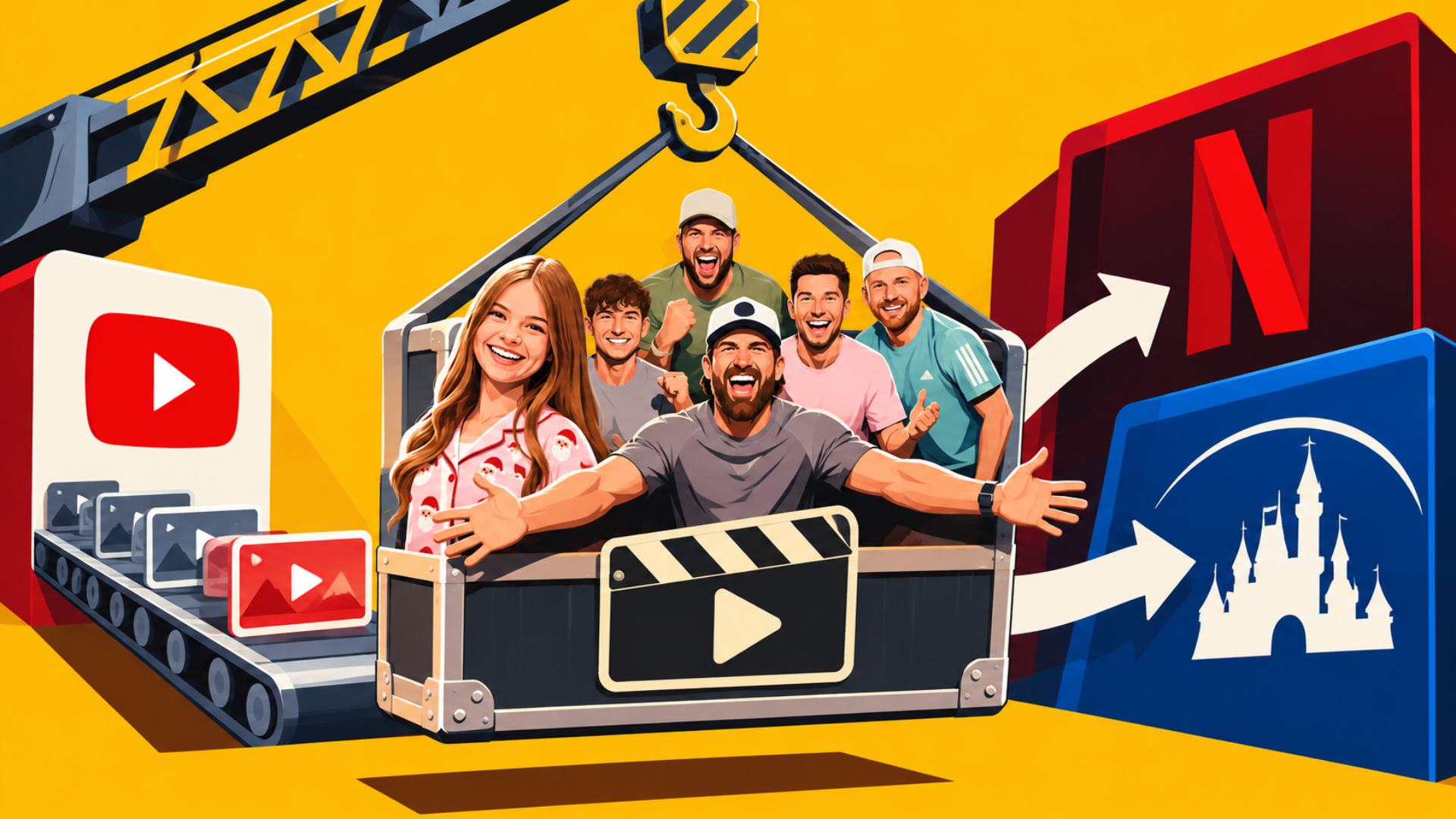
Netflix has a Salish Matter holiday special coming November 28, and Disney has signed a company-wide deal with Dude Perfect. Both are getting something Hollywood usually spends a lot of money trying to establish: a working entertainment business with an audience already attached.
The creators made the programming, tested the formats, absorbed the misses and kept publishing. Netflix and Disney can now evaluate years of actual audience behavior before making their next investment. For someone still trying to break in, the order is a lot less appealing: pay to make the show, build the audience and hope a buyer eventually notices.
Hollywood Buys the Proof
YouTube captured a record 15.8% of U.S. TV viewing in August, according to Nielsen. That’s a huge supply of programming being tested in public, with viewers showing creators what works before a studio gets involved. A buyer can see which formats earn repeat viewing, which personalities can carry a show and whether an idea holds up beyond a viral hit.
Salish Matter and her father, Jordan, built a channel with more than 34 million subscribers and 13.3 billion lifetime views. Netflix already carries a three-season licensed series featuring the family and will premiere Salish’s 12 Games of Christmas on November 28.
Netflix gets established personalities, a production operation and years of evidence that viewers come back for this kind of programming. The existing licensed series also gives it a way to observe how that material performs among Netflix members before commissioning more. It still has to see whether the wider YouTube audience follows the family to Netflix, but the family isn’t arriving with an untested pitch.
Disney’s company-wide partnership with Dude Perfect takes the same advantage across more businesses. Dude Perfect brings 130 million followers and more than 22 billion lifetime views. Disney gets selected content for Disney+, ESPN and its social channels, plus collaborations around Marvel, Star Wars and sports.
Dude Perfect already has the audience, production infrastructure and distribution. Disney can put its franchises in front of those fans and potentially create demand for subscriptions, movies, merchandise and experiences. It also gets reach beyond its own services without having to build a creator channel from scratch.
Neither deal guarantees a hit. But both buyers are paying to work with creators who have already proved they can attract viewers and keep them coming back. Much of that testing happened outside a studio development budget.
YouTube Raises the Toll
For established creators, the money is getting interesting. For newcomers, YouTube is making the climb to its main advertising revenue-sharing program steeper.
Starting February 1, 2027, new applicants will need 1,000 subscribers and either 8,000 qualified watch hours in the previous 365 days or 20 million qualified Shorts views in 90 days. The viewing thresholds are double the old requirements.
Existing Partner Program members keep their status and access to long-form monetization. But Shorts has a separate new rule: all creators, including existing members, must maintain 10 million qualified Shorts views over 90 days to receive Shorts ad and Premium revenue sharing. Falling below that mark pauses those Shorts payments without removing the channel from the program. Lower thresholds for fan funding and shopping remain available.
For a channel built around Shorts, 10 million views is now a continuing performance target, not simply a qualification to clear once. A quiet stretch can interrupt Shorts revenue even as production costs keep coming. YouTube is introducing additional incentives, but those programs aren’t a guaranteed substitute for revenue sharing.
YouTube has also been exploring multimillion-dollar exclusivity arrangements with prominent creators as Netflix competes for their programming. The August discussions included possible direct production financing and shares of major brand deals. No agreements had been finalized when those talks came to light.
That gives established channels another source of bargaining power. YouTube’s competition with Netflix for creator programming could bring bigger checks to people whose shows already work.
Creators trying to get to that stage still need to pay for shoots, editing and the publishing schedule that makes an audience possible. Sponsors and fan payments can help, but they also require people willing to buy something from a channel that’s still finding its audience. The financing arrives more easily once there’s something to finance against.
Talent Has a Wealth Test
CreatorIQ surveyed 5,095 creators across 100 regions in 2026 and found that 67% earned less than $10,000 annually from content creation. For 62%, it wasn’t their primary source of income. The survey goes beyond YouTube, but it captures the basic problem: most creators aren’t earning enough from content to fund much production.
A commentary channel might get started with a laptop and a microphone. A scripted comedy or competition format could need writers, performers, locations and several shooting days before anyone knows whether viewers want it.
Someone with savings, outside income or financial backing can afford more attempts. They can hire an editor, improve a weak pilot and keep publishing while a format finds an audience. Someone holding down a full-time job may have an equally promising idea and far less time or money to test it. That gap gets wider when the show needs a crew rather than a single creator and a camera.
Studios can see subscribers, watch time and engagement. They can’t see whether a creator financed the work through sponsors, a second job, investors or family money.
Once a proven audience becomes a selling point for development deals, access to that early financing affects who gets into the room. Low-cost, repeatable formats are easier to test. Ideas requiring serious writing, casting or production design may never reach the point where they can produce the audience data buyers want.
Audience validation is useful. But the formats capable of generating those metrics depend partly on who can afford to keep producing through the unprofitable months. The risk is that Hollywood ends up choosing from what people could afford to make, rather than the full range of what audiences might pay to watch.
Indies Are Running Out of Runway
Independent producers face a similar squeeze, except they’re carrying payroll and overhead.
Pact’s September census found that UK domestic primary commissioning revenue fell 4.67% in 2025 to £1.65 billion. Total domestic TV revenue dropped below £2 billion for the first time in five years. International streaming investment helped the overall sector grow, but companies with annual revenue below £25 million received just 15.5% of international commissioning revenue.
Indielab examined filings from 203 active small UK production companies. Of those, 56% saw net assets decline over three years. It put the average small producer’s reserve cushion at £42,000, using net assets from company filings rather than cash balances.
That’s thin protection against a delayed commission, a failed pitch or months spent developing a show nobody buys. Record international streaming spend doesn’t automatically put more development cash in the hands of the small producers who need it.
An indie can try to bypass the commissioning queue by launching on YouTube, owning the IP and selling sponsorships or licensing rights once it builds an audience. But that adds another production and distribution business to the budget. Someone still has to finance the episodes.
With cash tight, companies have a strong incentive to try cheaper, repeatable formats. They can publish, measure the response and adjust quickly without staking months of payroll on one idea. Projects requiring bigger crews, substantial casting or longer development schedules are harder to justify without a buyer sharing the upfront cost.
Commissioners eventually get to pick from the formats that survived the test. They don’t get to see the ones that never found the funding to start it.
Capital Chases the Proven
There are financing options for creator businesses, especially once they’ve demonstrated what their audience is worth.
Viewture offers upfront funding against YouTube catalogs while creators retain their IP. Its published qualifications include $3,000 in monthly AdSense revenue, 2 million average monthly views and a channel library at least 12 months old. Viewture also offers financing for new projects, but those published benchmarks show how much easier a proven channel is to evaluate.
Someone with a successful library can point to real revenue. Someone with a concept and no finished episodes is asking a financier to bet on an outcome. Revenue-based financing helps a business borrow against performance; it doesn’t solve the problem of paying for the very first performance.
Channel 4 is making a more traditional bet. Its April proof-of-concept fund offered £100,000 each to three to five British independent unscripted projects, allowing producers to test ambitious formats before the broadcaster decides whether to order a full series.
That kind of agreement could work for digital-first projects too: a capped pilot budget, clear deliverables, a limited option window and an agreed decision on whether to commission more. The buyer could test audience response and production costs while the idea is still affordable. The creator gets money to produce something that might never survive on self-funding alone.
The rights need just as much attention as the check. A small pilot fee shouldn’t lock up a creator’s IP and future distribution rights indefinitely. If a buyer passes, the creator needs a clear path to take the project elsewhere.
The Streaming Wars Take
Smaller broadcasters can’t match the full package Netflix, Disney and YouTube can offer a creator with a proven audience. Those companies can monetize programming through subscriptions, advertising, franchises and their existing distribution businesses.
A smaller buyer’s best chance may come before the creator has multiple offers. Finance a few promising pilots, cap the exposure and negotiate rights that expire if the project doesn’t move forward.
Some of those investments will fail. That’s what development budgets are for. The question is whether the pilots that work justify the whole slate, not whether every experiment gets a series order.
The upside includes programming that might never get made in a system that asks creators to bankroll the proof themselves. A show needing writers, performers or production design can get a proper test without requiring its creator to fund a season out of pocket.
Buyers still need discipline: a real budget, a clear commissioning decision and rights that make sense for the amount invested. Creators need to be paid for development and keep enough ownership to build something if it works.
Waiting for the audience to arrive avoids the cost of those early experiments. It also means negotiating with a business that has already absorbed those costs and may have other buyers lined up.
Hollywood can skip the auditions. It shouldn’t expect the creators who paid for them to come cheap.
The Streaming Wars is intentionally ad-free
We don’t run display ads. Not because we can’t, but because we don’t believe in them.
They interrupt the reading experience. They cheapen the work. And they burn advertisers’ money on impressions nobody actually wants.
So we chose a different model.
We say the things people in this industry are already thinking but don’t say out loud. We connect the dots beyond the headline and focus on explaining why things matter to the people working in this business.
If you believe industry coverage can exist without clutter and interruption, you can support it here → SUPPORT TSW.
Support is optional. But it directly funds research and continued coverage — and helps prove this model can work.
Support TSW →