

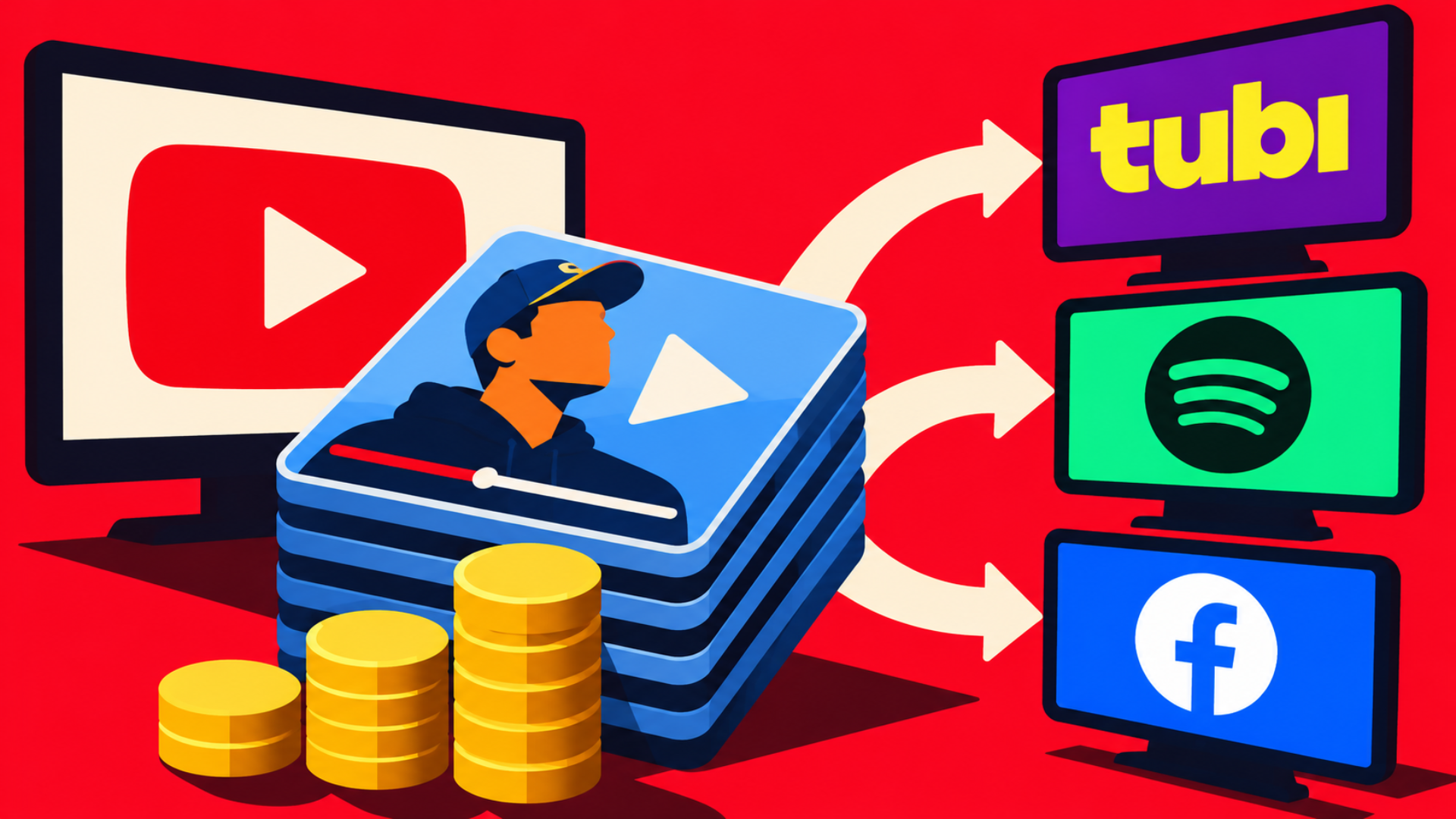
YouTube creators are generating additional revenue from finished videos across Tubi, Spotify and Facebook, giving streaming services programming without paying to produce it. Motion Society is building a distribution business around those archives, repackaging videos for other services in exchange for a share of the earnings.
Creators get another source of income from content they’ve already financed. Streaming services get established programming without absorbing the original production risk. YouTube faces more competition for viewing hours generated by catalogs built on its platform.
The Archive Pays Twice
One anonymous true-crime creator earned $154,000 across Spotify, Tubi and Facebook in September 2026, more than 1.8 times what the channel generated through YouTube’s Partner Program during the same month.
The figure comes from Motion Society, which handled the distribution. The company didn’t disclose the creator’s YouTube earnings, how much each service contributed, its own revenue share or whether the payments included guarantees.
The $154,000 represents one month of reported earnings, with too little information to establish the creator’s profit or a typical return for syndication.
The underlying economics are straightforward. The original videos have already been produced, edited and published. Additional distribution creates another opportunity to earn against those production costs, with new expenses concentrated in rights clearance, editing, delivery and revenue-sharing fees.
The financial benefit depends on what the creator retains after those expenses and whether the new services attract additional viewing or replace consumption that would otherwise occur on YouTube.
Motion Society’s example establishes the potential scale of a second revenue stream. The company’s selection criteria help explain why that opportunity isn’t available equally to every creator.
The 100K Filter
Motion Society generally looks for creators with at least 100,000 subscribers, weekly uploads and enough usable videos to maintain a regular programming schedule.
The company also prefers catalogs in which most videos run at least eight minutes. Longer programming typically generates stronger economics across the destinations it serves, making short-form-first creators less attractive under its model.
Those requirements favor established channels with deep long-form libraries and consistent publishing histories.
A creator with hundreds of usable episodes gives the distributor enough inventory to organize into seasons, maintain programming schedules and spread preparation costs across a larger volume of content.
A smaller creator with a limited archive presents a different proposition. The same delivery and compliance requirements may apply even when the catalog contains relatively few monetizable hours.
Syndication can extend the commercial life of existing programming, but the current model concentrates its advantages among creators who have already built substantial catalogs.
Tubi Buys the Proof
Tubi has become one of the largest buyers of creator-led programming.
Ampere Analysis counted more than 3,700 hours of creator-led content premiering on U.S. streaming services in the third quarter of 2026, up from 927 hours a year earlier. Tubi accounted for more than 75% of that total. The measurement includes programming newly available on a service, regardless of whether it was originally produced for that destination.
Since launching Tubi for Creators in June 2025, the service has added more than 35,000 episodes from over 700 creators.
Its licensed catalog includes existing programming from MrBeast, Joey Graceffa and other digital-first personalities. Tubi has also licensed content from creators such as Kinigra Deon, whose scripted dramas and comedies already have established audiences.
These agreements give Tubi access to formats, personalities and programming that have been tested through years of YouTube publishing.
The service can evaluate a creator’s audience history before acquiring the programming, then measure how that content performs with its own viewers.
Tubi also has more ways to sell advertising against that inventory.
In June, it expanded Creatorverse discovery to Fire TV and gave Amazon DSP customers priority access to associated advertising inventory. Creator programming now contributes to a larger distribution and advertising business.
Tubi is separately investing in exclusive creator productions. In October, it announced 12 TikTok creators developing 10 original series through its Creatorverse Incubator.
Licensing finished episodes limits exposure to original production costs. Commissioning new programming requires additional investment, although an established creator’s audience and track record can reduce some development uncertainty.
Tubi can pursue both models while building a larger creator programming business.
TV Has a Cover Charge
A YouTube archive requires substantial work before it can function as streaming TV programming.
Motion Society selects videos, organizes them into seasons, removes sponsor reads and YouTube-specific references, adjusts content to meet technical and brand-safety requirements, and creates new artwork.
Individual services may require several versions of promotional images, extensive metadata and detailed delivery documentation. Motion Society says some upload specifications run to 50 pages.
Insurance adds another expense. Some streaming services require media liability coverage in the millions, which Motion Society maintains for its clients.
Even after delivery, programming can take 60 to 90 days to appear on a streaming service.
These requirements explain why distributors can collect meaningful fees on programming they didn’t finance.
Motion Society works with more than 650 creators and IP owners, distributing over 30,000 videos each month across more than 20 digital and TV destinations.
That volume lets the company spread editing workflows, delivery infrastructure, compliance costs and service relationships across hundreds of catalogs.
Individual creators would have to replicate much of that operation to pursue the same distribution independently.
Motion Society generally earns a revenue share from the destination pages it manages, leaving creators’ existing YouTube earnings outside the arrangement. Its standard percentage hasn’t been disclosed.
The creator pays for access to an established distribution operation without having to build one.
The Middleman Sees More
Motion Society’s scale provides an advantage beyond delivery infrastructure.
The company manages more than 350 shows on Spotify and uses historical performance data to evaluate new programming.
Motion Society says that experience allows it to assess, within roughly 20 days, whether a newly launched Spotify show is likely to perform well over time.
Those projections aren’t guaranteed. Services retain control over merchandising and promotion, and an established YouTube audience doesn’t ensure similar performance elsewhere.
Still, Motion Society can compare consumption, revenue and programming results across hundreds of shows.
That information improves its ability to select catalogs, recommend destinations and estimate future earnings.
It can also influence licensing negotiations.
A creator receiving only aggregate revenue statements may know what the catalog earned without knowing which episodes, territories or services generated the strongest returns.
A distributor with detailed performance information can estimate which assets deserve additional placement and what those rights might command from another buyer.
The creator’s revenue share determines how the current income is divided. Access to performance data affects the creator’s ability to negotiate the next agreement.
A favorable revenue split loses some of its value when the distributor knows substantially more about the asset’s commercial performance than its owner.
Rights Set the Price
A YouTube video doesn’t automatically carry the rights required for distribution across streaming services.
Music, archival footage, guest appearances and third-party clips may have restrictions covering specific services, countries or usage periods.
Sponsorship agreements create another complication.
A brand may have paid for a YouTube integration without securing distribution across additional services. Removing the sponsorship can satisfy the receiving service’s programming requirements, but the original agreement determines whether the creator can make that edit.
Motion Society routinely removes sponsor reads and other YouTube-specific material when preparing programming for distribution.
As creators plan new programming for multiple destinations, production and sponsorship agreements will need clearer provisions covering additional distribution, editing rights, territories and usage periods.
The distribution agreement carries its own economic consequences.
Exclusivity, permitted destinations, contract duration, expense deductions, sublicensing rights and termination provisions determine how much control the creator retains.
A nonexclusive arrangement can allow the same episodes to remain on YouTube while generating revenue elsewhere. An exclusive window can eliminate some of those opportunities during the agreement.
The price of exclusivity therefore depends partly on the income the creator would surrender across competing services.
Creators who retain clean ownership and detailed performance records can substantiate that opportunity cost. Those who grant broad rights while receiving limited reporting may struggle to establish what their programming is worth when another buyer approaches.
YouTube Wants the Hours
YouTube is developing its own distribution format for programming already on its service.
Its Stations pilot turns existing creator videos, podcasts and media catalogs into continuous programming feeds, creating an always-on viewing experience with live chat.
The pilot remains limited to selected creators and media partners, but it gives YouTube another way to circulate older programming without commissioning new episodes.
Stations can generate additional viewing sessions while keeping advertising, audience engagement and consumption data inside YouTube.
Syndication gives competing services access to portions of that same programming inventory.
Tubi can place creator episodes alongside its broader streaming library and sell advertising against the viewing. Spotify provides another destination for eligible video programming, particularly podcast-style content. Facebook offers additional distribution for long-form videos.
Each service controls its own discovery environment, merchandising and monetization arrangements.
YouTube retains substantial advantages in recommendations, creator relationships and established viewing habits. The available syndication data doesn’t establish how much consumption is incremental or how much might otherwise have occurred on YouTube.
Creators nevertheless have more commercial options for programming that was previously monetized primarily through YouTube.
A catalog can remain available on YouTube while earning through other services, subject to its licensing terms. Successful creators can compare those opportunities when deciding whether to accept exclusivity, produce new episodes for a particular buyer or maintain broad distribution.
YouTube’s Stations experiment offers another way to monetize the archive internally. Outside syndication gives creators alternatives that don’t depend entirely on YouTube’s discovery and revenue systems.
The Streaming Wars Take
A successful catalog license can become the starting point for a much more expensive production negotiation.
Tubi has already commissioned exclusive series from creators whose programming demonstrated an audience on the service. Licensing an archive gives a buyer access to first-party viewing data before deciding whether to invest in additional episodes.
That adds another transaction to the creator’s business.
The original license covers finished programming. A new commission requires additional production spending, creative commitments and potentially rights to the underlying format.
Distributors have an incentive to participate in those subsequent deals, particularly when their relationships and performance data helped establish the opportunity.
Creators face a different calculation.
If an archive agreement also grants broad rights over future episodes, sequels or related formats, the distributor may retain an economic interest in programming it hasn’t financed or prepared for distribution.
If the creator preserves those rights, a successful streaming run can become evidence for negotiating directly with another buyer.
Netflix and Disney are already using established creator audiences to reduce development risk. Demonstrated viewing on an additional streaming service can give a creator another commercial proof point when pitching new programming.
The buyer’s own performance data, the distributor’s cross-service benchmarks and the creator’s rights ownership will influence those negotiations.
For creators, the commercial value of syndication extends beyond the revenue earned from existing episodes when the agreement preserves the ability to sell future productions separately.
A distributor that secures the next commission may earn another fee for that work. If a distribution agreement extends to future seasons, the intermediary can participate in revenue from programming it didn’t finance or prepare for distribution.
That makes the boundary between archive rights and future-production rights increasingly important.
The old catalog may establish what a creator’s programming earns across several services. Keeping the rights to the next season allows the creator to negotiate that production against the full range of competing offers.
The Streaming Wars is intentionally ad-free
We don’t run display ads. Not because we can’t, but because we don’t believe in them.
They interrupt the reading experience. They cheapen the work. And they burn advertisers’ money on impressions nobody actually wants.
So we chose a different model.
We say the things people in this industry are already thinking but don’t say out loud. We connect the dots beyond the headline and focus on explaining why things matter to the people working in this business.
If you believe industry coverage can exist without clutter and interruption, you can support it here → SUPPORT TSW.
Support is optional. But it directly funds research and continued coverage — and helps prove this model can work.
Support TSW →