

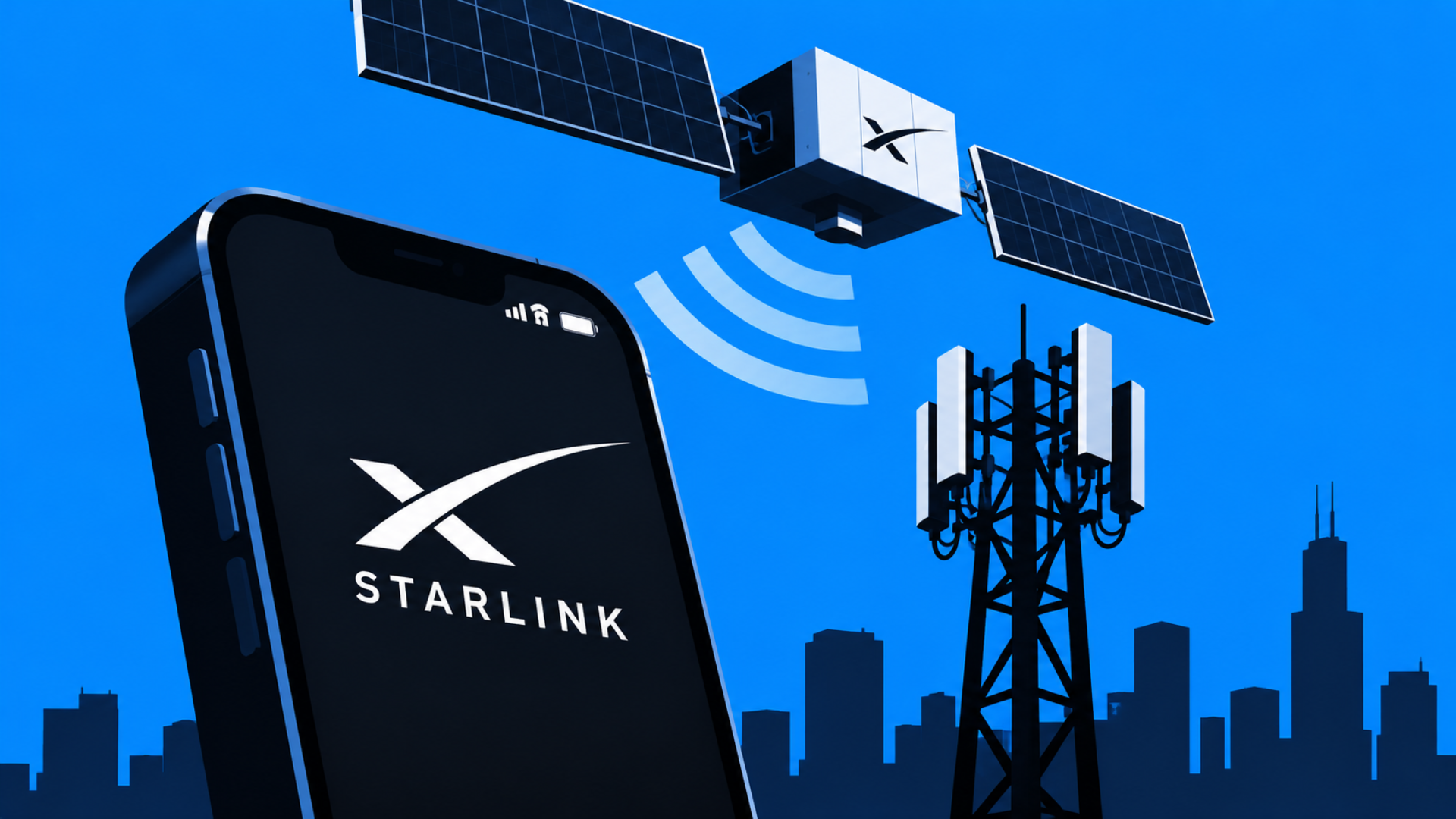
SpaceX has agreed to acquire Grain Management’s nationwide 800 MHz wireless spectrum portfolio, adding low-band coverage to the satellite and terrestrial network it is assembling for Starlink Mobile. The transaction requires FCC approval and would give SpaceX the frequencies needed to serve conventional smartphones inside buildings and across areas where satellite coverage alone faces limitations.
The acquisition advances SpaceX toward becoming a direct competitor to AT&T, Verizon, and T-Mobile. Its existing satellite partnerships allow wireless operators to sell expanded coverage to their customers. A standalone Starlink Mobile service would give SpaceX greater control over pricing, billing, and the recurring customer relationship.
T-Mobile’s Former Spectrum Gives Starlink the Indoor Coverage It Needs
The Grain agreement covers a nationwide portfolio of up to 14 MHz of paired spectrum in the 800 MHz band. Grain acquired the licenses from T-Mobile in August, paying $2.9 billion in cash and transferring its 600 MHz spectrum holdings to the carrier.
Low-band frequencies travel farther and penetrate buildings and other obstacles more effectively than higher-frequency signals. Those characteristics make the spectrum valuable for wide-area coverage and indoor mobile connectivity.
SpaceX plans to combine the 800 MHz holdings with its existing 2 GHz spectrum strategy. The company expects the 2 GHz network to supply higher-bandwidth capacity, while the lower-frequency holdings provide a coverage layer that can reach devices inside buildings and other challenging environments.
Most existing smartphones already support the 800 MHz band, reducing a potential barrier to adoption. Consumers wouldn’t necessarily need specialized handsets to access service using those frequencies.
The combination would also expand the situations in which Starlink Mobile can provide connectivity. Satellite coverage can extend service into remote areas, while terrestrial radios and antennas can support connections where buildings and network capacity create limitations.
For T-Mobile, the transaction creates an unusual competitive exposure. The company converted its 800 MHz portfolio into cash and additional 600 MHz spectrum, while SpaceX is now seeking to use those former T-Mobile frequencies as part of a network that could compete for its subscribers.
SpaceX’s Spectrum Commitments Could Approach $28 Billion Before Network Construction
The Grain acquisition follows approximately $19.6 billion in spectrum agreements with EchoStar.
SpaceX initially agreed to acquire EchoStar’s AWS-4 and H-block licenses for approximately $17 billion in September 2025. A subsequent agreement added nationwide unpaired AWS-3 licenses for approximately $2.6 billion.
The Wall Street Journal put the Grain purchase price at approximately $8 billion, citing people familiar with the transaction. Neither SpaceX nor Grain disclosed the financial terms.
If that estimate holds, SpaceX’s announced spectrum agreements would represent roughly $27.6 billion in purchase consideration before accounting for the cost of constructing a terrestrial mobile network.
The FCC also recently authorized SpaceX to launch and operate a next-generation Starlink Mobile constellation of 15,000 satellites optimized for 2 GHz spectrum. SpaceX expects those satellites to deliver more than 100 times the bandwidth of its current direct-to-cell generation.
That authorization supports the company’s planned satellite capacity, but a competitive nationwide wireless service still requires substantial ground infrastructure.
SpaceX will need terrestrial radios, antennas, site access, backhaul, and network operations capable of handling demand in densely populated markets. Satellite connectivity can extend geographic reach, but competing with established carriers on urban capacity and indoor service creates additional infrastructure requirements.
AT&T, Verizon, and T-Mobile already operate extensive terrestrial networks. SpaceX must decide where to construct equipment, where to lease existing infrastructure, and how much coverage can economically come from satellites.
That could create new demand for tower operators, infrastructure lessors, and fiber providers. It also introduces additional capital requirements before SpaceX can establish whether a direct mobile service can generate attractive returns.
Spectrum ownership gives the company access to frequencies needed for the network. Deployment costs, service quality, and subscriber acquisition will determine the commercial return on those licenses.
Starlink’s Retail Ambitions Put Its Carrier Partnerships Under Pressure
SpaceX already supplies satellite connectivity to established wireless operators, including T-Mobile.
T-Mobile’s T-Satellite service uses Starlink technology to extend coverage beyond conventional cell towers. T-Mobile sells the service through its own commercial offerings, maintaining the billing and customer relationship while SpaceX supplies satellite connectivity.
SpaceX’s EchoStar agreements also include a commercial arrangement enabling Boost Mobile subscribers to access its next-generation direct-to-cell service.
Those partnerships allow SpaceX to generate commercial demand for satellite connectivity through operators with established subscriber bases.
A standalone Starlink Mobile offering would introduce a competing distribution model.
SpaceX could sell wireless subscriptions directly, set retail prices, manage customer accounts, and retain the revenue relationship. Its existing Starlink broadband business already gives it direct consumer billing and service experience that could support expansion into mobile.
The resulting business would have different incentives from its current wholesale partnerships.
T-Mobile and other carriers benefit when Starlink connectivity improves their coverage and helps retain subscribers. They face additional competitive exposure if the same supplier develops a retail service designed to acquire those customers directly.
SpaceX would also face a commercial tradeoff. Carrier partnerships can generate revenue and expand access to satellite connectivity without requiring SpaceX to acquire every customer independently. Direct retail distribution offers greater control over pricing and customer relationships but brings subscriber acquisition, support, and retention costs.
Maintaining both businesses would require SpaceX to balance wholesale relationships against the economics of its own mobile offering.
The company has indicated that it intends to continue working with mobile operators globally. Those partnerships could remain valuable even as SpaceX develops a more direct relationship with American wireless consumers.
The Streaming Wars Take
Existing wireless carriers now have to consider whether a satellite supplier they depend on for coverage could eventually compete for their subscribers.
That prospect could influence wholesale negotiations, including pricing, contract duration, access guarantees, and carrier relationships with alternative satellite providers. SpaceX also has an incentive to protect revenue from existing partners while financing the terrestrial infrastructure needed for direct competition.
A substantial Starlink Mobile subscriber base would eventually give SpaceX another commercial opportunity: distributing third-party services through an established connectivity billing relationship.
Charter’s expansion of mobile, broadband, and streaming distribution through its Cox acquisition demonstrates how connectivity providers can use multiple services to increase household spending, strengthen retention, and negotiate with entertainment suppliers.
SpaceX hasn’t announced a comparable streaming aggregation strategy. Any opportunity to package entertainment subscriptions would depend on building a meaningful retail mobile business first.
For AT&T, Verizon, and T-Mobile, the more immediate competitive pressure is on the value of the wireless customer relationship. Incumbents must defend subscribers through network performance, pricing, and service packages while SpaceX develops an alternative network combining terrestrial and satellite coverage.
SpaceX’s investment also places substantial financial pressure on execution. Acquiring spectrum and securing satellite authorization establish the foundation for a competitive service, but nationwide mobile economics depend on the cost of operating the network and acquiring customers.
SpaceX is now committing billions toward controlling more of the wireless business directly. If it can deliver competitive service without replicating the full infrastructure cost of established carriers, it could challenge both their subscriber relationships and the economics supporting their broader connectivity and entertainment bundles.
The Streaming Wars is intentionally ad-free
We don’t run display ads. Not because we can’t, but because we don’t believe in them.
They interrupt the reading experience. They cheapen the work. And they burn advertisers’ money on impressions nobody actually wants.
So we chose a different model.
We say the things people in this industry are already thinking but don’t say out loud. We connect the dots beyond the headline and focus on explaining why things matter to the people working in this business.
If you believe industry coverage can exist without clutter and interruption, you can support it here → SUPPORT TSW.
Support is optional. But it directly funds research and continued coverage — and helps prove this model can work.
Support TSW →