
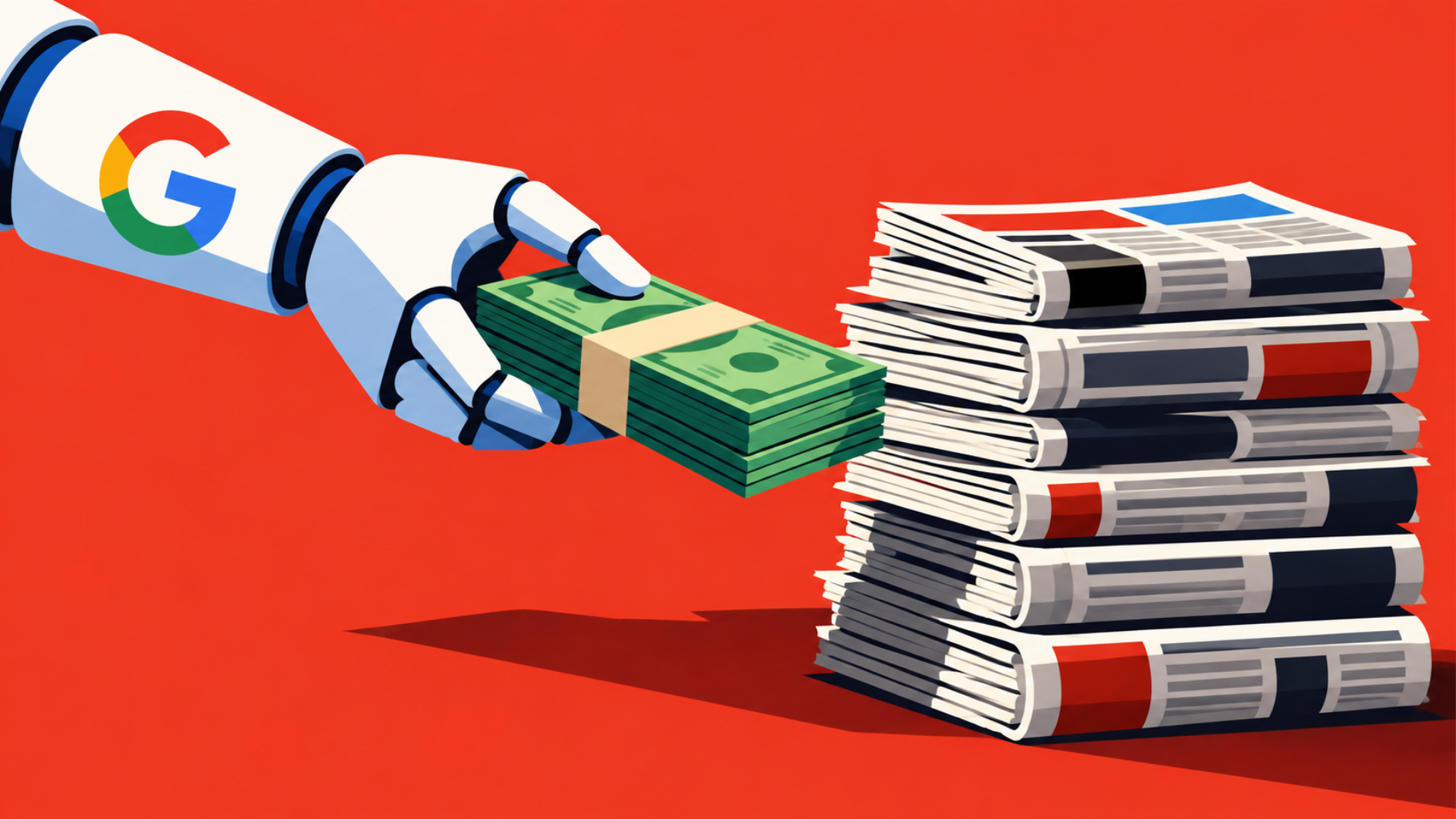
Google has expanded its paid News AI pilot to more than 400 publications, including CNN, Axios and The Financial Times. The agreements provide publishers with licensing revenue for enhanced content used in AI article overviews and audio briefings, while Google controls how that reporting appears within its products. As search referrals decline, publishers are negotiating payments for content that users may consume without visiting the original source.
Reach Licenses News to Google as Its Digital Revenue Falls 20.3%
Reach plc, the UK and Ireland’s largest commercial news publisher, owns more than 120 brands, including the Daily Mirror, Daily Express and Manchester Evening News. On October 12, Reach announced an agreement granting Google enhanced content rights across its UK and Ireland news portfolio for experimental AI features.
The following day, Reach disclosed a 20.3% year-over-year decline in third-quarter digital revenue. Indirect digital revenue, which includes programmatic advertising on owned websites and off-platform commercial activity, fell 29.7%. Reach identified declining audience referrals, primarily from Google, as a major pressure on its digital business.
Improved off-platform revenue, including AI licensing, partially offset weaker on-site monetization. Reach didn’t disclose how much licensing contributed or the value of its new Google agreement. The quarter ended September 30, and the results don’t establish how much, if any, revenue came from that specific partnership.
The pressure extends beyond Reach. Across Chartbeat’s publisher network, Google Search referrals declined 40.2% between July 2025 and July 2026, compared with a 21.9% decline the preceding year. The figures reflect broader changes in search distribution and audience behavior, without isolating the effect of Google’s AI features.
Fewer referrals reduce publishers’ opportunities to generate advertising impressions, register readers and convert visitors into subscribers. Licensing creates another revenue source when Google uses their reporting inside its own products.
Reach now has two commercial relationships with Google. The company depends partly on Google for audience acquisition while also selling Google rights to use its journalism. The value of that second relationship depends on what Google pays, how extensively it uses Reach’s content and whether compensation grows alongside usage.
Google’s News AI Products Can Deliver Reporting Without Sending Readers to Publishers
Google’s News AI pilot supports experimental features including detailed article overviews on Google News publisher pages and customizable audio briefings.
Participating publishers receive payment for the delivery and use of enhanced content. Google controls how that material appears within the features, including the surrounding experience and presentation of source links.
An article overview can give readers the information they need before opening the original report. Audio briefings can combine journalism into a listening experience that takes place within a Google product.
Google says the features include clear attribution and direct links. It hasn’t publicly disclosed the referral traffic generated by the pilot or whether publishers receive granular reporting on how often their material appears, how users engage with it and which presentations generate visits.
On October 15, Google separately announced changes to AI Mode and AI Overviews in Search, including more prominent inline links and expanded visual discovery features. Those changes affect Google’s broader AI Search experience rather than the News AI licensing pilot specifically.
Improving link visibility can create additional opportunities for readers to reach source publications. Publishers still need referral and conversion data to determine whether those opportunities produce meaningful audience growth.
A licensing payment compensates the publisher for contractually permitted content use. Referral traffic can create additional advertising, subscription and customer engagement revenue. Measuring the combined return requires information about both the licensed activity and the audience it produces.
CNN Is Licensing AI Rights While Expanding Its Subscription Business
CNN announced a multiyear agreement with Google on October 15, granting enhanced content rights for experimental AI features in exchange for compensation.
The agreement comes as CNN prepares to expand All Access into the UK and Canada on October 20, extending its direct subscription business internationally under new owner Skydance.
CNN is expanding its All Access subscription business while Skydance evaluates the economics of keeping news standalone. All Access will cost £4.99 per month in the UK and C$7.99 in Canada, combining live news, on-demand programming and digital journalism.
The Google agreement introduces another way to monetize CNN’s reporting alongside the subscription business it is trying to expand.
CNN can receive compensation when Google uses licensed content, regardless of whether a particular user becomes a CNN subscriber. Direct subscriptions generate revenue from customers who register, pay and renew through CNN’s own offering.
A reader who discovers CNN reporting through Google may become a valuable customer if that exposure produces a subscription. A reader who consumes the information entirely within Google may generate licensing value without entering CNN’s customer relationship.
CNN hasn’t disclosed the financial terms or specific usage rights associated with its Google agreement. The announced terms therefore don’t establish how the licensing revenue compares with the potential value of subscription acquisition or referrals.
As All Access expands internationally, CNN has another distribution relationship to evaluate alongside direct subscriptions, existing pay-TV arrangements and third-party subscription sales. Each route generates revenue under different terms and gives CNN a different degree of control over the customer relationship.
Google’s 400-Publisher Program Expands Licensed News Supply Without Establishing a Market Price
Google’s News AI pilot now includes international news organizations, national publications and smaller regional publishers with different content portfolios and commercial priorities.
The program builds on a much larger licensing operation. Google said in December 2025 that it had established commercial relationships with more than 3,000 publications, platforms and content providers across more than 50 countries. Those existing arrangements included extended display rights and content delivery through APIs.
The News AI pilot gives Google additional rights to incorporate professionally produced reporting into experimental AI news experiences.
Google hasn’t disclosed whether participating publishers receive fixed licensing fees, usage-based compensation, minimum guarantees or individually negotiated combinations of those arrangements.
The 400-publication count therefore establishes the scale of participation without revealing how much Google spends or what individual publishers earn.
The commercial value also differs by publisher. Reach depends substantially on advertising monetization across a large portfolio of news brands. CNN operates a global reporting business while investing in direct subscriptions. Smaller regional publishers may control original local reporting that national competitors don’t produce consistently.
Those differences affect the price each publisher might demand, the rights it can offer and the commercial outcomes it needs from the relationship.
Google can test licensed news experiences within an established consumer product. Publishers supplying the reporting must evaluate whether payments adequately compensate them for the rights granted and any consumption that occurs without a website visit.
The undisclosed contract terms leave several important questions unresolved, including how usage is measured, whether publishers can verify that reporting, what restrictions apply to the licensed content and how compensation changes if consumption increases.
Those terms will determine how publishers compare Google’s offer with other licensing opportunities and the revenue they can generate through their own properties.
The Streaming Wars Take
The next commercial challenge in AI news licensing is establishing a reliable way to measure how publishers’ content is used.
The Standards for Publisher Usage Rights coalition, known as SPUR, released its Content Telemetry Standard in October 2026. The framework defines a common way to record when AI systems retrieve publisher content, use it to support answers, cite it, present it to users and generate engagement.
The standard doesn’t compel Google or other AI companies to provide that reporting. Adoption and the ability to verify usage remain separate commercial and technical decisions.
Those measurements could change how publishers negotiate licensing fees.
A fixed annual payment provides predictable revenue, but a publisher may receive no additional compensation when the licensed product’s usage expands. Usage-based payments can better reflect increasing consumption, provided both parties agree on what counts as a compensable event and how that activity is verified.
Publishers can also negotiate reporting on source-link placement, outbound referrals and conversion activity. That information can establish whether AI distribution produces incremental audience value beyond the licensing fee.
For Google, a large portfolio of licensed reporting provides content for AI experiences inside products it operates. For publishers, the value depends on the price of the rights, the scope of permitted use and the audience relationship they can preserve or build.
Without consistent, verifiable usage reporting, publishers have limited ability to determine whether rising consumption of their journalism produces proportional licensing revenue.
The agreements signed today will be judged by how their payments, reporting obligations and permitted uses perform as Google’s AI news products develop. Publishers that can verify content consumption and negotiate compensation tied to that activity will have a stronger basis for pricing subsequent agreements.
The Streaming Wars is intentionally ad-free
We don’t run display ads. Not because we can’t, but because we don’t believe in them.
They interrupt the reading experience. They cheapen the work. And they burn advertisers’ money on impressions nobody actually wants.
So we chose a different model.
We say the things people in this industry are already thinking but don’t say out loud. We connect the dots beyond the headline and focus on explaining why things matter to the people working in this business.
If you believe industry coverage can exist without clutter and interruption, you can support it here → SUPPORT TSW.
Support is optional. But it directly funds research and continued coverage — and helps prove this model can work.
Support TSW →