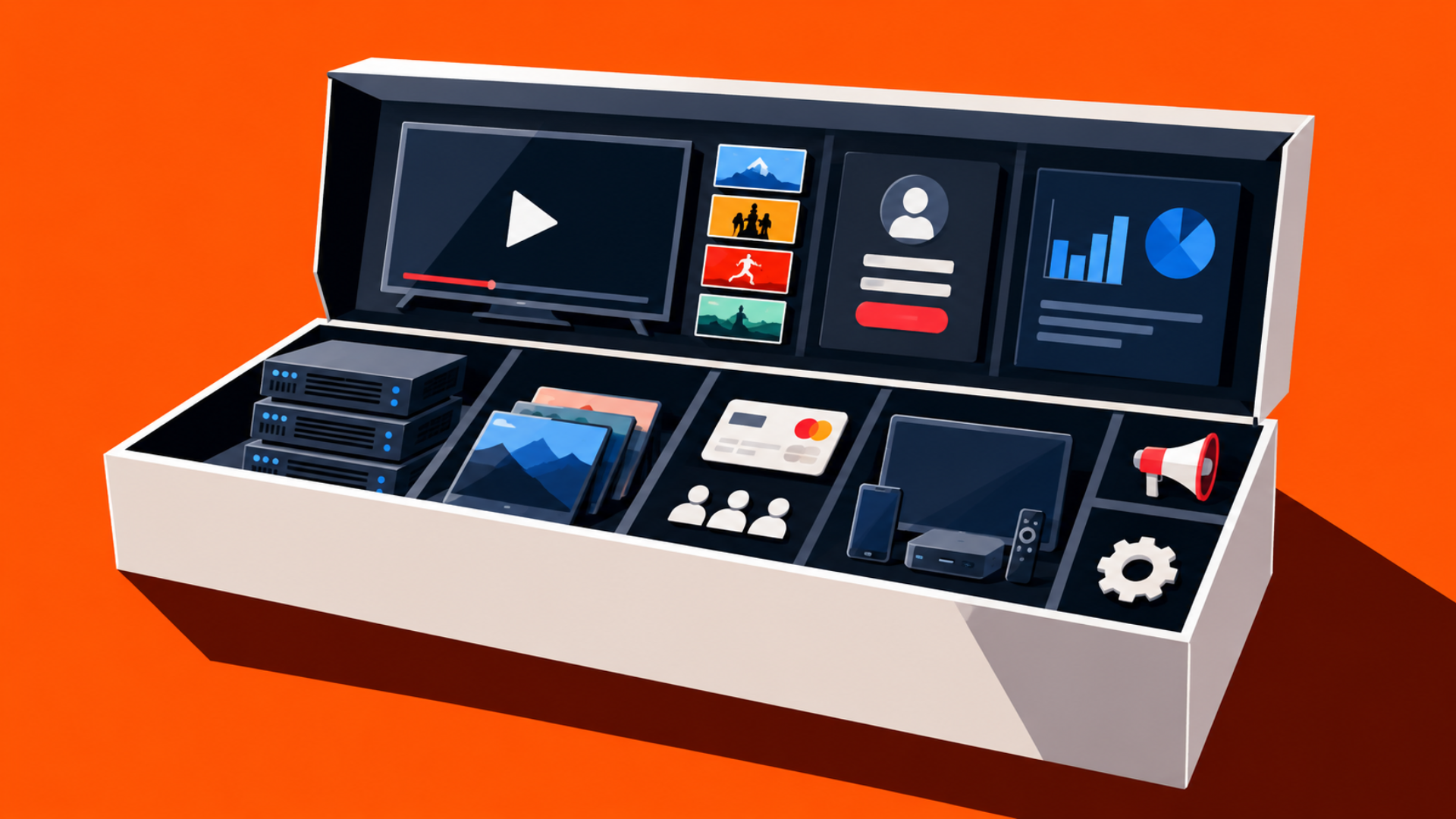
Buying a white-label streaming service gives an operator prebuilt technology for launching video under its own brand. Depending on the package, that can include video processing, content management, branded apps, subscriber tools, analytics, and monetization integrations. Suppliers spread development and maintenance costs across customers, making sophisticated capabilities economical for smaller services.
Buying still leaves work. Billing must connect to authentication, content rights must reach playback systems, ads need buyers, and CTV apps need certification. The commercial calculation starts with what the contract includes, what requires integration, and who maintains each connection.
Prebuilt Technology Still Needs a Defined Scope
Video infrastructure ingests, transcodes, packages, and delivers streams. A content management system (CMS) organizes programming, metadata, and availability. Apps present the catalog and initiate playback. An integrated provider can manage most of that chain; modular suppliers can add selected capabilities to systems an operator already uses.
The statement of work should separate standard features, configurable options, supported integrations, third-party licenses, custom development, and ongoing support. A package supporting digital rights management (DRM), for example, may still require a separately contracted license or key-management service. Device coverage and maintenance obligations also vary by agreement.
Acceptance testing should cover playback, account activation, rights restrictions, billing failures, analytics, and releases on every contracted device. A product demonstration establishes what software can do. Acceptance criteria establish what the purchased service must deliver.
Billing Must Translate Payments Into Viewing Rights
When a viewer subscribes, the payment system records the transaction and passes status changes to the entitlement system. At sign-in, authentication identifies the account so apps can check its current viewing rights. Renewals, cancellations, refunds, trials, and purchases through different storefronts complicate the workflow.
Stripe documents webhook events for keeping subscription and access records synchronized. Roku requires transactional apps to integrate Roku Pay, adding device-specific purchase and entitlement rules.
Operators need to decide which system authorizes viewing and who handles taxes, chargebacks, reconciliation, and customer support. Suppliers can provide the integrations and operational services, but the buyer still defines the commercial rules. An account that has paid but cannot play creates a retention problem regardless of which system malfunctioned.
Content Rights and Ad Monetization Require More Than Software
A prebuilt CMS can organize assets, schedule releases, and publish catalog changes. The underlying CMS and MAM workflows still need approved masters, captions, metadata, and rights information.
A sports service may have live rights in one territory and replay rights in another. Its rights records must communicate those restrictions to the catalog, entitlements, and playback systems. Publishing automation is only as reliable as the information feeding it.
Advertising follows a similar pattern. Server-side ad insertion can place commercials into streams, but monetization also needs ad demand, decisioning, measurement, and consent workflows. Some packages include managed monetization; others integrate with an operator’s existing ad stack. The agreement should specify responsibilities and any applicable revenue sharing.
CTV Apps Bring Certification, Releases, and Distribution Work
CTV operating systems have different technical specifications, certification processes, and update cycles. Samsung maintains detailed development and testing requirements; Roku imposes its own purchase and authentication rules.
A specialist supplier can manage shared code, device testing, app submissions, and ongoing fixes. The contract should specify supported devices, release responsibilities, service levels, developer-account control, and security updates.
Publishing an app doesn’t guarantee home-screen promotion or meaningful discovery. Those distribution opportunities depend on separate commercial relationships. App transfers also require planning: Apple allows eligible apps to move between developer accounts, subject to conditions that can affect subscriptions.
Fees Allocate Work and Risk Between Operator and Supplier
Suppliers fund software engineering, infrastructure, monitoring, security, device testing, and support. Fixed licenses compensate for maintained technology; usage-based fees track consumption; revenue shares can compensate for monetization or distribution functions. Each model serves a legitimate commercial purpose.
The relevant question is how specific contract terms affect contribution margin. Buyers should identify implementation charges, license scope, minimum commitments, CDN and processing usage, support tiers, customization, and price adjustments. Where a revenue share applies, the definition of gross or net receipts and permitted deductions affects how much the operator retains.
An SVOD service needs to model storefront fees, payments, content, delivery, and technology costs against subscription receipts. An AVOD service must also account for ad fill, realized prices, and intermediary shares. Live-event peaks deserve separate scenarios because usage charges can move faster than subscriber revenue.
Clear pricing schedules and usage thresholds make these economics easier to forecast. If streaming hours grow faster than subscriber revenue, metered delivery expenses can compress contribution margin even as the paying audience expands.
Custom Features Carry Maintenance Costs
Standardized templates let technology providers improve software for multiple customers. Custom recommendations, unusual entitlement rules, or specialized sports experiences may require dedicated design, code, testing, and ongoing support.
Contracts should distinguish configuration from custom development, identify ownership of new work, and establish whether tailored features receive routine updates. Operators still need a product team capable of deciding which changes are worth the expense.
Data Access Determines Operational Flexibility
Dashboards can show churn or viewing time without giving operators the underlying events needed for deeper analysis. Agreements should establish control over first-party subscriber records, permitted supplier usage, and access to entitlement history, playback activity, and advertising data, subject to privacy and storefront restrictions.
Export formats, APIs, retention, deletion, app-account control, and migration assistance affect continuity if a service changes technology. Migration carries costs even when suppliers cooperate: systems can use different identities, schemas, and interfaces.
A Three-Year Model Exposes the Tradeoff
Consider a hypothetical white-label deployment costing $50,000 to integrate and $10,000 a month for software and support. That’s $410,000 over three years. A hypothetical custom build costing $450,000 upfront and $110,000 annually to maintain reaches $780,000. These are illustrative figures, not any supplier’s quoted terms.
Neither figure includes expenses both models may incur, such as delivery, payments, content operations, or marketing. The comparison must also include custom change orders, traffic growth, required internal staffing, and launch timing. Missing a valuable programming window can cost more than an apparent development saving.
Buying tends to favor services whose requirements fit existing software. Building deserves consideration when proprietary features generate enough additional revenue or retention to cover their development and recurring maintenance.
Different Suppliers Cover Different Parts of the Stack
White-label streaming covers several buying models. Integrated OTT environments, modular infrastructure, and specialized CTV app development solve distinct operational problems.
inoRain offers branded OTT services spanning content management, video processing, secure delivery, analytics, and subscription, advertising, pay-per-view, and FAST monetization. That integrated approach can reduce the number of technology components an operator must coordinate.
Hypersolid combines HyStream live and on-demand infrastructure with HyView, its customizable CTV, web, and mobile app layer. Its modular approach allows customers to deploy a complete environment or retain existing systems and add specific capabilities.
Foxxum supplies CTV app technology through Core App, a hosted standardized offering with certification and maintenance, and Core App Plus, which supports deeper customization and third-party integrations. That addresses the specialized engineering needed to release and maintain apps across device ecosystems.
Together, the companies illustrate where operators can purchase an integrated environment, connect modular infrastructure, or outsource CTV app development. The appropriate boundary depends on existing systems, internal expertise, and product requirements.
For a deeper look at the companies building the future of streaming technology, visit our Industry Directory, which spotlights the operators driving the next phase of streaming.
Want your company listed in the TSW Industry Directory? Email us to learn more about eligibility, profile options, and how to get included.
The Streaming Wars Take
Capital spent rebuilding common streaming functions is capital unavailable for rights, marketing, and distribution. For a specialized service, using maintained infrastructure can make commercial sense when standardized features deliver the desired customer experience and earlier launch creates revenue.
Custom development earns its place when differentiated functionality has a credible return in engagement, retention, pricing, or operating efficiency that exceeds the full engineering commitment. The decision should survive a multi-year model, rather than rely on the appeal of controlling more code.
Operators still need internal technical leadership to set requirements, evaluate service levels, protect data access, and manage integrations. The contract should compensate suppliers for the engineering and reliability they provide while specifying pricing, accountability, and workable migration provisions.
If proprietary features cannot produce enough incremental contribution to pay for their development and maintenance, that investment has a stronger case elsewhere in the streaming business.
The Streaming Wars is intentionally ad-free
We don’t run display ads. Not because we can’t, but because we don’t believe in them.
They interrupt the reading experience. They cheapen the work. And they burn advertisers’ money on impressions nobody actually wants.
So we chose a different model.
We say the things people in this industry are already thinking but don’t say out loud. We connect the dots beyond the headline and focus on explaining why things matter to the people working in this business.
If you believe industry coverage can exist without clutter and interruption, you can support it here → SUPPORT TSW.
Support is optional. But it directly funds research and continued coverage — and helps prove this model can work.
Support TSW →