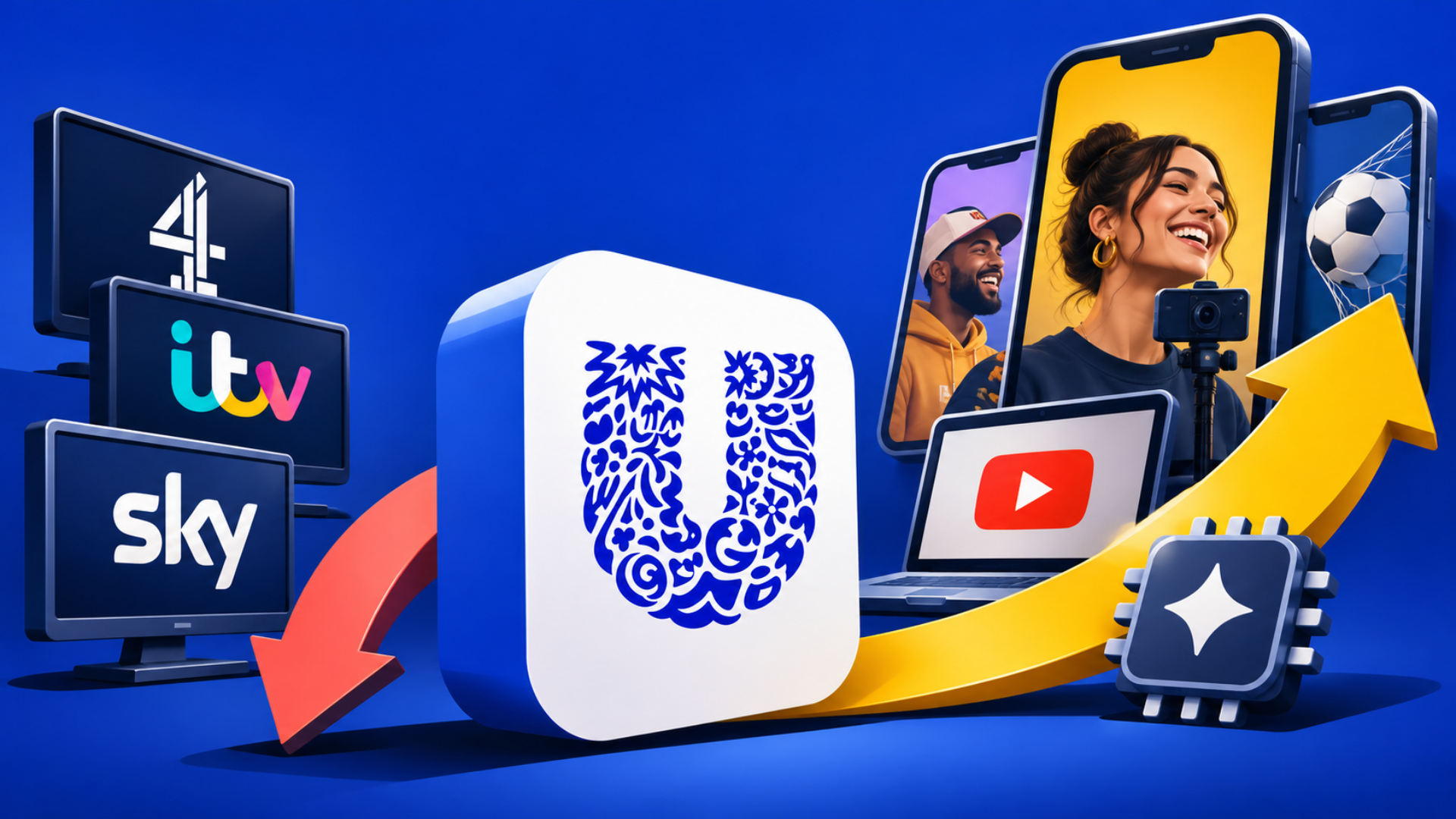
Unilever, the consumer goods giant behind Dove, Vaseline and Hellmann’s, is sharply reducing its investment in UK TV advertising as it shifts its global marketing strategy toward social media and creator-led content.
The company’s UK TV advertising spend has fallen by more than 50% so far in 2026 compared with the same period last year. Industry figures obtained by The Guardian show spending reductions of approximately 92% at Channel 4, 44% at Sky’s advertising operation and 42% at ITV. Unilever declined to comment on the figures.
The cuts coincide with a significant expansion of Unilever’s marketing capabilities. The company now works with more than 500,000 creators globally, up from 75,000 in 2024, and is using AI to produce substantially more marketing content at lower costs.
Unilever’s ability to commission content directly from creators and purchase distribution across social platforms gives it greater flexibility over where it allocates its multibillion-euro marketing budget. For commercial broadcasters, that means increased competition for the advertising revenue that finances their programming.
Creative Gets Cheap
Unilever spends more than €8 billion annually on marketing, with approximately 70% allocated to digital channels.
The company says it produces 12 times as much marketing content as it did in 2024 at 90% lower production costs. Video production that previously required three weeks can now take three hours.
Lower production costs make campaigns targeting smaller audiences more economically viable. Unilever can test creative across products, markets and communities before committing additional media spending to the content generating the strongest results.
Unilever puts the return on creator-led content at approximately 1.5x that of brand-led content. The company’s comparison doesn’t isolate TV as a media channel.
At its November investor event, Unilever said its proprietary measurement technology had increased media ROI by an average of 10% to 15%, while automated digital media buying delivered approximately 14% greater efficiency than last year.
The ability to produce, test and distribute creative more cheaply raises the opportunity cost of committing advertising dollars to a conventional TV campaign.
The Commissioning Squeeze
Unilever spent approximately £92 million on UK TV advertising in 2025 and has historically ranked among the country’s three largest TV advertisers. ITV and Sky sustained larger absolute spending losses this year, although Channel 4 experienced the steepest percentage decline.
Channel 4 invested £640 million in content in 2025, equivalent to 62% of its revenue. It recorded a £10 million pre-tax deficit and proposed eliminating 28% of its workforce in September to protect programming investment.
ITV expects fourth-quarter advertising revenue to decline between 5% and 10% and has identified £25 million in temporary content savings for the quarter. The company attributes weaker advertising demand to economic uncertainty, increased competition from global streaming services and restrictions on less healthy food advertising.
Digital growth provides some protection, but the economics remain challenging. Channel 4’s digital advertising revenue increased 13% in 2025. ITV’s streaming hours grew 29% through September 2026, while digital advertising revenue increased 6%.
Growing streaming consumption alone won’t resolve the financial pressure on commissioning budgets if digital advertising gains fail to replace declining linear revenue.
YouTube Gets Paid
YouTube can capture advertising expenditure associated with content financed by brands and independent creators.
Its Open Call advertising product connects advertisers with creators and allows brands to purchase additional distribution behind selected submissions. YouTube can participate in creative procurement, distribution and campaign measurement within the same commercial relationship.
Independent creators assume much of the upfront financial risk of producing content and developing audiences, while YouTube monetizes their output and shares advertising revenue with eligible creators.
Its connected TV presence extends that economic model onto the screens where commercial broadcasters and ad-supported streaming services compete for viewing time and advertising dollars.
The Reach Premium
Unilever’s 2026 FIFA World Cup sponsorship demonstrates the commercial value of combining mass reach with localized creator campaigns.
The company deployed more than 100,000 pieces of content across 120 markets and worked with approximately 50,000 creators. Unilever says limited-edition products associated with the tournament generated approximately €350 million in sales.
The World Cup supplied a global cultural event that Unilever could commercialize through sponsorship, creator content, paid distribution and retail activations.
Research commissioned by Thinkbox, the UK commercial TV marketing body, illustrates the economics of that media mix. Broadcast TV accounted for approximately 39% of measured advertising awareness gains, compared with 1% for influencers. Influencers, however, delivered 15 awareness points per £1 million invested, compared with 12 for broadcast TV.
Influencer efficiency at current spending levels doesn’t establish that equivalent returns would hold at TV’s scale. Broadcasters retain a commercial advantage in delivering widespread awareness, particularly around programming that audiences can’t readily find elsewhere.
The Streaming Wars Take
Commercial broadcasters have an opportunity to retain advertiser relationships even when the spending moves outside their owned inventory.
Channel 4 is already pursuing that business through 4Studio, its digital production operation. In September, it expanded a branded content partnership with Nestlé’s Maggi through a short-form recipe series distributed across YouTube, Instagram, TikTok and Facebook.
Those arrangements give broadcasters access to production, sponsorship and partnership budgets that might otherwise bypass their sales operations. They also introduce a different competitive problem: broadcasters increasingly depend on third-party platforms to distribute and monetize some of the content they produce for advertisers.
The economics of those campaigns will depend on production margins, distribution costs and how much of the advertiser relationship the broadcaster retains.
Premium programming can still give broadcasters negotiating leverage and access to distinctive talent. Extending those assets into advertiser-funded content and social distribution could help preserve commercial relationships without requiring every campaign to run through broadcaster-owned inventory.
Unilever’s expanding marketing capabilities increase the number of suppliers competing for its budget. Broadcasters’ ability to finance programming will increasingly depend on how much of that budget they can retain, including when the advertiser buys something other than a TV spot.
The Streaming Wars is intentionally ad-free
We don’t run display ads. Not because we can’t, but because we don’t believe in them.
They interrupt the reading experience. They cheapen the work. And they burn advertisers’ money on impressions nobody actually wants.
So we chose a different model.
We say the things people in this industry are already thinking but don’t say out loud. We connect the dots beyond the headline and focus on explaining why things matter to the people working in this business.
If you believe industry coverage can exist without clutter and interruption, you can support it here → SUPPORT TSW.
Support is optional. But it directly funds research and continued coverage — and helps prove this model can work.
Support TSW →