

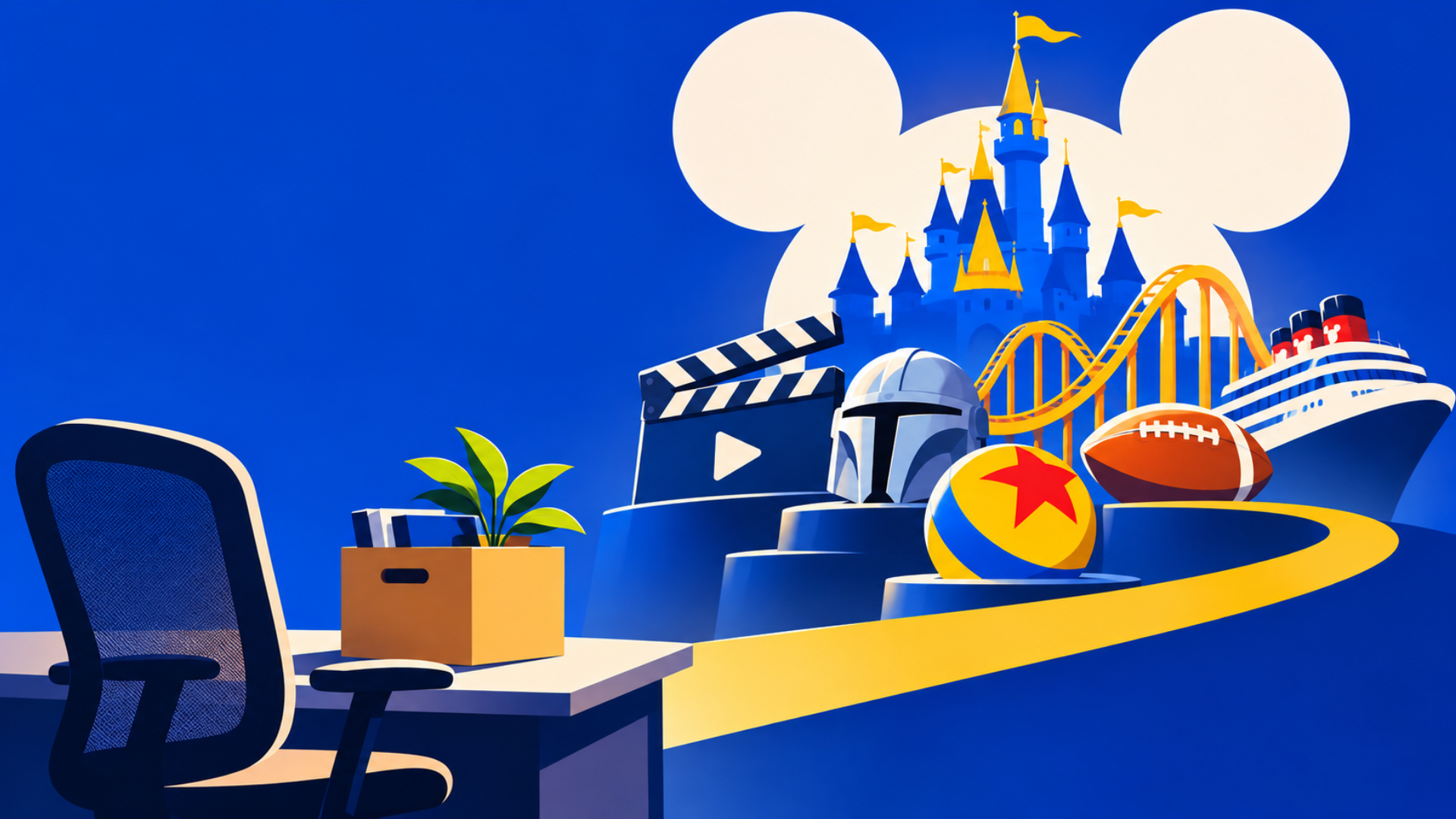
Disney is considering thousands of job cuts, with some managers asked to identify as much as 20% in annual cost savings, people familiar with the discussions say. CEO Josh D’Amaro reportedly intends to redirect part of the savings toward film and TV programming, technology, parks and cruises. Disney has declined to comment on the plan, and neither the number of affected jobs nor a companywide savings target has been disclosed.
D’Amaro is concentrating more of Disney’s spending around franchises and consumer relationships that can generate revenue across multiple businesses. Lower operating costs could improve margins and free capital for growth, but a leaner organization will have fewer resources to develop the content and products supporting those investments. The strategy increases the financial pressure on Disney’s remaining creative and technology operations.
20% Isn’t Headcount
The reported 20% savings target applies to selected managers and operating groups. It covers labor and nonlabor expenses, including payroll, vendors, systems and other operating costs.
Disney employed approximately 231,000 people at the end of fiscal 2025. The company’s restructuring has already eliminated roughly 1,000 positions in April, several hundred more in July, and additional jobs in technology, human resources and Experiences since September.
The latest proposed reductions would extend that effort across multiple divisions, including TV networks and film studios.
Disney’s One Disney operating model creates opportunities to eliminate duplicated marketing, technology and administrative functions. Combining operations can reduce the expense of supporting businesses that increasingly share franchises, customer accounts and distribution infrastructure.
The financial risk depends on which costs disappear.
Corporate departments can consolidate management and vendors. Studios still need development and production capabilities to create films and series. Streaming requires engineers, advertising systems and product teams capable of supporting millions of customer relationships.
Reducing duplicated overhead improves profitability. Eliminating capabilities that Disney later needs to rebuild through outside contractors, additional hiring or delayed projects can consume those savings.
Cable’s Cost Ceiling
Disney’s traditional TV businesses face declining pay-TV subscribers while programming commitments remain substantial. Lower distribution revenue puts pressure on the operating expenses supporting those networks.
ESPN demonstrates how difficult that balance has become.
Disney’s Sports segment generated $4.5 billion in fiscal third-quarter revenue, up 4%, while operating income declined 17% to $858 million. The decline reflected several factors, including fewer NBA playoff games and a carriage dispute.
Sports remains a profitable business, but revenue growth offers limited protection when programming, production and distribution costs rise.
ESPN is expanding its direct subscription business while maintaining expensive rights agreements. That requires continued investment in streaming technology, product development and the infrastructure supporting live sports.
Disney can reduce network overhead as traditional distribution contracts lose subscribers. The company still needs sufficient programming and technical capacity to monetize its sports rights through advertising, affiliate fees, direct subscriptions and bundles.
The larger challenge is replacing the economic contribution of declining pay-TV subscribers with direct revenue that can support those commitments.
Cost reductions can protect existing margins. ESPN’s subscription and advertising businesses have to generate the additional revenue needed to sustain its sports economics.
Hits Need Second Jobs
Disney’s franchise economics explain why D’Amaro wants to protect selected content investments while reducing expenses elsewhere.
Toy Story 5 surpassed $1 billion at the global box office. The broader franchise has generated more than 2 billion hours of Disney+ viewing, supported merchandise sales and established a presence across Disney’s parks and cruise ships.
A successful franchise can generate returns through theatrical distribution, streaming, licensing, merchandise and physical experiences.
Disney is reorganizing to connect those economics more directly to its creative operations.
Effective October 4, Disney moved global consumer-product licensing and publishing under Disney Entertainment Studios. Parks merchandise, Disney Store and DisneyStore.com remained within Experiences.
The restructuring brings more of the commercial revenue generated by Disney’s intellectual property into the organization responsible for creating and managing it.
Studios will have closer oversight of licensing and publishing businesses that extend the economic life of their franchises.
That increases the importance of selecting projects capable of sustaining consumer demand beyond their initial release.
Disney acknowledged that The Mandalorian and Grogu and the live-action Moana fell short of box-office expectations, although both contributed to broader franchise activity.
Merchandise, streaming engagement and attractions can generate additional revenue from those investments. They still have to produce enough incremental earnings to justify the original production and marketing costs.
Disney has also been reducing studio production volume. July’s layoffs affected Pixar’s production and operations teams even as Toy Story 5 delivered a major commercial success.
A smaller development pipeline concentrates spending on fewer projects. Each successful franchise can generate substantial returns, but fewer releases also mean fewer opportunities to develop intellectual property capable of supporting future theatrical, streaming, licensing and Experiences revenue.
Disney+ Must Convert
Disney’s subscription streaming businesses are becoming more profitable, increasing their importance to the company’s broader investment strategy.
Disney+, Hulu and related subscription video-on-demand operations generated $712 million in fiscal third-quarter operating income, up from $329 million a year earlier. Operating margin increased to 12.9%.
Those figures represent Disney’s non-GAAP Entertainment SVOD measure, which excludes Hulu + Live TV and Fubo. The quarterly margin also benefited partly from the timing of programming and marketing spending.
The improvement gives Disney greater capacity to invest in technology and customer engagement while sustaining streaming profitability.
D’Amaro wants Disney+ to serve as the company’s primary digital connection to its broader consumer businesses, bringing entertainment, sports, personalized experiences and additional Disney products into a more connected relationship.
That strategy depends on increasing the revenue generated by existing subscribers.
Disney’s ESPN bundle pricing encourages consumers to combine sports and entertainment subscriptions. Shared accounts and technology can also help Disney lower customer acquisition expenses, improve recommendations and reduce churn.
The economic benefit depends on measurable changes in subscriber behavior.
Moving an existing customer between Disney-owned services doesn’t automatically increase revenue. Higher subscription spending, better retention, additional advertising revenue and purchases across Disney’s businesses can.
Those outcomes require technology that works reliably across billing, identity, recommendations, advertising and customer support.
Disney has already reduced technology positions while identifying technology infrastructure as an investment priority.
Consolidating duplicated systems can lower recurring expenses. It also places more responsibility on the engineering and product teams supporting Disney’s increasingly integrated consumer operations.
Parks Need Payback
Disney’s Experiences division generated approximately $3 billion in fiscal third-quarter operating income, an increase of 20% year over year.
That growth included approximately $100 million from a tariff refund, which contributed roughly four percentage points to the reported increase.
The division remains a major profit contributor, but its expansion requires substantial capital.
Disney expects approximately $9 billion in companywide capital expenditures for fiscal 2026, with the majority directed toward Experiences. New attractions, resort expansions and cruise ships require large upfront commitments before generating their full expected returns.
Disney Destiny and Disney Adventure increased the cruise fleet’s stateroom capacity by approximately 50% year over year during the third quarter.
That additional capacity creates opportunities for passenger revenue, onboard spending and more extensive franchise experiences. It also requires sustained occupancy and pricing to support the investment.
Disney expects its future Experiences capital projects to generate double-digit returns over their lifetimes.
D’Amaro’s capital-allocation decisions will therefore be measured against long-term operating performance, including attendance, guest spending, cruise occupancy and the costs of maintaining new attractions and vessels.
The company has also eliminated positions within Imagineering, the organization responsible for designing and developing physical experiences.
Reducing administrative costs can improve project economics. Delays, higher contractor expenses or weaker execution can increase the total cost of projects already requiring substantial investment.
Disney needs its remaining teams to deliver the attractions and experiences that justify its expanding capital commitments.
Show the Dollar Savings
Disney hasn’t disclosed the annual savings it expects from the proposed reductions, the restructuring expenses required to implement them or how much of the money would be reinvested.
Those figures will determine how much of the restructuring improves recurring profitability.
A reduction in corporate overhead can flow directly into operating income. Reinvestment in film production, technology or physical expansion requires additional spending before Disney realizes the anticipated financial returns.
The company has reiterated expectations for double-digit adjusted earnings-per-share growth in fiscal 2027, excluding the impact of the extra week in fiscal 2026.
Disney’s November 17 earnings presentation provides an opportunity to clarify the broader restructuring effort, although management hasn’t committed to disclosing details of the proposed layoffs at that event.
The financial assessment needs to separate recurring expense reductions from severance costs, restructuring charges and spending redirected into growth initiatives.
It also needs to account for changes in Disney’s segment structure.
As consumer-product licensing and publishing move into Entertainment beginning in fiscal 2027, some income previously recorded within Experiences will shift between reporting segments.
That change will affect how investors compare Entertainment and Experiences results across reporting periods, independent of the underlying performance of either business.
A successful restructuring must improve Disney’s companywide returns after accounting for those transfers and the cost of reinvestment.
The Streaming Wars Take
Moving licensing and publishing into Entertainment changes how Disney’s studio economics will be measured.
Franchise revenue that previously appeared in Experiences will increasingly sit alongside the creative businesses responsible for generating it. That should make the commercial contribution of intellectual property more visible, but it could also make Entertainment’s reported profitability appear stronger without producing additional companywide earnings.
The change increases the importance of separating accounting movements from actual financial improvement.
It also creates a more demanding test for Disney’s content investments.
A theatrical release that generates meaningful licensing revenue, streaming engagement and demand for physical experiences can justify spending that would look excessive against box-office returns alone. Disney’s reorganized studio operations will have a closer connection to those broader commercial results.
The risk comes from narrowing the pipeline that produces them.
Established properties such as Toy Story, Marvel and Star Wars give Disney several ways to monetize audience demand. Developing additional franchises requires creative experimentation, production resources and spending on projects whose commercial potential remains uncertain.
Reducing development capacity can improve near-term studio expenses while limiting the number of new properties available to support future revenue.
Disney+ adds another financial requirement. As the streaming service becomes more closely connected to ESPN, commerce and other Disney businesses, its value increasingly depends on generating additional spending from existing customer relationships.
That requires continued investment in both content and technology. Higher margins achieved through lower expenses will be less valuable if the service cannot sustain engagement, retention and subscription revenue.
D’Amaro is concentrating more capital around franchises, consumer relationships and physical investments that can produce returns across Disney. The restructuring increases the financial importance of each creative decision and the operational burden placed on the teams responsible for executing it.
The company’s results will need to demonstrate recurring savings, stronger streaming profitability and higher returns on franchise investment after accounting for the reallocation of income between segments.
A smaller development pipeline raises the cost of a creative miss across theatrical releases, streaming, licensing and parks, even when the initial payroll reduction improves reported margins.
The Streaming Wars is intentionally ad-free
We don’t run display ads. Not because we can’t, but because we don’t believe in them.
They interrupt the reading experience. They cheapen the work. And they burn advertisers’ money on impressions nobody actually wants.
So we chose a different model.
We say the things people in this industry are already thinking but don’t say out loud. We connect the dots beyond the headline and focus on explaining why things matter to the people working in this business.
If you believe industry coverage can exist without clutter and interruption, you can support it here → SUPPORT TSW.
Support is optional. But it directly funds research and continued coverage — and helps prove this model can work.
Support TSW →