
Teams are moving from RSNs to a combination of streaming subscriptions and free local broadcasts. Everyone seems excited about reaching fans directly, but can those arrangements really replace the money the RSNs used to pay?
— VP, Partnerships
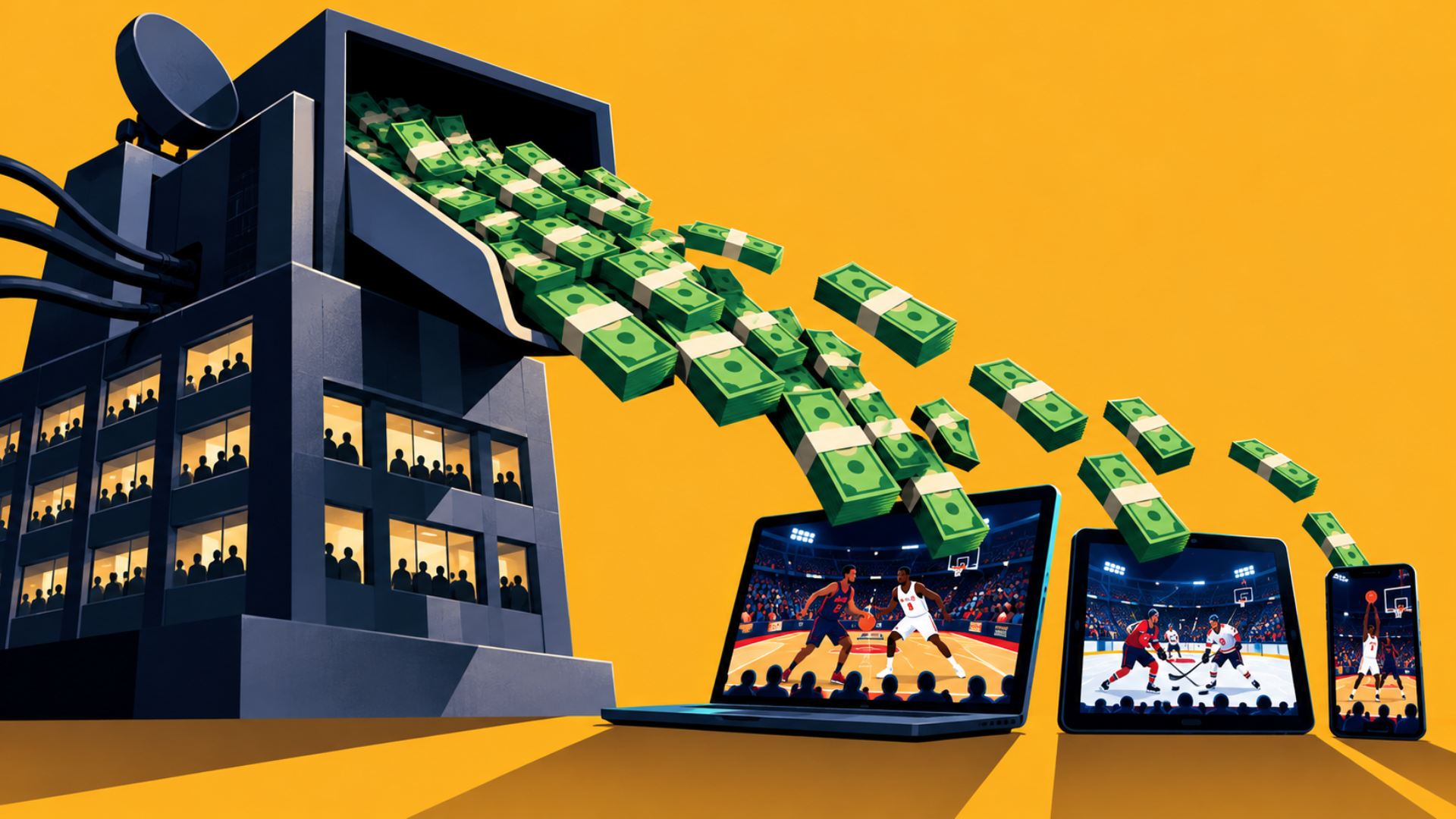
Probably not all of it. The old RSN business collected money from millions of households that never watched the games, and replacing that subsidy with only sports fans is going to be expensive.
The collapse of Main Street Sports Group left 13 NBA teams and seven NHL teams looking for new local media arrangements. Teams are now piecing together streaming subscriptions, free broadcasts, sponsorships, advertising, and distribution partnerships.
The new deals can make games easier to find, bring back casual viewers, and give teams better information about their fans.
They also force everyone to confront something the old cable model managed to disguise remarkably well.
The number of people willing to pay specifically for local sports is considerably smaller than the number of households that used to help finance it.
The Old Rights Fee Was Paid by the Whole Neighborhood
The regional sports model worked because the economics were spread across a large pay-TV subscriber base.
A passionate fan watching 70 basketball games contributed to the RSN through their cable package. So did the household that hadn’t watched a basketball game since Michael Jordan retired.
The distributor collected the subscriber payment, the RSN collected affiliate fees, and the team received a contracted rights fee.
The team didn’t have to acquire every paying viewer. It didn’t have to own billing, manage subscription cancellations, or persuade casual fans to buy a separate product.
The RSN absorbed much of the commercial risk around carriage, advertising, and the subscriber base.
The arrangement worked until cord-cutting removed enough paying households that the rights obligations became unsustainable. Main Street’s financial problems eventually left teams facing missed payments from the very contracts that were supposed to provide dependable revenue.
A guaranteed rights fee is only as good as the company guaranteeing it.
Still, moving away from that system means teams have to replace substantial money without access to the same broad subsidy.
The shutdown of Main Street forced that reckoning across much of the NBA and NHL.
A Subscriber Forecast Isn’t a Rights Check
The Minnesota Timberwolves provide a useful example of the replacement economics.
The team’s new DAZN offering costs $19.99 per month or $119.99 for a standard season pass, with more expensive plans offering additional features. Fifteen games are available free through DAZN and local over-the-air partner KARE 11.
That’s a sensible combination of paid access and broader distribution.
Now do the subscription math.
If 100,000 fans bought the $119.99 season pass, the retail sales would total roughly $12 million.
That’s before accounting for how the commercial agreement allocates revenue, what DAZN retains, payment processing, customer acquisition, service operations, and other associated costs.
It’s also a hypothetical subscriber count. It says nothing about how many Timberwolves fans will actually purchase the package.
DAZN is the team’s media rights partner, so the subscription revenue collected from fans doesn’t automatically flow to the franchise. The numbers I’d want in the board presentation are the guaranteed rights payment, any performance-based upside, and who carries the costs of production, marketing, and customer service.
The $12 million hypothetical tells us how much fans might spend. It doesn’t tell us what the team earns.
The old RSN model generally gave the team a more predictable rights payment backed by a broader distribution business.
The replacement may offer greater upside, but somebody’s gotta absorb the downside.
Free Games Have a Job, Even When They Don’t Produce Subscription Revenue
Free local broadcasts deserve more attention in this conversation.
A team is an entertainment business with commercial interests well beyond the media rights line.
It sells tickets, suites, sponsorships, merchandise, hospitality, and local relevance. A young fan who can watch games without an additional subscription can become valuable to the organization over many seasons.
That broader relationship is difficult to build when the first interaction requires a credit card.
The Timberwolves’ agreement with KARE 11 puts 15 games on free local TV, reaching households that may never buy the full-season package.
The team can use those broadcasts to showcase sponsors, create demand for paid games, promote ticket inventory, and remind casual fans that the team exists outside the occasional national broadcast.
Those benefits can have real economic value.
But reach needs its own financial model.
If a sponsor agrees to pay more because free broadcasts create additional local impressions, count the incremental revenue. If wider access improves ticket demand, measure that contribution. If free games produce paying subscribers, track the conversion and their retention.
Don’t just assign a giant number to the theoretical value of fan engagement and declare the missing rights fees replaced.
I’ve seen enough presentations where a projected audience becomes a projected customer and then somehow turns into projected revenue without anybody stopping to explain the transitions.
That’s how you end up with a beautiful deck and a very uncomfortable finance meeting.
The Streaming Distributor Still Gets a Vote
The NHL’s arrangement with Prime Video shows another way to rebuild local distribution.
Amazon is the exclusive local streaming home for six NHL teams beginning with the 2026-27 season. The Ducks and Stars include local games with Prime membership at no additional subscription charge, while the Hurricanes, Blue Jackets, Wild, and Blues sell separate team subscriptions through Prime Video. Fans buying those add-ons don’t need a paid Prime membership.
Amazon brings a massive existing customer base, familiar billing, established device distribution, and a place where many fans already watch sports.
A team can launch its own streaming service, but building an app is the easy part compared with persuading consumers to install it, create an account, enter payment details, and remember where it lives on game night.
Distribution partners reduce that friction. They also want to be compensated.
The financial terms haven’t been disclosed. What teams need to understand is how any rights payments, distribution fees, revenue sharing, billing control, and customer data provisions affect their economics.
A distributor that controls billing and renewals has influence over customer acquisition, upgrades, cancellation, and the data available to the rights holder.
Those details can determine whether a streaming business produces attractive long-term cash flow or merely creates another intermediary collecting money between the team and its fans.
Short-Term Deals Preserve Something Teams May Need Later
There’s a reason the NBA encouraged teams affected by Main Street’s shutdown to pursue shorter-term arrangements or contracts with exit provisions.
Adam Silver has said he expects the league’s centralized local streaming hub to launch for the 2027-28 season. Teams signing lengthy agreements today could limit their ability to participate in that offering.
That leaves clubs balancing immediate cash needs against the value of future rights.
A team with a large revenue hole may need the strongest guaranteed payment available today. Another may accept a less lucrative arrangement in exchange for keeping more control of distribution and the ability to participate in a future league offering.
The mistake is treating every new direct-to-fan arrangement as evidence that the team has finally gained complete control over its business.
The team may have traded one distribution dependency for another, with a smaller guaranteed check and more variables in the revenue forecast.
Underwrite the Revenue Gap Before Celebrating the Reach
I’d build the local media plan around the money that can be collected.
Start with the guaranteed rights payments. Add the realistic contribution from subscriptions, advertising, sponsorship, and other commercial revenue. Deduct production, distribution, technology, marketing, and customer support costs.
Then run the downside case.
What happens if paid subscriptions come in 30% below forecast? What happens when the team has a bad season? How much sponsorship revenue is contractually committed, and how much depends on audience performance?
Free games should serve a deliberate business purpose, with results measured separately from the paid package. Customer data and billing rights should be negotiated carefully. And any long-term distribution commitment should be priced against the flexibility the team gives up.
The old RSN arrangement generated money from households that had little interest in local sports. Teams are now building businesses around the people who care enough to watch, pay, or engage.
Better access and more direct fan relationships can create value across sponsorships, tickets, merchandise, and subscriptions. But those gains have to appear somewhere in the team’s financial results.
A bigger fan database isn’t going to cover a hypothetical $20 million hole in the media budget unless somebody can explain exactly how that database becomes revenue.
Ask Me Anything
Whether you’re fed up, fired up, or just want the truth behind the trends, send me your questions using this form. Anonymity guaranteed. Bullshit not included.
The Streaming Wars is intentionally ad-free
We don’t run display ads. Not because we can’t, but because we don’t believe in them.
They interrupt the reading experience. They cheapen the work. And they burn advertisers’ money on impressions nobody actually wants.
So we chose a different model.
We say the things people in this industry are already thinking but don’t say out loud. We connect the dots beyond the headline and focus on explaining why things matter to the people working in this business.
If you believe industry coverage can exist without clutter and interruption, you can support it here → SUPPORT TSW.
Support is optional. But it directly funds research and continued coverage — and helps prove this model can work.
Support TSW →