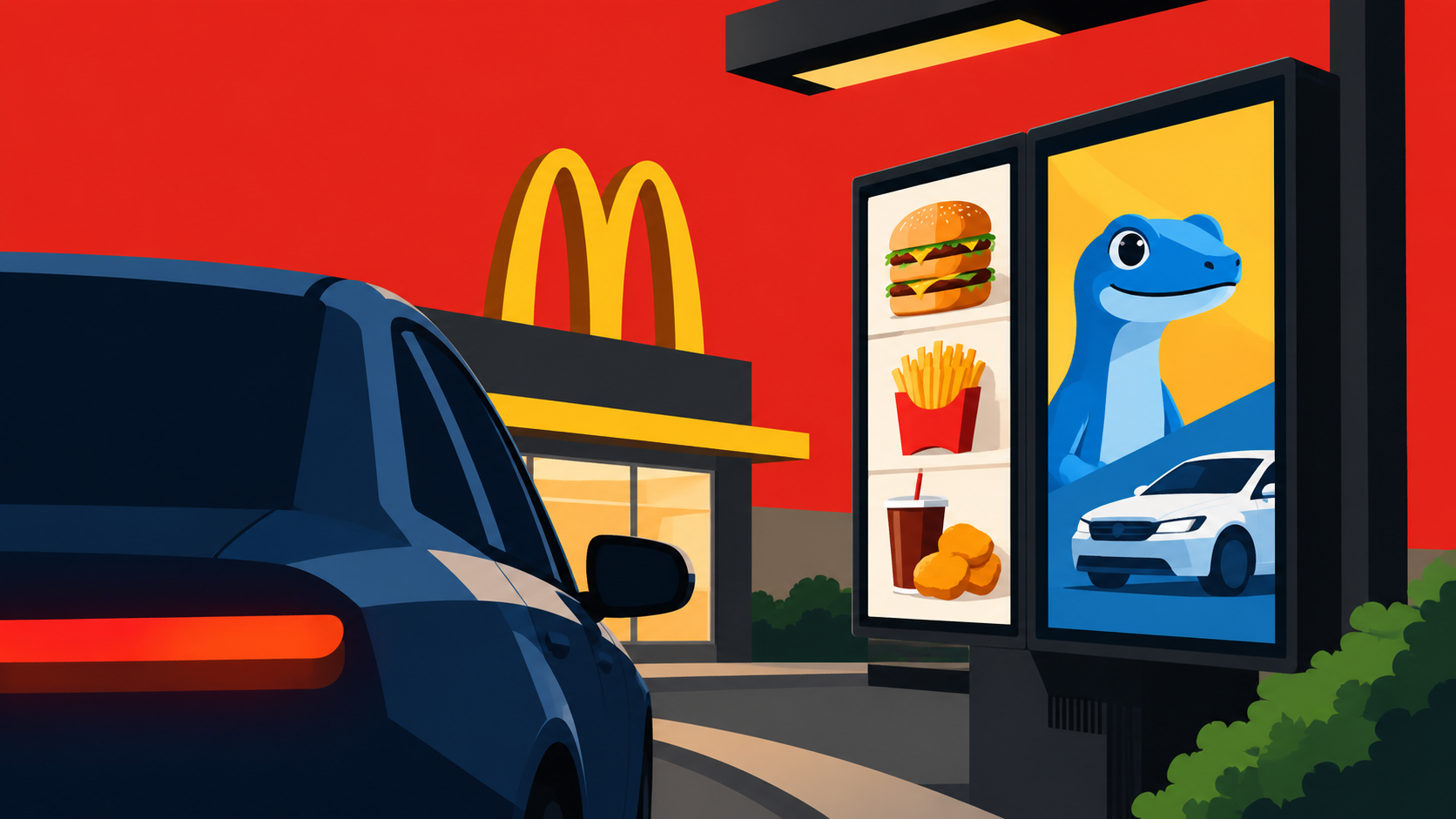
McDonald’s is testing third-party ads on digital drive-thru menu boards at 450 company-owned U.S. restaurants, with ads appearing after customers place their orders. The pilot is the first piece of a broader McDonald’s Media Network spanning its app, kiosks, menu boards and restaurants, with the company targeting a billion-dollar business over time. McDonald’s already pays to operate the restaurant and attract the customer for food. Advertising gives it another way to monetize the visit.
McDonald’s Can Sell Reach Without Carrying the Product
McDonald’s showed a Geico ad on a drive-thru board during its investor presentation, demonstrating how the advertiser base can extend beyond companies that sell products through its restaurants.
An insurer doesn’t need shelf space at McDonald’s to buy access to the customer visit. McDonald’s supplies the location, screen and recurring traffic, while the advertiser pays for exposure during a defined part of that visit.
That puts the company in competition for some of the same brand budgets available to TV, streaming services, social media and digital out-of-home advertising. Each channel reaches the customer in a different setting and sells a different combination of attention, targeting and measurement.
A streaming service generally needs programming to create viewing time before it can monetize that attention. McDonald’s already has a reason for people to show up. McDonald’s serves more than 70 million customers daily worldwide.
Turning those visits into an agency-buyable media product requires McDonald’s to define which restaurants, screens and dayparts an advertiser can purchase, how campaigns are delivered, what frequency controls exist and what reporting comes back afterward.
Scaling the business requires McDonald’s to build the commercial infrastructure that makes its existing screens reliably purchasable across the system.
Post-Order Dwell Time Protects the Menu’s Primary Job
The current drive-thru pilot places third-party advertising on the screen after the customer has ordered.
That reduces the direct conflict between advertising and the menu’s primary function. McDonald’s can monetize post-order dwell time without removing prices, food photography or merchandising from the moment when the customer is deciding what to buy.
The placement also gives McDonald’s a more defensible piece of inventory to test. Once the customer has made their selection, an outside ad is less likely to interfere with food choice or slow the drive-thru.
McDonald’s still has to protect the restaurant experience. Post-order screen time could otherwise carry order information, loyalty messaging or McDonald’s own marketing, and customer tolerance for unrelated advertising becomes part of the economics.
The company has told investors the network can generate revenue with little additional cost, no operational complexity and no customer disruption. The pilot has to validate those assumptions at the restaurant level while establishing how much advertisers will actually pay for the exposure.
High-margin media revenue becomes less attractive if restaurants need additional labor, equipment support or operational intervention to deliver it consistently. A centrally managed campaign that runs without involving restaurant employees keeps the economics much closer to the model McDonald’s is pitching.
First-Party Customer Data Doesn’t Solve Off-Site Attribution
McDonald’s has nearly 220 million loyalty members active within 90 days across 70 markets, giving the company a substantial base of identified customers alongside its physical restaurant traffic.
Loyalty identification lets McDonald’s observe purchases associated with an account. A drive-thru screen impression doesn’t automatically establish that an identified customer saw a Geico ad, requested an insurance quote later or eventually bought a policy.
That measurement gap separates McDonald’s own transaction data from the outcome an outside advertiser ultimately wants.
Retail media has raised advertiser expectations by connecting media exposure with later purchases. Amazon and Walmart can sell advertising against commerce environments where they also observe large volumes of transactions. That gives buyers more evidence about what happened after the impression.
McDonald’s can observe restaurant purchases associated with identified customers, giving it stronger measurement for activity inside its own commerce environment. An advertiser selling insurance, electronics or another product outside the restaurant requires a different data connection if it wants sales attribution.
McDonald’s can still sell reach, frequency, geography and other exposure metrics without following every campaign through to a transaction. Those measures compete more directly for brand budgets. Performance-oriented spending places more pressure on the company to connect restaurant exposure with behavior elsewhere.
That could require advertiser data, third-party identity or location partners, clean-room infrastructure, campaign-specific offers or other measurement arrangements. Each additional party adds cost and determines how much of the advertiser relationship McDonald’s controls itself.
A Billion-Dollar Network Needs a Repeatable Buying Product
A successful pilot proves that an ad can run on a screen. A scalable media business requires advertisers and agencies to buy thousands of those placements through a consistent commercial system.
McDonald’s has to standardize inventory, creative specifications, campaign scheduling, pricing, trafficking, pacing, verification and reporting. National advertisers also need confidence that the campaign they purchased ran across the locations and times included in the order.
The broader McDonald’s Media Network expands that job beyond the drive-thru. The app can offer authenticated digital inventory. Kiosks create another screen inside the transaction. Restaurant displays create physical-world reach. Each surface gives McDonald’s a different combination of customer identity, context and measurable behavior.
Those products don’t necessarily carry the same value. An app impression attached to a logged-in loyalty member gives McDonald’s more information than an anonymous exposure on a restaurant screen. A post-order drive-thru ad offers physical reach but less direct evidence about who consumed it.
Packaging everything under one media network gives McDonald’s more inventory to sell, but advertisers will price each placement according to the targeting, attention and measurement attached to it.
The sales operation also has to generate enough demand to keep the inventory filled at worthwhile prices. Screens with unsold ad time don’t create incremental revenue simply because they exist.
A Systemwide Rollout Requires Franchisee Economics
Approximately 95% of McDonald’s restaurants worldwide are owned and operated by independent local business owners. The current U.S. pilot is running in company-owned restaurants.
That gives McDonald’s control over the initial test while postponing one of the largest economic questions surrounding a broader rollout: how advertising revenue flows through the franchise system.
Franchisees provide the restaurants, screens and customer traffic that create much of the physical inventory. McDonald’s can centralize advertiser sales, campaign technology, standards and reporting, but a systemwide product ultimately depends on thousands of independently operated restaurants delivering the inventory promised to advertisers.
The company hasn’t publicly disclosed how advertising revenue would be divided with franchisees.
That split will influence operator participation and McDonald’s corporate economics. A national advertising campaign becomes much more valuable when McDonald’s can offer broad restaurant coverage, but expanding supply through franchised locations means establishing terms that operators will accept.
The arrangement also needs rules covering eligible advertisers, creative standards, campaign schedules, equipment responsibilities and support. Franchisees have little incentive to take on additional restaurant complexity for media revenue that primarily accrues elsewhere in the system.
The billion-dollar ambition therefore describes the potential scale of the network more clearly than it describes McDonald’s eventual corporate revenue. Franchisee payments, sales expenses, technology, measurement and outside data partners can all sit between advertiser spending and the amount McDonald’s retains.
The Streaming Wars Take
Every large consumer business with screens, authenticated users and habitual traffic can compete for advertising budgets once it can package those assets into reliable inventory. McDonald’s adds a massive physical distribution layer to that market, increasing competition for brand dollars already pursued by TV networks, streaming services, digital publishers and other ad sellers.
Retailers have already pushed the market further by combining media inventory with customer transactions. Walmart’s Vizio strategy connects TV advertising with a retail business capable of measuring subsequent purchases. McDonald’s also has first-party transaction data, but an insurance policy or other off-site purchase sits outside its own checkout data.
That gives McDonald’s an easier path into selling reach than into selling closed-loop performance. The company can put a Geico ad in front of drive-thru customers at scale with relatively little incremental infrastructure at the point of exposure. Proving that the impression produced a quote or policy requires considerably more measurement machinery.
Streaming services face another source of competition for advertiser spending as companies with large non-media businesses monetize customer attention around their core transactions. McDonald’s doesn’t need the advertising business to pay for the customer visit because the food sale already does that work.
Customer identity, campaign measurement and franchise participation will determine how much value McDonald’s can extract from that screen inventory.
McDonald’s corporate economics will depend on how cheaply it can prove advertiser outcomes, how much infrastructure it needs to sell and measure campaigns, and how much of the revenue returns to the franchisees whose restaurants create most of the available reach.
The Streaming Wars is intentionally ad-free
We don’t run display ads. Not because we can’t, but because we don’t believe in them.
They interrupt the reading experience. They cheapen the work. And they burn advertisers’ money on impressions nobody actually wants.
So we chose a different model.
We say the things people in this industry are already thinking but don’t say out loud. We connect the dots beyond the headline and focus on explaining why things matter to the people working in this business.
If you believe industry coverage can exist without clutter and interruption, you can support it here → SUPPORT TSW.
Support is optional. But it directly funds research and continued coverage — and helps prove this model can work.
Support TSW →