
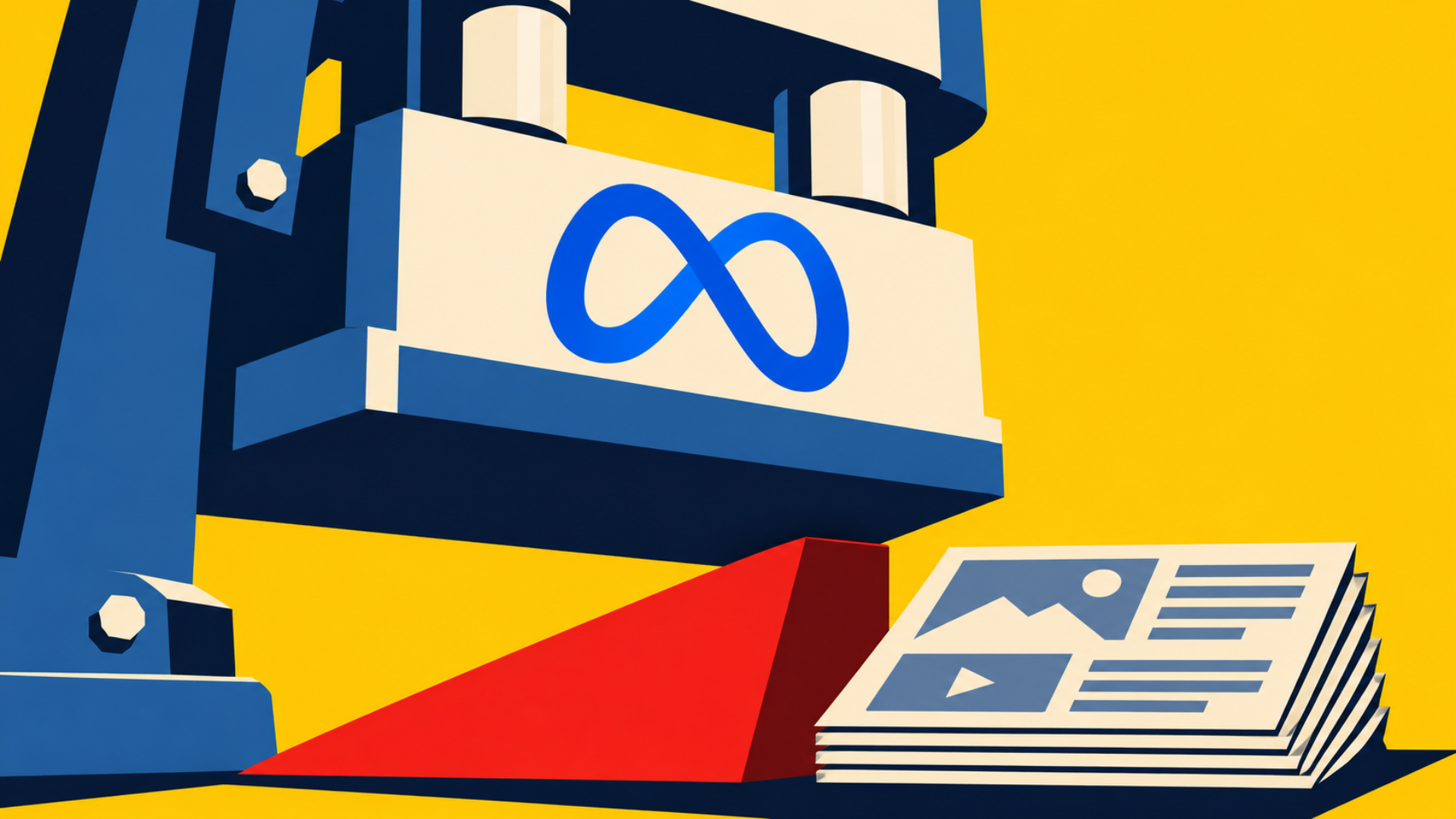
Meta has paused commercial terms that would’ve granted broad permission to crawl websites associated with business accounts, leaving publishers’ external content outside the additional contractual authorization the company sought.
The November 20 rollout is off after court injunctions in Norway and Brazil, coordinated publisher opposition and a UK competition investigation. The pause preserves publishers’ ability to negotiate content access separately as AI licensing becomes a more significant revenue source and technology companies compete for rights to current information.
The Fine-Print License
Meta’s proposed terms would’ve authorized the company and its contractors to use scrapers, bots and other automated software to collect content from domains, pages and URLs associated with business accounts. The language also permitted creating test credentials and retrieving ongoing website updates.
That reached beyond articles, videos and links deliberately uploaded to Facebook and Instagram. Publishers using Meta’s commercial services could’ve granted the company broader contractual permission to collect material directly from their websites.
The original language explicitly included training Meta products. After criticism, Meta removed the word “train” and narrowed the stated purposes to advertising and business products.
The revised terms retained extensive crawling permissions without expressly excluding AI products from those categories.
Meta maintained that the update consolidated existing permissions, wouldn’t change its crawling practices and was intended to support functions such as accurate product information for advertising and recommendations. It also said website owners could continue using robots.txt to communicate crawling preferences.
The proposed agreement didn’t explicitly guarantee that those preferences would be honored.
Publishers faced uncertainty over whether Meta could use material collected under its commercial terms for AI-related applications without a separately negotiated content license.
The postponed terms would’ve given Meta additional contractual grounds to access material publishers otherwise control through licensing agreements. Meta’s existing crawling permissions and practices remain in place.
The Price of No
Publishers had no independent mechanism to reject the expanded crawling permission while accepting the rest of Meta’s proposed business terms.
The agreement instructed businesses that refused the update to stop using Meta products for commercial purposes. For publishers, that could mean giving up advertising tools, business accounts and audience relationships across Facebook and Instagram.
Those distribution relationships remain commercially important even as publishers diversify revenue away from website advertising and search referrals.
Meta controls access to services publishers use to reach audiences. Publishers own or license the content that Meta and other AI companies want to collect.
The proposed terms would’ve linked those transactions. Continuing to use Meta for distribution could have supplied contractual consent for broader website collection.
That would complicate a publisher’s ability to negotiate compensation, restrict permitted uses or withhold specific content from AI products.
The UK Competition and Markets Authority opened an investigation on October 30 into whether Meta’s commercial terms constitute an abuse of a dominant position through unfair trading conditions.
The regulator is examining both existing terms and proposed revisions, including whether businesses dependent on Meta can meaningfully reject permissions affecting their content.
The investigation remains open, with initial information gathering scheduled through January 2027. No finding of a competition-law violation has been made.
Meta Already Pays
Meta has multiyear commercial agreements with publishers including CNN, Fox News, People Inc. and USA Today. Those partnerships supply current reporting and other content to Meta AI, supporting responses to news-related questions.
The company already pays for content rights through negotiated contracts.
Publishers are turning those relationships into a larger revenue business.
People Inc.’s licensing and other revenue increased 49% to $52.7 million in the third quarter.
The company attributed the growth primarily to stronger performance from Apple News+ and other syndication relationships, alongside a contribution from its Meta agreement signed in December 2025. The category also includes brand licensing and other arrangements, and People doesn’t disclose revenue from Meta separately.
Google has expanded paid AI news agreements to more than 400 publishers, adding another buyer for publisher content as search-driven advertising opportunities decline.
Those agreements create revenue from content consumed or presented outside publishers’ own websites. Their value depends on the rights granted, compensation, usage restrictions and opportunities to retain audience relationships.
Meta’s proposed terms would’ve complicated that commercial market.
A negotiated content agreement can define which reporting is available, how it’s retrieved, whether it can be used for model training and where it may appear.
A broad permission embedded in standard business terms could overlap with portions of those rights without requiring another licensing negotiation.
The revised crawling clause covered advertising and business products, with its possible application to AI uses disputed. There was no established finding that Meta could replace its existing paid AI agreements through the proposed language.
The uncertainty alone presented a commercial risk. Publishers negotiating future agreements could face arguments that their standard business relationship already authorized some of the content access they were seeking to sell.
Courts Break the Bundle
Publishers have secured legal restrictions against Meta’s proposed permissions in two markets.
On October 28, an Oslo court blocked the disputed clause following legal action supported by 180 Norwegian media companies. The injunction prevents Meta from introducing the provision while its legality remains unresolved.
In Brazil, a São Paulo court prohibited Meta from scraping articles, photographs, videos and other content belonging to members of three press associations or using that material to develop and train AI systems.
The Brazilian order also required Meta to keep affected publishers’ accounts, pages and business tools operating normally without penalizing them for rejecting the disputed terms.
That requirement directly addresses the commercial pressure created by tying content permissions to continued use of Meta’s services.
The Brazilian court also identified a copyright problem. Publishers routinely distribute third-party photographs, syndicated reporting and other licensed material. Permission to publish that content doesn’t necessarily include the right to authorize another company to collect and reuse it for AI development.
A commercial agreement granting Meta access to an entire website could therefore create conflicts involving rights the account holder doesn’t fully control.
The Norwegian and Brazilian injunctions apply within their respective proceedings. They don’t establish a universal prohibition on Meta’s website crawling.
Meta has withdrawn the preview of its proposed language and paused updates to four sets of commercial and advertising terms without announcing a new implementation date.
The company can return with revised provisions. Broad permissions, however, now face organized publisher resistance, judicial restrictions and an active UK competition investigation.
The Streaming Wars Take
Media companies with mixed rights catalogs have an additional incentive to scrutinize future agreements that authorize external website collection.
A sports broadcaster may distribute league footage under territory and usage restrictions. An entertainment company may have promotional rights to trailers, photographs or clips without permission to authorize their reuse in AI products.
Even a publisher willing to license its original reporting may be unable to grant equivalent rights over every asset hosted on its website.
That makes broad, account-level crawling permissions commercially difficult to apply across media businesses with different ownership and licensing arrangements.
Meta’s next terms will face pressure to identify which material can be collected, which products may use it and how publishers can refuse additional permissions while maintaining their advertising and distribution relationships.
Such restrictions could increase the expense of acquiring protected content. Meta could continue obtaining information needed for advertising and product catalogs under appropriately limited permissions while negotiating separately for broader rights to journalism and other media assets.
Publishers would retain more control over the scope and price of AI training, retrieval and content-display agreements.
The UK investigation adds another layer of uncertainty because it covers Meta’s existing terms as well as proposed revisions. Withdrawing the postponed clause may not resolve the regulator’s concerns about how Meta conditions access to its commercial services.
For Meta, future content agreements will need to account for both the rights held by publishers and the restrictions imposed by their own licensing relationships.
The company already operates a paid AI news licensing business. Its attempt to expand website access through standard commercial terms has encountered limits that could make separately negotiated rights more important.
The next version will determine whether Meta provides publishers with enforceable control over external content collection or renews its effort to obtain broader permissions through the business relationship they depend on for distribution.
The Streaming Wars is intentionally ad-free
We don’t run display ads. Not because we can’t, but because we don’t believe in them.
They interrupt the reading experience. They cheapen the work. And they burn advertisers’ money on impressions nobody actually wants.
So we chose a different model.
We say the things people in this industry are already thinking but don’t say out loud. We connect the dots beyond the headline and focus on explaining why things matter to the people working in this business.
If you believe industry coverage can exist without clutter and interruption, you can support it here → SUPPORT TSW.
Support is optional. But it directly funds research and continued coverage — and helps prove this model can work.
Support TSW →