

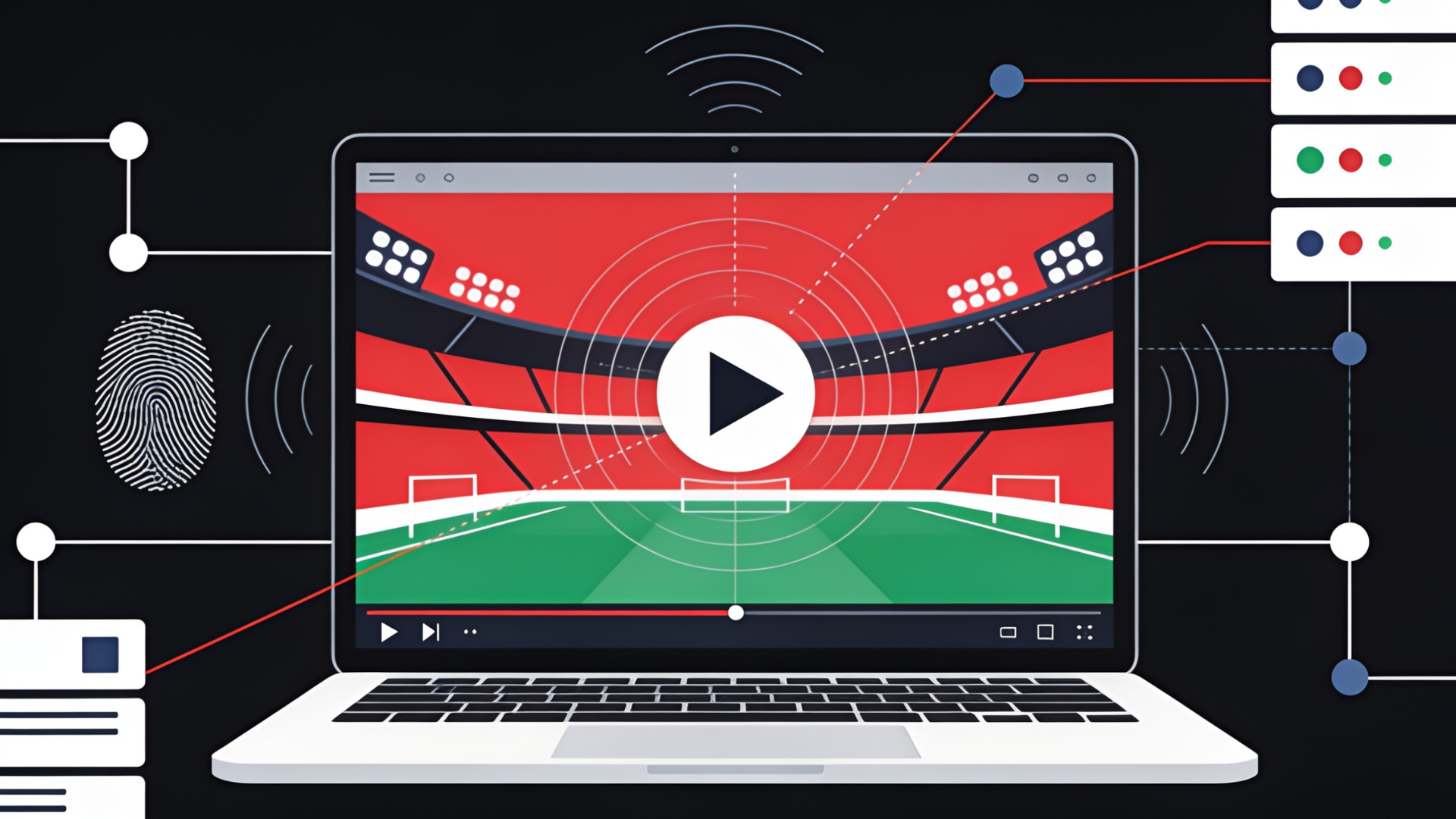
Every major sporting event, film premiere, or premium streaming release attracts unauthorized streams within minutes of going live.
For live sports and exclusive events, piracy is a race against time. An illegal stream does not need to remain available for several days to cause financial damage. If viewers can access it during the most valuable moments of a match, concert, or premiere, much of the commercial loss has already occurred.
Stopping streaming piracy is therefore no longer limited to sending legal notices after content has been stolen. Modern streaming platforms operate continuous anti-piracy systems designed to detect, identify, trace, and disrupt unauthorized streams while the content is still live.
Behind every major broadcast is an invisible surveillance and enforcement operation running alongside the streaming infrastructure.
Piracy Monitoring Happens Continuously
Streaming platforms no longer depend entirely on viewers or rights holders manually reporting illegal streams.
Dedicated anti-piracy systems continuously scan websites, pirate streaming portals, IPTV services, social media platforms, search engines, messaging channels, mobile applications, and online marketplaces for unauthorized broadcasts.
Monitoring usually intensifies during high-value events such as major football and cricket matches, pay-per-view fights, concerts, award shows, film premieres, and premium regional releases.
These systems attempt to locate illegal streams before they attract a large audience.
For on-demand content, discovering piracy within several hours may still be useful. For live events, however, detection speed is critical. A stream discovered after the final whistle has already delivered most of its value to the pirate audience.
Detection Begins Before the Event Goes Live
Anti-piracy work often starts well before viewers press play.
Rights holders may identify websites, social media accounts, IPTV operators, and online communities that have previously promoted unauthorized broadcasts. Search activity, domain registrations, promotional posts, subscription advertisements, and channel announcements can reveal where illegal streams are likely to appear.
This allows enforcement teams to create watchlists before an event begins.
A known piracy website may be monitored for new embedded players. A social media account may be watched for suspicious links. An IPTV service advertising access to an upcoming match may be investigated before the broadcast starts.
Pre-event intelligence helps platforms reduce the time between the appearance of an illegal stream and the first enforcement action.
Automated Crawlers Search for Unauthorized Broadcasts
One of the main tools used in piracy detection is automated web crawling.
Crawlers systematically scan public websites and search results for pages that appear to offer unauthorized access to protected content. They may search for combinations of programme titles, team names, event dates, and phrases commonly associated with illegal streaming.
These systems examine more than visible text. They can also inspect embedded video players, streaming URLs, redirect chains, page metadata, advertising scripts, hosting information, and links shared across multiple websites.
Pirate operators frequently create networks of pages that redirect viewers toward the same underlying stream. Automated systems can map these connections and identify clusters that may be controlled by the same operation.
However, crawlers work best on publicly accessible piracy. Streams hidden inside private messaging groups, closed forums, password-protected websites, or subscription-based IPTV services require different investigative methods.
Content Fingerprinting Identifies the Broadcast
Finding a suspicious video player does not automatically prove that it contains stolen content.
Platforms must determine whether the stream is actually carrying their broadcast. One of the most common methods is content fingerprinting.
Fingerprinting systems extract distinctive characteristics from audio or video and compare them with reference material supplied by the rights holder. These characteristics can include patterns derived from frames, motion, colour, commentary, music, and other elements of the broadcast.
The process is conceptually similar to identifying a song from a short audio sample. Even when the pirate stream has been resized, recompressed, cropped, mirrored, or recorded from another screen, the system may still recognize the underlying programme.
Fingerprinting is especially valuable on large platforms where thousands of videos may be uploaded or broadcast simultaneously. Instead of requiring a person to watch every stream, automated systems compare the content against protected reference files.
Pirates Attempt to Avoid Detection
Pirate operators know that content-matching systems exist, so they frequently manipulate streams to make identification more difficult.
They may crop the picture, mirror the video, alter the playback speed, change the audio pitch, cover channel logos, add borders, lower the resolution, or place the broadcast inside another visual frame.
Some services repeatedly switch between sources or camera feeds to interrupt consistent matching.
More advanced detection systems are designed to recognize content even after these changes. This creates a continuous technological contest. Detection tools become more resilient, while piracy operators search for new ways to reduce matching accuracy without making the stream unusable for viewers.
Watermarking Helps Trace the Source
Fingerprinting can establish that a stream contains protected content. Watermarking can help determine where the stolen copy originated.
Forensic watermarking inserts a subtle identifier into the video signal. The identifier may be unique to a distributor, platform, device, account, or viewing session. It is designed to remain detectable even after the content has been compressed, cropped, recorded, or redistributed.
When investigators recover an illegal stream, they can analyze the watermark and potentially trace it back to the source.
The watermark may reveal that the stream originated from a particular subscriber account, set-top box, commercial venue, geographic region, distribution partner, internal feed, or playback session.
The platform can then suspend the account, revoke the session, invalidate playback credentials, or investigate the associated distributor.
Watermarking is particularly useful against restreaming, where a legitimate subscriber captures an authorized broadcast and retransmits it to a much larger unauthorized audience.
Session Data Can Reveal Suspicious Behaviour
Streaming platforms can also analyze activity within their own systems.
A legitimate account that behaves unusually may indicate restreaming, credential theft, automation, or commercial misuse.
Warning signs can include unusually long viewing sessions, rapid changes in location, repeated token requests, abnormal device behaviour, simultaneous playback from incompatible locations, excessive data consumption, or frequent account resets.
No single signal necessarily proves piracy. A traveller, shared household, unstable connection, or accessibility tool may also create unusual patterns.
Platforms therefore combine multiple signals before taking action. The objective is to identify high-risk activity without disrupting legitimate customers.
Leaked Credentials and Playback Tokens Are Monitored
Some pirate services do not capture video from a screen. Instead, they attempt to obtain direct access to a platform’s streaming infrastructure.
This may involve stolen subscriber credentials, exposed playback URLs, compromised applications, leaked authentication tokens, or manipulated devices.
Streaming systems reduce this risk by using short-lived access tokens, encrypted connections, device authentication, digital rights management, and frequently refreshed playback credentials.
If a token or stream URL is discovered on a piracy website, the platform may invalidate it. The illegal stream then stops working, even if the piracy page remains online.
This is often faster than waiting for a website owner or hosting provider to remove the entire page.
Social Media Has Become a Major Detection Area
Unauthorized broadcasts increasingly appear on social platforms because they provide large audiences and immediate distribution.
A user can begin livestreaming a television screen, publish short clips, or direct viewers to an external piracy website within seconds. Accounts may use altered titles, unrelated thumbnails, coded language, or private groups to avoid detection.
Platforms and rights holders use automated matching, keyword monitoring, account analysis, and user reports to locate these streams.
Once detected, the platform may end the livestream, mute protected audio, remove the post, restrict its visibility, or suspend the account.
Piracy accounts are often temporary. When one account disappears, another may appear under a different name. Enforcement systems must therefore examine networks, recurring behaviour, and account relationships rather than focusing only on individual profiles.
IPTV Piracy Is More Difficult to Observe
Illegal IPTV services present a different challenge from open streaming websites.
These services often sell subscriptions that provide access to hundreds or thousands of television channels through private applications, set-top boxes, playlists, or login credentials.
Because the streams are distributed behind a paywall, investigators may need to purchase access, inspect applications, monitor reseller groups, or enter closed online communities.
Once inside, they may collect evidence about available channels, stream quality, server locations, payment methods, customer-support channels, applications, reseller networks, and possible upstream content sources.
The objective is not only to remove individual streams but also to understand the commercial organization behind the service.
A large IPTV operation may involve source suppliers, hosting providers, application developers, payment processors, resellers, and customer-acquisition networks spread across several countries.
Enforcement Targets the Supporting Infrastructure
Removing a single stream is useful, but sophisticated anti-piracy programmes attempt to disrupt the wider operation supporting it.
An illegal streaming service may depend on domains, hosting providers, advertising networks, payment processors, social accounts, search visibility, mobile applications, and reseller communities.
Rights holders may send notices to hosting companies, platforms, search engines, registrars, payment providers, advertisers, and other intermediaries connected to the service.
Disrupting payment processing can make it difficult for an IPTV operator to collect subscription revenue. Removing domains from search results can reduce discovery. Suspending social accounts can weaken customer acquisition. Terminating hosting can take entire services offline.
Piracy enforcement is therefore increasingly focused on networks rather than isolated links.
Takedown Notices Must Move Quickly
Once an unauthorized stream has been verified, enforcement teams may issue a takedown notice to the relevant website, platform, hosting provider, or intermediary.
The notice normally identifies the protected work, explains the rights holder’s claim, and provides the location of the infringing stream.
For live events, the process must happen rapidly. Traditional notice systems designed for static files may be too slow when the commercial value of the content lasts only a few hours.
Some platforms maintain dedicated channels for trusted rights holders, allowing verified live-piracy reports to receive faster review. Automated systems may also generate notices immediately after a match is confirmed.
However, response speed varies between platforms, hosting companies, and jurisdictions. A responsive social network may remove a stream within minutes, while an uncooperative overseas host may ignore repeated requests.
Dynamic Blocking Can Restrict Access During Live Events
In some regions, rights holders can seek legal orders requiring internet service providers to block access to piracy infrastructure.
Unlike a traditional order that lists a fixed set of domains, a dynamic blocking order may allow newly discovered domains, servers, or IP addresses to be added during the protection period.
This is particularly useful because pirate operators frequently change domains and infrastructure during live events.
A blocked website may reappear under a new address within minutes. Dynamic systems allow enforcement teams to respond without beginning a completely new legal process for every domain.
Blocking does not remove the pirate service from the internet. Instead, it limits access through participating networks.
Pirates may still attempt to bypass restrictions using mirror domains, proxy services, virtual private networks, or rapidly changing server infrastructure. Blocking is therefore most effective when combined with source identification, takedowns, watermarking, payment disruption, and account enforcement.
Human Analysts Remain Essential
Although automation performs much of the scanning and matching, human investigators remain important.
Automated systems can incorrectly identify legitimate uses of content. A news report, commentary programme, review, reaction video, educational clip, or authorized partner stream may contain material that resembles a protected broadcast.
Analysts review uncertain cases, validate evidence, investigate complex networks, and decide which enforcement method is appropriate.
Human judgment is especially important when ownership is unclear, several distributors hold different territorial rights, a clip may qualify for a legal exception, or the suspected source is an authorized partner.
A fast system that removes lawful content can damage creators, customers, partners, and the platform’s reputation. Effective anti-piracy operations must therefore balance speed with accuracy.
Piracy Detection Has Geographic Limitations
Streaming rights are often divided by territory, language, platform, and distribution window.
A service may own rights to an event in one country but not another. A stream that is unauthorized in one market may originate from a legitimate broadcaster in a different region.
This makes enforcement more complicated.
Anti-piracy systems must understand which company controls which rights, in which territory, during which period, and on which platform. Incorrect rights data can lead to invalid takedown requests or conflicts between legitimate distributors.
Piracy enforcement therefore depends not only on surveillance technology but also on accurate rights-management information.
Detection Does Not Automatically Eliminate Piracy
Even the most advanced monitoring systems cannot guarantee that every illegal stream will disappear.
Pirates continually adapt by moving into private groups, changing domains, rotating servers, creating new user accounts, using offshore infrastructure, encrypting communications, and restreaming from several legitimate sources.
Enforcement is therefore an ongoing process rather than a one-time solution.
The realistic objective is to reduce availability, increase operating costs, disrupt audience growth, shorten the lifespan of illegal streams, and make piracy less reliable for viewers.
For live events, even a partial reduction can be commercially meaningful. Interrupting a stream during the first half of a match may prevent thousands of viewers from relying on the same source for the remainder of the event.
The Viewer Experience Also Matters
Technology alone cannot solve piracy.
Some viewers turn to unauthorized services because legal access is unavailable, fragmented, difficult to understand, or priced beyond their expectations. A single sporting competition may be divided across several broadcasters, while films and series move between services as rights windows change.
Improving the legal customer experience can reduce the appeal of piracy.
Clear pricing, reliable playback, broad device support, accessible regional packages, easy subscription management, transparent availability, consistent video quality, and responsive customer support all make legal services more competitive.
Enforcement can make illegal streams harder to access. A strong legal service gives viewers a reason not to search for them in the first place.
Anti-Piracy Is Becoming Part of the Streaming Stack
Content protection was once treated mainly as a legal and compliance function. It is now increasingly integrated into the technical operation of streaming platforms.
Modern anti-piracy programmes combine web monitoring, fingerprinting, watermarking, account analytics, device security, digital rights management, token protection, platform reporting, infrastructure investigation, and legal enforcement.
These systems operate alongside encoding, content delivery, playback, monetization, and audience analytics.
The result is a parallel infrastructure whose purpose is not to deliver the stream, but to control where the stream travels after delivery.
The Future of Streaming Surveillance
As piracy operations become more automated, anti-piracy systems will also become faster and more predictive.
Detection may increasingly focus on identifying piracy infrastructure before a broadcast begins. Machine-learning systems can map relationships between domains, accounts, payment channels, applications, and hosting providers to uncover networks that would be difficult to recognize manually.
Watermark extraction may become faster, allowing platforms to identify and terminate the source of a restream in near real time. Automated evidence collection may also help rights holders coordinate enforcement across several platforms and jurisdictions simultaneously.
At the same time, these systems will face growing expectations around transparency, proportionality, privacy, and appeal mechanisms. Aggressive surveillance and automated removal can create serious problems when legitimate users or lawful content are incorrectly targeted.
The challenge is therefore not simply to build stronger enforcement. It is to build enforcement that is fast, accurate, accountable, and technically resilient.
What This Means for Streaming
The battle against streaming piracy is no longer fought only in courtrooms after content has been copied.
It now unfolds live.
While viewers watch a sporting event or premium release, anti-piracy systems scan the web, compare content fingerprints, extract watermarks, analyze suspicious sessions, trace leaked credentials, issue takedown notices, and disrupt the infrastructure carrying unauthorized streams.
Piracy operators respond by changing domains, modifying video, rotating accounts, and moving into private networks. Platforms respond with faster detection, stronger playback security, dynamic blocking, and broader infrastructure enforcement.
Streaming piracy may never disappear completely. However, the speed at which illegal streams are identified and disrupted can determine whether they remain commercially useful.
In the streaming era, protecting content is no longer only about controlling the original file. It is about monitoring the entire journey of the broadcast, from the authorized playback session to every unauthorized screen attempting to redistribute it.
The Streaming Wars is intentionally ad-free
We don’t run display ads. Not because we can’t, but because we don’t believe in them.
They interrupt the reading experience. They cheapen the work. And they burn advertisers’ money on impressions nobody actually wants.
So we chose a different model.
We say the things people in this industry are already thinking but don’t say out loud. We connect the dots beyond the headline and focus on explaining why things matter to the people working in this business.
If you believe industry coverage can exist without clutter and interruption, you can support it here → SUPPORT TSW.
Support is optional. But it directly funds research and continued coverage — and helps prove this model can work.
Support TSW →


