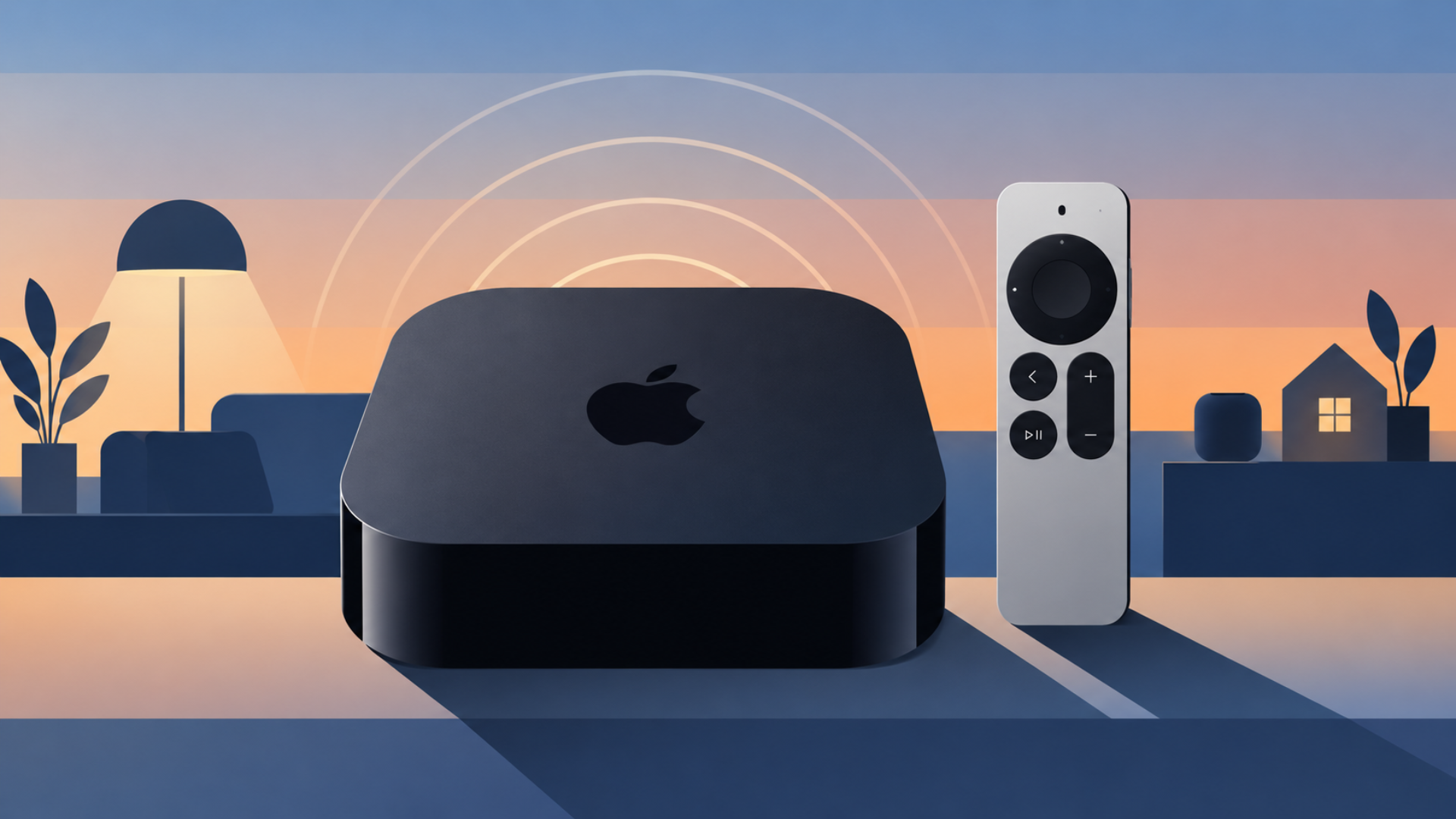
Apple introduced a $299 Apple TV 4K with three far-field microphones, an A19 chip and hands-free Siri AI, with availability beginning November 13. The new box can answer questions about programming, recommend shows and control Apple Home devices without the viewer touching a remote.
Apple gains another way to steer discovery and sell connected-home products and services to households already using its devices. The price also reinforces a long-standing limitation: Apple TV remains a premium niche hardware product in a market where controlling the TV OS at scale has become a valuable advertising and subscription business.
Apple’s $299 Price Keeps tvOS Out of the Mass-Market OS Race
The third-generation Apple TV 4K launched at a starting price of $129 in 2022. The fourth-gen model costs $299, even as most smart TVs ship with an OS and cheaper Roku, Fire TV and Google streaming devices offer another route into the living room.
Apple TV appeals to customers who value performance, a cleaner interface and tight integration with iPhones, AirPods and HomePods. It also benefits from a loyal base of Apple diehards willing to pay a premium. At $299, that loyalty helps sustain premium hardware pricing while doing little to expand tvOS beyond Apple’s existing customer base.
The company has not made tvOS a widely licensed operating system for TV manufacturers, and it doesn’t disclose Apple TV hardware sales or active households. Its streaming service reaches far beyond its own boxes, but those viewers encounter Apple inside interfaces run by other companies.
Apple already has established payment relationships with its customers, a well-designed TV operating system, powerful hardware and cross-device identity. A cheaper device lineup or partnerships with TV manufacturers could have put tvOS on millions more screens, giving Apple greater control over streaming discovery, app placement and subscription sales.
Apple’s decision to prioritize premium boxes and original programming over broad TV operating-system distribution left that opportunity open to rivals. The $299 launch confirms that Apple still isn’t pursuing it.
Roku Monetizes 100 Million Households While Apple Keeps tvOS Tied to Premium Hardware
Roku’s OS now reaches more than 100 million streaming households worldwide through players and TVs. In the second quarter of 2026, Roku generated $1.22 billion in platform revenue from advertising and subscriptions, compared with $134 million in device revenue.
Roku uses inexpensive hardware and TV-manufacturer licensing to expand distribution, then monetizes that reach through advertising, subscription relationships and control of the TV interface. Platform revenue carries the business, reducing its dependence on hardware sales.
Apple had the financial resources, technology and customer relationships to pursue broader distribution. Instead, it concentrated tvOS on premium hardware, leaving Roku, Amazon and TV manufacturers to build much larger footprints. Apple now distributes its own streaming service through Roku, Fire TV and Prime Video Channels, where other companies influence discovery, merchandising and the customer relationship.
Hands-Free Siri Gives Apple More Control Over Discovery Inside tvOS Homes
Previous Apple TV 4K models relied on the Siri Remote for voice input. The new model adds three far-field microphones to the box, with echo cancellation that allows viewers to speak while a show is playing.
Siri AI can answer questions about Emmy winners, provide information about a program and use personal context from an Apple Intelligence-enabled iPhone or iPad to retrieve a show recommended by a friend.
Those requests can influence what viewers watch before they enter a streaming app. Apple’s interface presents the answers and recommendations, giving it influence over which participating services and titles viewers discover.
TV operating systems already merchandise programming before the app opens. Siri adds conversational discovery to that existing layer. Participating streaming services need their catalogs integrated with Apple’s search and discovery systems to benefit from the experience.
For Apple, better discovery increases the utility of tvOS and creates more opportunities to influence viewing. For streaming services, it introduces another interface that can shape the viewer’s decision before their app opens.
Siri AI is also available in beta on second-generation Apple TV 4K hardware and later. The $299 model adds roomwide voice access, a faster chip, dedicated AV1 decoding and four-speaker HomePod support. Apple is charging for a more capable hardware experience rather than exclusive access to its new assistant.
HomePods and iCloud+ Give Apple More Ways to Monetize Each TV Household
Apple introduced the new box alongside HomeView, HomePod mini 2 and a collection of smart-home accessories developed with LG and Schneider Electric. Apple TV now serves as another hands-free endpoint for Apple Home, extending the role it already played as a home hub.
Viewers can use Siri to trigger smart-home scenes, see compatible doorbell video, speak to visitors and control connected locks. The box can also pair with four eligible HomePods for surround sound, with matching front and rear speaker pairs automatically calibrated to the room.
Apple Intelligence can generate descriptions of HomeKit Secure Video camera activity and summarize notifications. Those capabilities require setup using an Apple Intelligence-enabled iPhone or iPad and an eligible iCloud+ subscription.
The connected-home features give Apple more opportunities to sell HomePods and maintain iCloud+ subscriptions. Third-party cameras, locks and other accessories can increase engagement with Apple Home, strengthening the customer’s reliance on Apple devices and services.
Apple has also bundled its streaming service into iCloud+ plans in more than 100 participating markets, although the U.S., U.K., Canada and Australia remain outside that rollout. Apple can use programming, storage and connected-home services to support a broader subscription relationship.
A household buying the $299 box can add HomePods, maintain paid storage and subscribe to other Apple services. Those purchases increase the economic value of the customer relationship without requiring Apple to match Roku’s distribution scale.
The tradeoff remains reach. Apple can generate more spending inside households already committed to its products while leaving most TV operating-system distribution to competitors.
Roomwide Siri Makes Privacy and AI Costs Part of Apple’s TV Economics
Adding far-field microphones to the box makes voice-data protections more consequential. Apple says Secure Exclaves isolate microphone processing from tvOS and apps, while Siri requests can run on-device or through Private Cloud Compute. HomeKit Secure Video footage remains end-to-end encrypted.
Those protections support Apple’s pitch as Siri accesses personal context and controls cameras, doorbells and locks. Reliability and trust become commercial requirements when the box is expected to manage household activity throughout the day.
Apple has separately disclosed daily usage limits on certain Siri AI capabilities that rely on server-side models and plans to charge for expanded access in the future. It hasn’t announced an Apple TV-specific fee or identified which TV requests could be subject to additional charges.
Cloud inference introduces recurring computing costs, giving Apple another reason to manage usage and potentially charge customers who make heavier use of its AI services.
The Streaming Wars Take
Roku is already incorporating AI into search to interpret broad, conversational requests based on mood and context. That puts Apple and Roku on a similar product path, with a major difference in distribution. Roku can extend conversational discovery across a much larger TV footprint while monetizing the resulting engagement through advertising, subscriptions and merchandising.
Streaming services will increasingly need accurate metadata, availability information and deep links across these AI-driven interfaces. Their integration priorities and promotional spending will still depend on how many viewers each operating system reaches and how much viewing or subscription activity it can generate.
Apple’s $299 hardware strategy limits its bargaining power in those conversations. Wider tvOS distribution would require cheaper devices, TV-manufacturer licensing or partnerships that put Apple’s interface on screens it doesn’t manufacture. Those approaches would introduce new distribution costs and potentially require Apple to share economics with hardware partners.
Apple has chosen a different commercial path. It can make its existing TV households more valuable through HomePods, iCloud+, entertainment services and potentially paid AI access. Meanwhile, Roku and other widely distributed operating systems retain the larger opportunity to monetize home-screen inventory, subscription relationships and advertising across the TV market.
Three microphones give Apple more control inside the homes that buy its box. They don’t give tvOS the distribution Apple once had the resources to pursue.
The Streaming Wars is intentionally ad-free
We don’t run display ads. Not because we can’t, but because we don’t believe in them.
They interrupt the reading experience. They cheapen the work. And they burn advertisers’ money on impressions nobody actually wants.
So we chose a different model.
We say the things people in this industry are already thinking but don’t say out loud. We connect the dots beyond the headline and focus on explaining why things matter to the people working in this business.
If you believe industry coverage can exist without clutter and interruption, you can support it here → SUPPORT TSW.
Support is optional. But it directly funds research and continued coverage — and helps prove this model can work.
Support TSW →