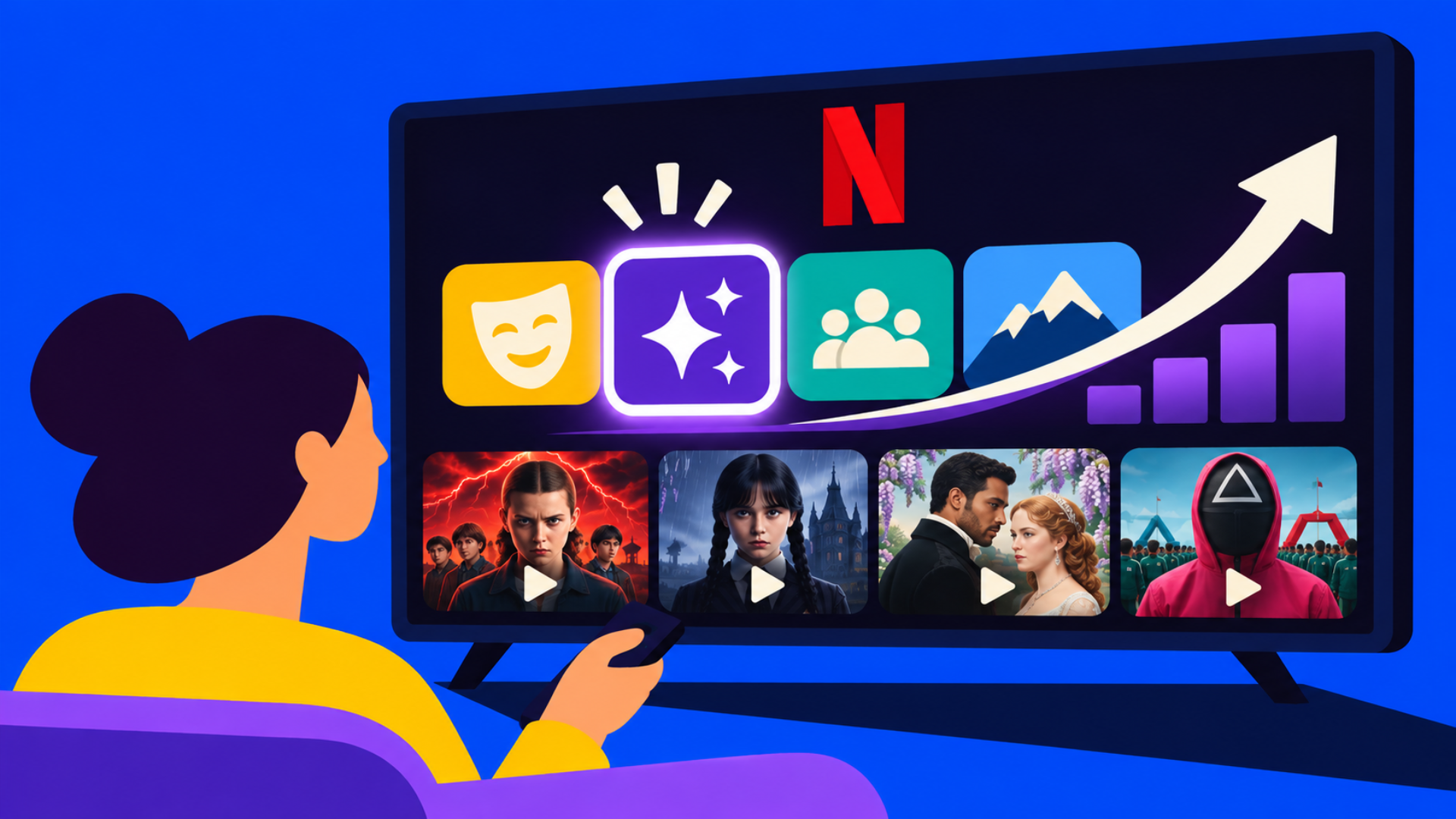
Netflix is introducing AI Discover, a new TV-app experience that turns subscribers’ immediate viewing preferences into personalized recommendations and refines them through real-time feedback. With viewing hours growing 2% in the first half of 2026 and approximately $20 billion in planned annual cash content spending, Netflix has an incentive to generate more consumption from programming it already produces and licenses.
The feature began rolling out November 3 to a small group of U.S. members using Netflix in English on supported TVs, with access expanding over the coming weeks.
Netflix’s Revenue Growth Is Outpacing Viewing-Hour Growth
Netflix members watched more than 97 billion hours of programming in the first half of 2026, up 2% year over year. That improved on the 1.5% growth recorded across 2025, but consumption continues to grow considerably more slowly than revenue.
Third-quarter revenue increased 12% to $12.9 billion, driven primarily by membership growth, higher subscription pricing, and advertising. Netflix acknowledged investor concerns about viewing-hour growth in its October shareholder letter and identified accelerating that growth as a priority.
The company continues to demonstrate pricing power and healthy retention. Its ability to increase revenue despite modest viewing growth reflects the strength of its subscription business, although additional consumption could provide greater support for retention and advertising revenue.
Netflix also expects to invest approximately $20 billion in cash on content during 2026, roughly 10% more than the previous year. That spending covers original productions, licensed programming, and an increasingly broad entertainment offering.
Improving discovery offers another way to increase the productivity of those investments.
A movie or series that attracts additional viewing after its initial promotional window generates more engagement from an existing content investment. For programming that Netflix has already financed or licensed, better recommendations can increase consumption without requiring the company to acquire another title to fill the same viewing occasion.
AI Discover targets that opportunity by making recommendations more responsive to what subscribers want during an individual session.
Real-Time Intent Gives Netflix Information Its Existing Algorithms Must Infer
Netflix already uses viewing history, ratings, title characteristics, time of day, device information, and other behavioral signals to personalize recommendations.
AI Discover adds more explicit information about a subscriber’s immediate preferences.
The experience presents AI-generated themes such as “Something Light,” “Scare Me,” “Family Movie Night,” and “Quick Watches.” Other themes can reflect trending programming, recent viewing activity, and individual tastes.
Each theme includes a preview clip. Selecting one produces matching recommendations, followed by more specific themes that allow viewers to refine their selections. A “Something Different” option generates another set of suggestions.
Netflix is also introducing a “Tune Your Recommendations” button alongside individual titles. Viewers can keep a recommendation or tell Netflix to stop suggesting that title within AI Discover. The system remembers those choices and adjusts subsequent recommendations.
The additional information can help resolve a limitation of historical personalization.
Someone who regularly watches crime dramas might want a family comedy on a particular evening. Existing viewing behavior provides a strong indication of general preferences, but an explicit theme selection tells Netflix what the subscriber wants during that session.
Subsequent refinements add more context, while rejected recommendations provide direct feedback about what isn’t relevant.
Netflix’s new intelligence layer processes those interactions in real time and adjusts the discovery experience.
The initial interface also accommodates the limitations of TV navigation. Rather than requiring subscribers to enter detailed prompts with a remote, AI Discover uses selectable themes that gradually narrow the available choices.
That approach builds on Netflix’s 2025 TV interface redesign, which introduced more responsive recommendations, simplified navigation, and a flexible layout designed to accommodate the company’s expanding entertainment offering.
Better Discovery Can Extend the Commercial Life of Licensed Programming
Netflix continues expanding its catalog through third-party licensing agreements and distribution partnerships.
Its recent Disney licensing arrangement brought additional library programming to the service, including all five Ice Age films, which reached Netflix’s global weekly Top 10. The company’s TF1 partnership in France has also produced encouraging early results, with Netflix indicating that the integration is generating incremental viewing.
Those arrangements expand the range of programming available to subscribers. They also increase the importance of connecting viewers with relevant titles across a growing catalog.
AI Discover could create more opportunities for older or less prominently promoted programming to attract attention.
A familiar comedy might satisfy a request for something light. A licensed family film could fit a weekend viewing occasion. A documentary with a shorter runtime might become relevant when a subscriber indicates limited available time.
These recommendations depend on Netflix’s ability to understand programming through characteristics such as tone, subject matter, audience suitability, and runtime.
More context-sensitive discovery increases the usefulness of accurate descriptive metadata, particularly for titles that don’t generate enough recent viewing activity to dominate conventional recommendations.
It also reinforces Netflix’s control over how programming reaches its audience.
Studios and other rights holders supply content, while Netflix determines how titles appear, which recommendations receive priority, and how viewer feedback influences subsequent exposure.
As the economics of recommendation engines demonstrate, ranking decisions allocate valuable screen space across programming that may have cost billions to produce, acquire, and market.
More responsive ranking could give Netflix additional flexibility to distribute audience attention across that investment.
The Business Case Depends on Incremental Viewing, Not More Recommendation Clicks
Netflix is introducing AI Discover as a dedicated testing environment. The company plans to evaluate new discovery capabilities through member usage and feedback, with successful features potentially moving into its main TV experience.
That structure lets Netflix experiment without immediately changing the primary interface used by its broader subscriber base.
The commercial test is whether the new recommendations generate meaningful additional consumption.
A subscriber selecting more titles through AI Discover doesn’t automatically translate into higher engagement. The feature could simply redirect viewing from one title to another without increasing the total amount watched.
Likewise, a recommendation that produces a quick playback start followed by immediate abandonment offers limited evidence of improved satisfaction.
The more consequential measures involve incremental viewing hours, sustained playback, repeat usage, and longer-term subscriber behavior.
Those outcomes would help determine whether AI Discover increases consumption beyond what Netflix’s existing recommendation system already produces.
Real-time AI recommendations also introduce operating expenses associated with inference, infrastructure, and ongoing experimentation. Netflix hasn’t disclosed the cost of running AI Discover or provided performance data demonstrating an improvement over its existing discovery experience.
The financial case for broader deployment would depend on whether the additional engagement justifies those costs.
Netflix has reason to evaluate the results carefully. Its recommendation system already operates at enormous scale, and incremental improvements become harder to identify when the existing experience performs well.
A new discovery feature needs to generate enough additional subscriber value to justify replacing or supplementing established recommendation methods.
The Streaming Wars Take
AI Discover could give subscribers more influence over which titles receive prominent placement within Netflix’s TV interface.
Today, Netflix balances personalized recommendations with merchandising priorities surrounding new originals, major licensed acquisitions, and established catalog programming.
If real-time intent proves effective, Netflix could incorporate more responsive recommendations into its primary interface, changing how promotional space gets allocated.
That would introduce a more direct tradeoff between promoting titles Netflix wants to feature and responding to what individual subscribers indicate they want to watch.
For studios and licensors, greater reliance on contextual recommendations could increase the commercial importance of detailed metadata and content characteristics. Titles capable of satisfying a broader range of viewing occasions would have more opportunities to surface, while Netflix would retain control over ranking decisions and the underlying audience data.
The financial implications depend on whether that flexibility produces viewing that wouldn’t otherwise occur.
Netflix’s existing catalog represents a substantial committed investment. Better discovery can increase its productivity, but the company needs measurable gains in sustained viewing to establish that AI Discover improves the economics.
The strongest outcome would be additional engagement from programming that already sits in the catalog, achieved at a recommendation cost that preserves the incremental benefit.
That would give Netflix more room to generate viewing growth from its current content investments while maintaining discipline over future spending.
The Streaming Wars is intentionally ad-free
We don’t run display ads. Not because we can’t, but because we don’t believe in them.
They interrupt the reading experience. They cheapen the work. And they burn advertisers’ money on impressions nobody actually wants.
So we chose a different model.
We say the things people in this industry are already thinking but don’t say out loud. We connect the dots beyond the headline and focus on explaining why things matter to the people working in this business.
If you believe industry coverage can exist without clutter and interruption, you can support it here → SUPPORT TSW.
Support is optional. But it directly funds research and continued coverage — and helps prove this model can work.
Support TSW →