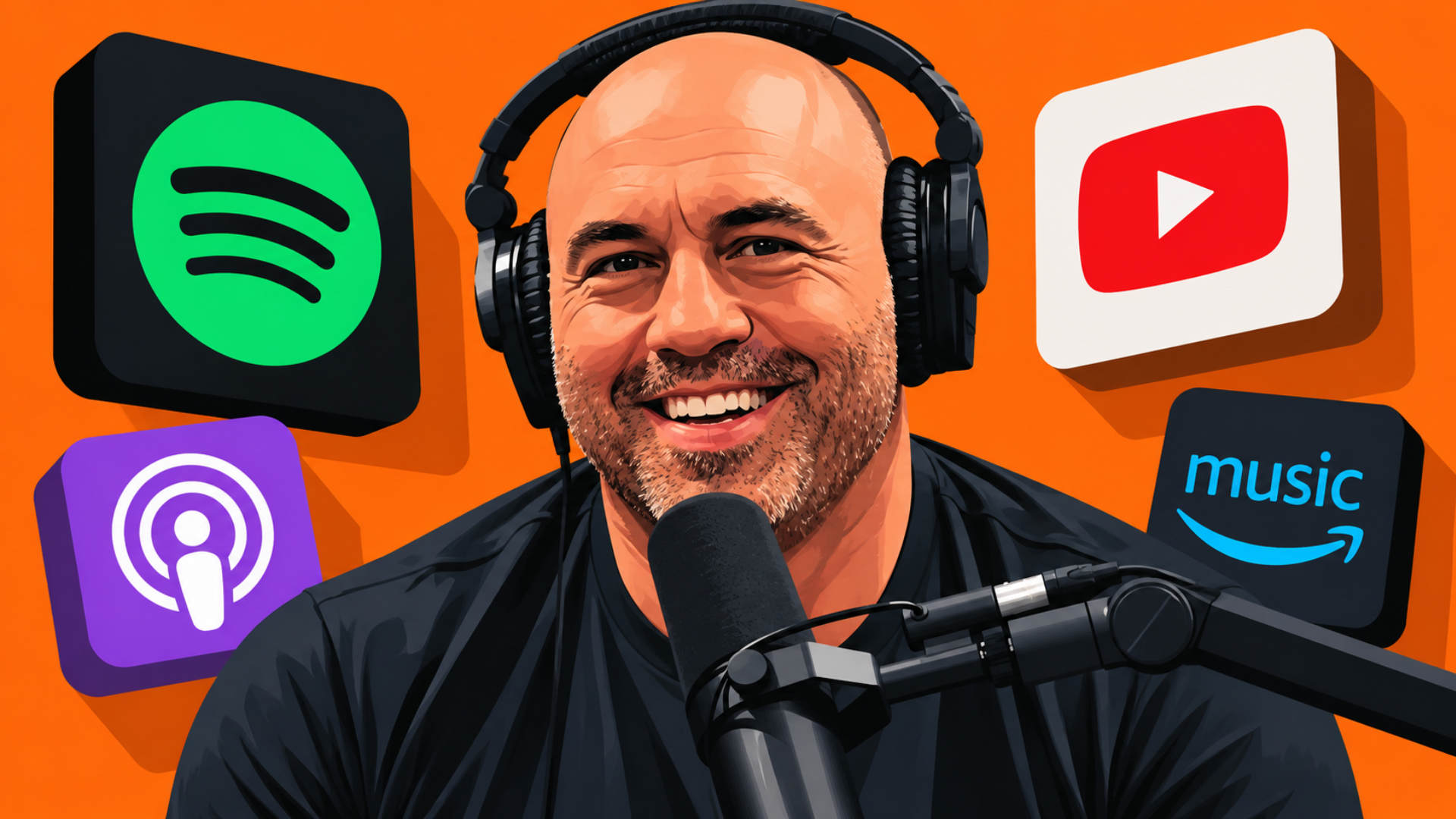
Spotify has renewed its multiyear licensing agreement for The Joe Rogan Experience, retaining its advertising-sales and licensing role while keeping the show available on YouTube, Apple Podcasts, Amazon Music, and other services. The agreement extends the distribution model Spotify adopted in 2024, allowing it to sell advertising around Rogan’s audience without requiring listeners to consume the show exclusively on Spotify.
The renewal preserves Spotify’s commercial relationship with one of podcasting’s largest franchises while leaving competing services free to distribute the programming and capture audience engagement.
Spotify’s Rogan Economics Depend on Advertising Beyond Its Own App
The Joe Rogan Experience has more than 18 million followers on Spotify and over 21 million YouTube subscribers. It also ranked first among U.S. podcasts by reach in Edison Research’s second-quarter 2026 rankings.
Those figures measure different audiences and can’t be combined into a unique listener total. They do establish Rogan’s substantial presence across competing distribution services, giving Spotify a larger potential advertising audience than it could reach through exclusive distribution.
Financial terms of the renewal weren’t disclosed. The Wall Street Journal described the new agreement as having terms similar to the previous deal, which carried an estimated potential earnout of $250 million.
That makes advertising performance central to the investment. Spotify needs to generate sufficient revenue from sponsorships, advertising inventory, and licensing to justify the financial commitments attached to the agreement.
Broader distribution gives advertisers access to consumers who prefer watching Rogan on YouTube or listening through other podcast apps. Spotify can represent that audience commercially without requiring those consumers to adopt its own service.
At its May 2026 investor day, Spotify said its podcast business had entered its second year of profitability and identified publishing and advertising sales as important parts of its operation.
The Rogan agreement gives that publishing business one of the most recognizable properties in audio and video. Its financial performance will depend on advertiser demand, pricing, and the contractual economics of the licensing arrangement, which remain undisclosed.
YouTube Gains Audience Engagement While Spotify Retains Advertising Rights
Spotify originally secured exclusive distribution of Rogan’s show in 2020, using the programming to differentiate its service and attract listeners.
The 2024 renewal opened distribution to competing services while preserving Spotify’s commercial role. The latest agreement confirms that Spotify intends to continue operating under that structure.
For YouTube, Rogan generates recurring long-form viewing, search activity, and recommendation opportunities. The service benefits from having his programming available to viewers who already use YouTube as a primary destination for video podcasts.
Spotify retains the licensing and advertising-sales relationship with Rogan, giving it access to commercial opportunities generated across that broader audience.
The arrangement comes as Spotify continues investing in video podcasting within its own service. Its expansion of video-podcast monetization has created additional revenue opportunities for creators through advertising and payments tied to engagement.
Those investments support consumption inside Spotify. The Rogan agreement extends the company’s commercial presence into audiences consuming content through other services.
That approach also carries a tradeoff. YouTube controls discovery, recommendations, and the viewing relationship for audiences watching Rogan there. Spotify can sell advertising associated with the show, but it doesn’t control every environment where the content is consumed.
The company must maintain the value of its advertising representation while competing with YouTube for podcast viewing and creator relationships.
Rogan’s Distribution Flexibility Strengthens His Negotiating Position
Keeping the show available across multiple services gives Rogan a larger set of established audience relationships.
His viewers can continue watching through YouTube, while audio listeners can use Spotify, Apple Podcasts, Amazon Music, or other podcast apps.
That reach gives Rogan additional bargaining power in future licensing negotiations. His audience doesn’t depend on a single service for access, reducing the importance of exclusive distribution when evaluating potential commercial partners.
Spotify retains an advantage through its advertising infrastructure, established advertiser relationships, and ability to represent a major podcast franchise across different listening environments.
Those capabilities become increasingly important when competing to retain established creators.
A podcast with a large audience can generate interest from multiple commercial partners. Spotify must demonstrate that its sales operation can produce enough incremental revenue to justify the compensation and rights it negotiates.
The renewal indicates that both parties see value in continuing the arrangement. Spotify secures a commercially valuable podcast franchise, while Rogan preserves broad distribution and access to Spotify’s advertising operation.
For Spotify, retaining those rights also requires accepting that the show’s audience will continue generating engagement for competing services.
The Streaming Wars Take
Major podcast creators now have a stronger negotiating precedent for preserving broad distribution while selling advertising and licensing rights through a commercial partner.
That could increase pressure on podcast publishers and sales organizations to compete through advertising guarantees, sponsorship pricing, audience measurement, and revenue performance.
Spotify’s challenge is demonstrating that its commercial infrastructure produces enough additional revenue to justify expensive licensing agreements with creators who already command large audiences across multiple services.
YouTube has a different advantage. It can capture viewing activity, strengthen recommendations, and attract advertisers through its own video business without acquiring exclusive distribution rights to every major podcast.
As more podcast consumption moves toward video, creators with established audiences across services will have greater flexibility in deciding which companies distribute their content and which companies sell advertising around it.
Spotify’s Rogan renewal commits it to competing on the commercial side of that relationship. The financial return will depend on how effectively its advertising business converts multiplatform reach into revenue after accounting for the cost of securing the rights.
That puts sponsorship performance and licensing economics at the center of future negotiations with major podcast talent, where broad distribution is increasingly something creators can preserve while demanding substantial compensation for commercial rights.
The Streaming Wars is intentionally ad-free
We don’t run display ads. Not because we can’t, but because we don’t believe in them.
They interrupt the reading experience. They cheapen the work. And they burn advertisers’ money on impressions nobody actually wants.
So we chose a different model.
We say the things people in this industry are already thinking but don’t say out loud. We connect the dots beyond the headline and focus on explaining why things matter to the people working in this business.
If you believe industry coverage can exist without clutter and interruption, you can support it here → SUPPORT TSW.
Support is optional. But it directly funds research and continued coverage — and helps prove this model can work.
Support TSW →