


Netflix, Disney+ and Amazon are raising streaming prices by less than they were three years ago, while widening the price gap between ad-supported and ad-free subscriptions. Ampere Analysis found that the average increase across the three companies fell from 24% of the previous subscription price in 2023/24 to 14% in 2025/26. The change coincides with a more valuable pricing lever: giving price-sensitive subscribers a cheaper place to stay while charging more to viewers willing to pay to avoid advertising.
The Price Ladder Now Determines How a Subscriber Gets Monetized
The average dollar increase across Netflix, Disney+ and Amazon has barely moved compared with the decline in percentage increases. It fell from $1.67 in 2023/24 to $1.54 in 2025/26, according to Ampere.
Over the past three years, ad-free plans received average increases of $1.62, compared with $1.21 for ad-supported plans. Across markets where the three services offer advertising tiers, the average gap between ad-supported and ad-free pricing widened from $4.53 in August 2023 through July 2024 to $5.35 in August 2025 through July 2026.
Netflix provides the clearest example in the U.S. The difference between Standard with Ads and Standard increased from $8.50 in August 2023 to $11 by July 2026.
That creates two different monetization paths inside the same streaming service. A household with greater price sensitivity can remain subscribed at a lower monthly price while generating advertising inventory. A household with a stronger preference for an uninterrupted experience pays an increasingly large premium.
The price ladder therefore gives services somewhere to send a subscriber who rejects the premium price without necessarily losing the customer.
That becomes more valuable as subscriber acquisition gets harder. A price increase on a single-tier product forces the customer toward a binary decision: pay or cancel. A sufficiently large gap between tiers adds a third option: downgrade.
Ad-Supported Pricing Has Become a Retention Tool
Keeping the advertising tier relatively cheap carries an opportunity cost because the service gives up subscription revenue. Advertising can recover some or all of that difference while reducing the pressure to extract additional dollars directly from the subscriber.
Netflix’s own results show how those revenue streams are increasingly operating together. Q2 2026 revenue increased 13% year over year to $12.6 billion, driven by membership growth, pricing and increased advertising revenue. Netflix has continued expanding its advertising business while integrating programmatic buying, additional formats and its own ad technology into the service.
The economic objective increasingly centers on total revenue generated by a viewer rather than the subscription fee in isolation. Ad tiers have put revenue per viewer at the center of streaming economics, particularly as a subscription payment and advertising impressions can monetize the same household simultaneously.
A lower-priced tier can protect the size of the addressable audience, reduce the economic penalty of a downgrade and create more impressions to sell. The service can then push harder on the ad-free tier, where customers are effectively paying for both the content and the removal of advertising.
The growing premium for ad-free viewing starts to resemble an explicit price on avoiding monetization through ads.
Advertising Gives Streamers Another Place to Look for ARPU
Subscription pricing once carried more of the burden of increasing revenue from an established customer base. Advertising, paid sharing, bundles and other forms of monetization have added alternatives.
Ampere expects ad-supported subscription tiers to generate more than $45 billion in North American revenue during 2026, including more than $18 billion from advertising. That would put ad-supported tiers at 54% of subscription-streaming revenue in the region.
Netflix’s integration of advertising into its core model shows where the economics can go when a service already has global subscription scale. Content, distribution infrastructure and the customer relationship already exist. Advertising adds another revenue source against viewing taking place inside that existing cost structure.
It also creates a different constraint. More ad-supported viewers don’t automatically produce proportionally more advertising revenue. Inventory has to be sold at attractive rates.
Streaming CPMs declined 4.9% during the 2026 upfront, according to Media Dynamics estimates, even as streaming captured more advertiser commitments. Growing CTV inventory, FAST supply and programmatic availability give buyers more alternatives. Streaming’s larger share of upfront spending is therefore increasing the importance of sell-through, targeting and measurement.
Keeping ad-supported subscriptions inexpensive works best when the advertising operation can monetize the additional viewing without flooding the market with inventory or degrading the customer experience.
Disney’s Smaller Increases Show How Quickly the Equation Can Change
Disney+ recorded the sharpest deceleration in Ampere’s data. Its average increase fell from $1.86, or 31%, in 2023/24 to $1.45, or 13%, in 2025/26.
Disney has more ways to monetize the relationship than subscription pricing alone. Disney+ increasingly connects streaming with advertising, ESPN, commerce and the company’s broader consumer businesses. Its streaming operation has also moved from a subscriber-growth mandate toward sustained profitability, making the quality and composition of revenue more important than maximizing the sticker price of every subscription.
A cheaper advertising tier can serve a different economic function inside that system. It maintains reach, produces advertising inventory and keeps the customer inside Disney’s digital environment. Higher-priced tiers can then capture more subscription revenue from households with lower price sensitivity.
Amazon takes the diversification further. Prime Video sits inside a Prime membership whose economics include retail frequency, shipping, advertising and other services. Ampere found that Amazon made the fewest streaming price increases among the three companies over the period, consistent with a product whose value can’t be measured solely through video subscription ARPU.
Price comparisons become less revealing as these business models diverge. Netflix primarily has to monetize entertainment engagement. Disney can connect streaming to a larger portfolio of consumer businesses. Amazon can monetize Prime members across commerce and advertising. Each company can tolerate a different relationship between subscription price and the economic value of the customer.
Western Europe Shows Where Subscription Pricing Still Has Room
The regional data also complicates the idea of a single global affordability ceiling.
Western Europe recorded the largest average dollar increase across the three services during the past three years at $1.86, ahead of North America at $1.70, Central and Eastern Europe at $1.68, the Middle East and North Africa at roughly $1.60, and Asia Pacific at roughly $1.50. Central and South America and Sub-Saharan Africa saw materially smaller dollar increases.
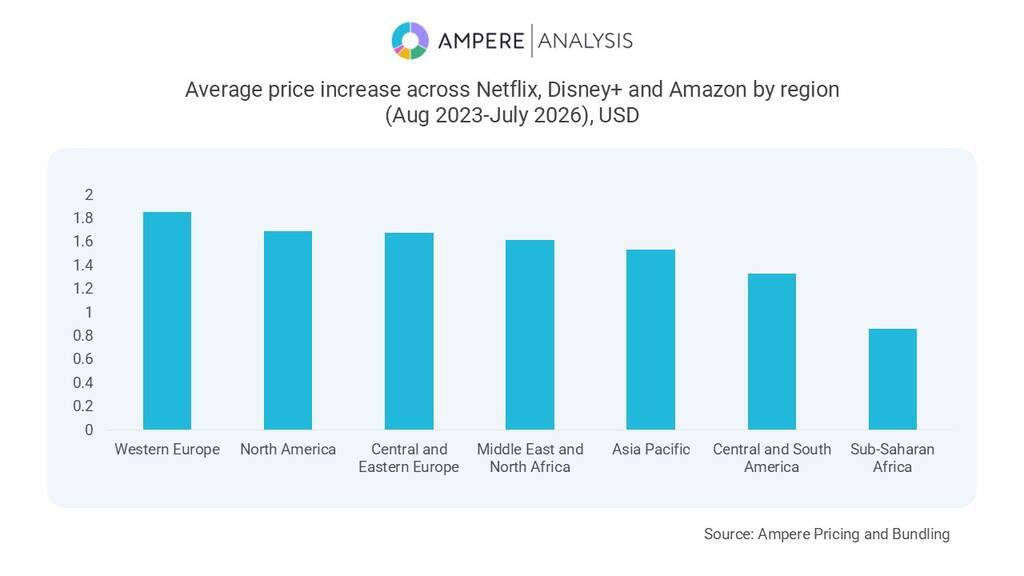
Global streaming pricing is increasingly constrained by local purchasing power, competitive intensity, exchange rates and the relative maturity of each market. A service that can extract another $2 from a Western European subscriber doesn’t necessarily have the same room elsewhere.
Advertising can partially separate audience value from local subscription purchasing power. A lower subscription price can preserve reach in markets where direct consumer pricing has less room, while advertising creates another route to monetization where advertiser demand and CPMs can support it.
That makes international advertising execution increasingly important to global streaming economics. The ability to build an ad business outside the U.S. determines how far services can reduce their dependence on subscription pricing without sacrificing revenue growth.
The Streaming Wars Take
The widening gap between ad-supported and ad-free subscriptions gives streaming services more control over where price-sensitive customers land when they resist an increase.
That makes the downgrade path economically important. Keeping a customer at a lower subscription price can outperform losing the household when advertising revenue, engagement and future upsell opportunities remain attached to the account. The premium tier can simultaneously absorb larger dollar increases from subscribers demonstrating a willingness to pay for an ad-free experience.
A growing population of lower-paying subscribers only improves the economics if services can sell the resulting inventory at sufficient yield. Expanding supply faster than advertiser demand pressures CPMs, while heavier ad loads can damage the viewing experience that supports retention.
Pricing strategy will therefore depend increasingly on the revenue difference between tiers after advertising is included, not simply the monthly subscription difference displayed on the signup page.
Smaller price hikes don’t necessarily indicate weaker pricing power. Netflix, Disney+ and Amazon now have more ways to monetize the customer after deciding not to use it.
The Streaming Wars is intentionally ad-free
We don’t run display ads. Not because we can’t, but because we don’t believe in them.
They interrupt the reading experience. They cheapen the work. And they burn advertisers’ money on impressions nobody actually wants.
So we chose a different model.
We say the things people in this industry are already thinking but don’t say out loud. We connect the dots beyond the headline and focus on explaining why things matter to the people working in this business.
If you believe industry coverage can exist without clutter and interruption, you can support it here → SUPPORT TSW.
Support is optional. But it directly funds research and continued coverage — and helps prove this model can work.
Support TSW →