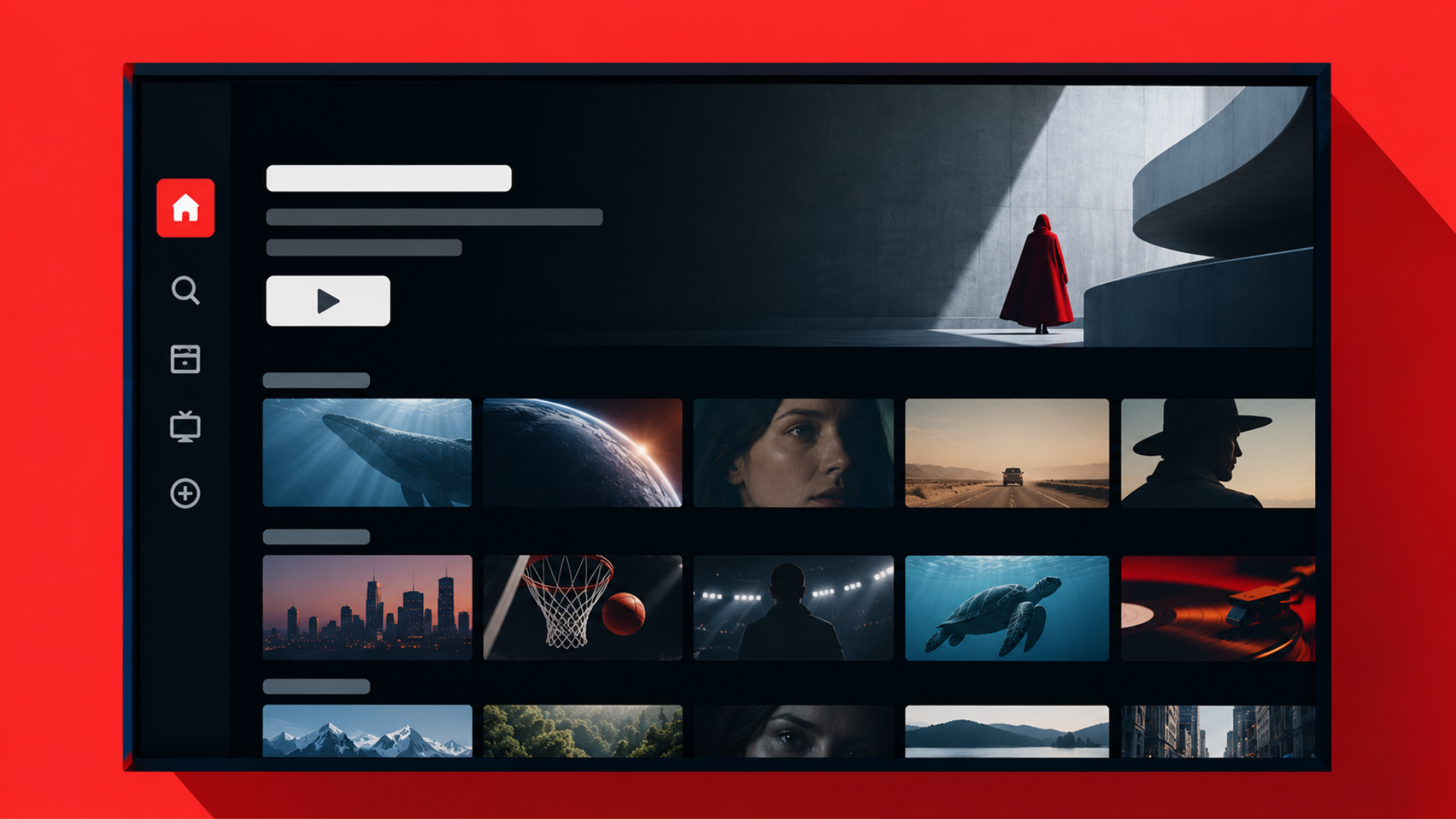
Every slot on a streaming homepage is scarce shelf space. A Netflix-like recommendation engine decides which titles get that space, in what order, and for which viewer. Netflix personalizes the rows on its homepage, the titles within those rows, and the order in which those titles appear. The machinery underneath that experience allocates viewer attention across a catalog that may have cost billions to produce, license, localize, market, and operate.
That makes recommendation part of the economics of the content library. Better discovery gives more programming a chance to earn viewing, gives subscribers more reasons to return, and produces better evidence about what audiences respond to. Weak discovery can bury a title before enough relevant viewers ever see it. The service’s broader curation and discovery strategy starts with that competition for attention.
Building the engine requires much more than choosing an algorithm. The service needs clean catalog data, reliable behavioral signals, eligibility rules, candidate-generation and ranking logic, low-latency serving, experimentation, monitoring, and people accountable for the system when it makes bad decisions.
Unwatched Doesn’t Mean Unwanted
The engine first needs to know what exists. The metadata that identifies and describes the catalog connects viewing activity to the correct movie, series, season, or episode and gives the system descriptive information it can use to find relationships among titles.
Availability sits alongside that catalog data. Territory, licensing windows, subscription entitlements, maturity settings, and profile restrictions determine which titles qualify for a recommendation. Filtering an unavailable title after a sophisticated ranking calculation wastes compute. Letting a relevance score override authorization creates a much larger problem.
Behavioral data then tells the system what viewers did. Starts, completions, ratings, searches, viewing duration, recent activity, and similar signals can all contribute to personalization. Netflix says its own system considers viewing history, ratings, title information, language, device, time of day, and viewing duration.
Impression history records which recommendations actually appeared and where they appeared. Netflix uses impression data for personalization, frequency management, merchandising analysis, and tracking exposure to new releases. Its impression pipeline also enriches those events with information such as page and row location.
A server returning a title doesn’t necessarily mean the viewer saw it. The service needs a consistent definition of visible exposure and enough logging to reconstruct the recommendation later.
Playback behavior needs similar discipline. A movie abandoned after five minutes may have disappointed the viewer. The viewer may also have fallen asleep, lost connectivity, switched devices, or encountered a playback error. Feeding every early exit into the model as dislike teaches the system a cleaner story than reality provides.
Candidate Generation Shrinks the Problem Before Ranking Gets Expensive
Large recommendation systems commonly divide the work into candidate generation, scoring, and re-ranking. Candidate generation takes a potentially large catalog and produces a smaller pool worth evaluating more carefully. Scoring ranks those candidates. Re-ranking applies additional considerations such as diversity and freshness.
Content-based candidate generation uses characteristics of the titles. If someone watches a political thriller, the engine can find programming with overlapping genres, themes, cast, tone, subjects, or other descriptive attributes.
Collaborative methods learn from audience behavior. Viewers who respond similarly to some titles can reveal relationships between other titles that aren’t obvious from the metadata.
Many systems represent viewers and titles using embeddings, numerical representations learned from data. Items that the model considers related end up positioned closer together in that mathematical space. Nobody needs to manually create a rule saying that one Scandinavian crime series is 73% similar to another.
Ranking then applies a more expensive model to the reduced candidate pool. Recent activity, context, title attributes, viewer history, and other signals can help predict the outcome the service cares about.
The objective needs to be specific. “Relevance” is too vague to train against. The system might predict an intentional start followed by sustained viewing, a strong explicit rating, or another measurable behavior tied to the product’s goals.
Re-ranking keeps the mathematically strongest results from turning the homepage into Groundhog Day. A viewer who liked one detective show probably doesn’t need 30 minor variations of the same detective show. Diversity, freshness, business rules, and deduplication can all affect the final page.
The service still has to decide where those recommendations live. Rows compete for prominence, and titles compete within the rows. A great recommendation sitting nine rows below the fold has a very different opportunity than the hero tile. The same placement economics extend beyond the app when TV operating systems merchandise programming on their own home screens.
For smaller catalogs, scoring every eligible title may be cheaper and simpler than maintaining a separate retrieval layer. Benchmark the workload before building hyperscale architecture for a problem that isn’t hyperscale.
Cold Start Forces the Engine to Take Calculated Risks
A brand-new viewer has supplied almost no behavioral evidence. A brand-new title has no meaningful audience history. Recommendation systems need an explicit strategy for both.
Netflix asks new profiles to choose titles they like and otherwise begins with a diverse set of popular programming. As the viewer interacts with the service, more recent behavior gradually replaces those initial assumptions.
New titles lean more heavily on content information. Netflix’s recommendation foundation model combines learned title identities with metadata such as genres, storylines, and tones. Newer titles with little interaction history can rely more heavily on those metadata-based representations until behavioral evidence accumulates.
The service also needs room to explore. A model that only promotes titles with strong existing engagement keeps generating more evidence about the titles it already favors. New and niche programming can get trapped in a visibility problem.
Controlled exploration gives plausible recommendations a limited opportunity to collect evidence. The allocation should remain measurable and bounded. Randomly spraying obscure titles across the homepage is experimentation in the same way throwing darts in the dark is portfolio management.
Fresh Recommendations Don’t Require Retraining the Model Every Five Minutes
Training, updating viewer state, and serving a recommendation are separate jobs.
Historical model training can happen offline. Recent events can update viewer information more quickly. Request-time systems can combine precomputed results with current context when the viewer opens the app.
Netflix has described architectures combining offline, nearline, and online computation. Offline processes can handle heavier calculations, nearline systems can respond asynchronously to viewer events, and online components can use current context while meeting strict response-time requirements.
A model can therefore react to the episode someone finished two minutes ago without retraining the entire recommendation model two minutes ago.
Latency needs an end-to-end budget. Feature retrieval, eligibility checks, ranking, downstream services, network calls, and page assembly all consume time. A scoring model that runs in 20 milliseconds provides little comfort when another dependency adds a second.
Fallbacks belong in the architecture from day one. Netflix’s published architecture describes precomputed results as one fallback when an online component can’t meet its response requirements. A service might also fall back to a simpler ranker or editorial collection. Whatever fallback appears still needs current eligibility checks.
More Clicks Can Produce a Worse Recommendation System
A ranking change can increase starts by making thumbnails or titles more tempting while also increasing rapid abandonment. Netflix has specifically warned that over-optimizing play-through rate can promote clickbait and hurt longer-term satisfaction. Retention creates the opposite measurement problem: it’s commercially important but slow, noisy, and difficult to attribute to an individual recommendation.
The model therefore needs a tractable training target while the business keeps a broader product scorecard.
Offline evaluation comes first. Train on earlier behavior and test against later behavior. Keep training and production feature calculations consistent. Differences between training and production environments create training-serving skew, which can make a model look better in testing than it performs in production.
Offline improvement still doesn’t settle the launch decision.
Historical engagement reflects the recommendations viewers were previously shown. Netflix calls this presentation bias: viewers can only click, play, or rate content the existing system put in front of them. Its page-simulation work also shows why a model that performs better on an offline metric can produce no improvement, or even perform worse, in an online A/B test.
That makes controlled experimentation the commercial test. Compare the new system with the existing experience, measure service-level outcomes, and evaluate important groups separately.
Treat subscriber retention and churn as their own measurement problem. More recommendation clicks don’t establish that fewer subscribers canceled. Retention requires enough accounts, time, and experimental discipline to identify an incremental effect.
The Model Is Only One Line Item in the Bill
A recommendation program consumes engineering time, storage, event processing, feature computation, training resources, serving infrastructure, experimentation capacity, observability, and on-call support.
That operating bill belongs inside the full cost structure of running a DTC streaming service. Estimate peak recommendation requests, catalog size, candidates evaluated, update frequency, latency requirements, model complexity, and availability targets before debating architecture.
Large language models raise that economic bar. Netflix’s GenRec adapts an LLM to recommendation ranking while constraining its scores to catalog items. Netflix tested GenRec on batch-computed recommendation surfaces covering roughly 10% of its traffic for about four weeks in 2026 and reported gains over its production baseline.
Netflix says GenRec’s serving cost depends heavily on model size, context length, and inference mode. Its implementation uses smaller or distilled models, compresses context, and avoids expensive token-by-token generation by scoring candidates in a prefill-only pass.
An LLM earns production traffic when its incremental recommendation value exceeds its incremental compute, integration, experimentation, and operating cost.
The same standard applies to buying the capability. Managed recommendation products can remove substantial implementation work, but the streaming service still owns its catalog rules, business objectives, experiment design, observability, and exit strategy.
The Companies Connecting Content Data to Discovery
Recommendation depends on multiple capabilities that often come from different systems or suppliers. Content needs a stable identity, viewer and catalog data need to become recommendation decisions, and some discovery products also need accurate information about where programming is available.
Gracenote supplies entertainment metadata and standardized content IDs that support search, navigation, and personalization. Those identifiers and descriptive attributes help recommendation systems understand what the catalog contains and connect activity to consistent title records.
ThinkAnalytics works further into the decisioning layer, using first-party audience data and metadata across discovery, personalization, viewer intelligence, and advertising. That puts its technology closer to the systems deciding what gets surfaced and how audience behavior feeds subsequent decisions.
Reelgood combines title metadata with current and historical streaming availability data. That capability becomes particularly useful for discovery experiences spanning multiple services, where recommending the correct title still leaves another question: where can the viewer actually watch it?
Together, these companies show three distinct parts of the discovery problem: identifying and describing content, converting data into personalized decisions, and connecting discovery with current availability. A service may source those capabilities differently, but the handoffs still have to stay accurate.
For a deeper look at the companies building the future of streaming technology, visit our Industry Directory, which spotlights the operators driving the next phase of streaming.
Want your company listed in the TSW Industry Directory? Email us to learn more about eligibility, profile options, and how to get included.
The Streaming Wars Take
Programming teams that treat raw viewing totals as pure audience demand risk grading their own merchandising decisions.
A title shown broadly to relevant viewers and repeatedly rejected has generated useful evidence. A title with weak viewing and little qualified exposure hasn’t run the same test. Impression data gives the business a way to separate those situations before viewing totals influence renewal, licensing, marketing, or programming decisions.
Homepage promotion also changes the data used to train future recommendations. A heavily promoted title collects more impressions and interactions, which can affect subsequent ranking. Product, programming, and marketing teams therefore need to preserve promotion and experiment context when those events flow back into recommendation models. Otherwise, a merchandising decision can quietly become evidence that the audience independently demanded the title.
That puts discovery spending in direct conversation with content spending. A service considering another expensive acquisition should know whether the existing library is failing to satisfy subscribers or whether the product is failing to connect subscribers with the programming already on the books.
A service that keeps buying shows without diagnosing discovery can wind up using content dollars to compensate for a merchandising problem.
The Streaming Wars is intentionally ad-free
We don’t run display ads. Not because we can’t, but because we don’t believe in them.
They interrupt the reading experience. They cheapen the work. And they burn advertisers’ money on impressions nobody actually wants.
So we chose a different model.
We say the things people in this industry are already thinking but don’t say out loud. We connect the dots beyond the headline and focus on explaining why things matter to the people working in this business.
If you believe industry coverage can exist without clutter and interruption, you can support it here → SUPPORT TSW.
Support is optional. But it directly funds research and continued coverage — and helps prove this model can work.
Support TSW →