
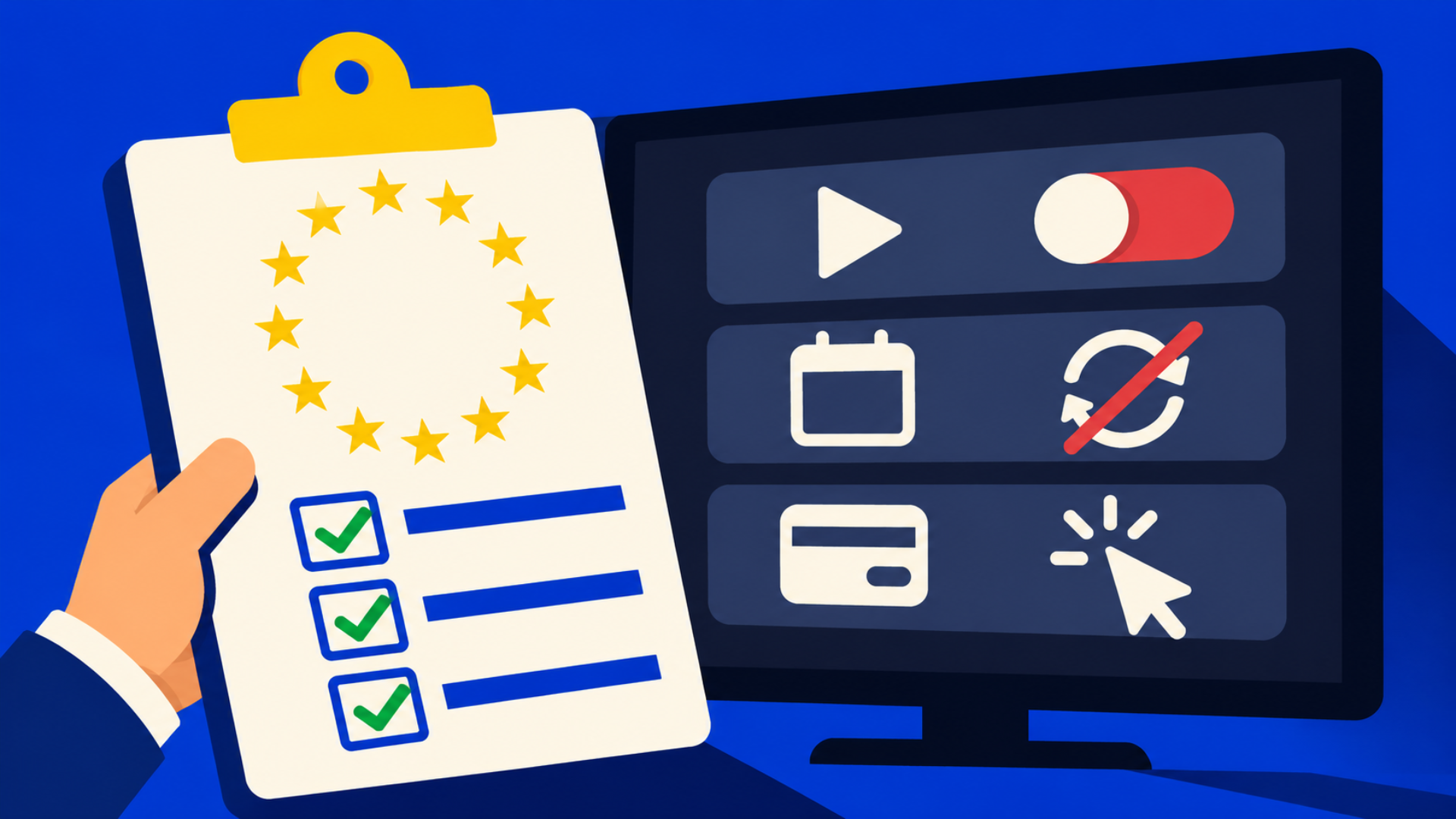
The European Commission wants to restrict the product features that help streaming services generate viewing time, convert free trials and retain paying subscribers. Its proposed Digital Fairness Act would require covered services to provide accessible autoplay controls, obtain renewed consent before free trials become paid subscriptions and make online cancellation easier.
Those requirements could reduce automatic content starts, increase customer acquisition costs and expose how much subscriber retention depends on friction rather than continued demand.
The Commission introduced the proposal on November 11, 2026, alongside an enforcement overhaul that could allow fines of up to 6% of worldwide annual revenue in major EU-wide consumer protection cases. Both proposals require approval from the European Parliament and EU member states.
Streaming businesses would face different economic pressures depending on how they monetize engagement, acquire customers and manage renewals. Product teams would also have to determine when removing friction improves the customer experience and when it generates revenue from decisions consumers never actively made.
Autoplay Mints Minutes
Autoplay eliminates the decision between finishing one episode and starting another. Viewers who want uninterrupted entertainment get it. Streaming services generate additional content starts, longer viewing sessions and, on advertising-supported tiers, more opportunities to sell advertising.
A 2025 experimental study involving 76 U.S. Netflix users found that disabling autoplay reduced average daily viewing by approximately 21 minutes and average session length by 17.6 minutes.
The study involved a small sample of moderate-to-heavy Netflix users over a relatively short experimental period. It measured viewing behavior, with no statistically significant change in the time between sessions. It didn’t establish an effect on subscriber retention, advertising revenue or customer lifetime value.
The results demonstrate how strongly a single interface setting can influence consumption.
For advertising-supported streaming services, additional viewing can produce more commercial inventory. That inventory generates revenue only when advertisers purchase the impressions at prices that justify the costs of delivery and monetization.
As streaming advertising economics increasingly depend on monetized fill and yield, another minute of viewing doesn’t guarantee another minute of profitable engagement.
An automatic episode start in a market with weak advertising demand may generate additional delivery costs without meaningful incremental revenue.
Subscription-only services face a different calculation. A customer paying a fixed monthly fee doesn’t generate more subscription revenue by watching another episode. Additional viewing becomes economically valuable when it improves satisfaction, strengthens retention or increases willingness to pay.
Europe’s proposal would require digital products designed or operated in ways that encourage compulsive or excessive use to provide accessible controls for disabling covered features. These include automatic playback, uninterrupted consumption without effective stopping points and certain engagement-driven notifications.
Streaming services wouldn’t automatically have to eliminate autoplay or disable it by default.
Netflix already allows viewers to turn off next-episode autoplay through their profile settings. The proposal would establish an enforceable standard for covered services rather than leave those controls entirely to individual product decisions.
For UX teams, autoplay presents a legitimate trade-off.
A viewer watching multiple episodes of a series may appreciate the convenience of continuous playback. Another may prefer to stop after a single episode and resent having to interrupt an automatic countdown.
Both behaviors can exist within the same product.
Making controls accessible preserves the benefit for viewers who want continuous playback while reducing unwanted consumption for those who don’t.
The commercial question is whether the additional viewing improves the customer’s relationship with the service enough to justify its operational costs and potential effect on satisfaction.
A longer session is an observable result. Its contribution to subscription economics has to be established separately.
The Second Yes
The proposed free-trial rules create a more direct threat to subscription conversion.
Article 20 would require services to remind customers before their free trial expires, disclose the paid subscription terms and obtain express agreement before the paid contract begins.
If the customer doesn’t actively agree, the paid contract wouldn’t bind them.
Automatic conversion would no longer allow a trial user to become a paying subscriber simply by failing to cancel.
The impact would vary considerably across streaming businesses.
Netflix no longer offers free trials, so this requirement wouldn’t directly disrupt its current customer acquisition model.
Apple TV continues to advertise a seven-day free trial in European markets, including Ireland. Services using similar offers would have to secure an additional affirmative decision before collecting payment.
That extra decision introduces another point of potential abandonment into the acquisition funnel.
Consider a streaming service converting 50% of trial users into paying subscribers. If the requirement reduced conversion to 45%, acquisition cost per paying customer would increase approximately 11%, assuming trial acquisition spending and volume remained unchanged.
That’s an illustrative sensitivity calculation, not a forecast of the legislation’s actual effect.
The economics would depend on what happens after conversion.
A customer who actively accepts the paid price has demonstrated willingness to pay after experiencing the service. Someone who automatically converts may have made the same decision or may simply have forgotten to cancel.
Both currently contribute to reported trial-to-paid conversion.
Requiring affirmative agreement could reduce the number of paying subscribers while improving the quality of the resulting cohort. Lower refund rates, fewer payment disputes and stronger paid retention could offset some of the lost conversions.
Whether they offset enough would depend on the contribution margin those customers generate over subsequent billing periods.
The requirement also increases the commercial importance of the trial experience itself.
Programming has to create enough interest to justify another payment. Onboarding needs to demonstrate value quickly. Recommendations must introduce additional reasons to watch before the trial ends.
A service that acquires customers through a single heavily marketed title could face greater pressure if viewers finish that programming without discovering another reason to subscribe.
A service with strong discovery and compelling follow-on programming has more opportunities to turn trial engagement into an intentional purchase.
The acquisition objective becomes more demanding when the customer has to say yes twice.
Churn Without Friction
Europe also wants to make cancellation easier and renewal terms harder to overlook.
Article 23 would require businesses offering online contracts to provide a prominently displayed online termination function, regardless of how the consumer originally entered the contract.
Articles 21 and 22 would introduce reminders before specified automatic renewals.
Contracts lasting six months or longer would require renewal reminders between 14 days and one month before extension. Shorter contracts would trigger reminders after defined renewal thresholds.
Automatic renewal would remain available. Customers would receive additional opportunities to reconsider their subscriptions before specified charges.
Those moments create commercial exposure for services whose reported retention benefits from customers overlooking renewal dates or struggling to complete cancellation.
Streaming retention teams have legitimate reasons to intervene when customers consider leaving.
A lower-priced tier can address affordability. A subscription pause can preserve a relationship between programming releases. Better recommendations can help a subscriber who hasn’t found enough to watch.
Those interventions create value when they change customer behavior profitably.
Making cancellation harder produces a different economic result. The service may collect another payment without improving satisfaction or addressing the reason the customer wanted to leave.
The proposed rules would restrict how much procedural friction can contribute to retention.
As streaming churn systems increasingly distinguish prediction from profitable intervention, the relevant outcome is incremental contribution margin.
A discounted subscriber who would have renewed at full price represents lost margin. A customer retained for one additional month may generate less profit than the incentive costs.
An effective cancellation offer needs to improve the customer’s expected future contribution relative to allowing the original cancellation to proceed.
Annual subscriptions face another pressure point.
A renewal reminder puts the upcoming price directly in front of the customer. A discounted annual plan that looked attractive at signup must justify its cost again when the renewal decision arrives.
That increases the importance of programming availability, perceived catalog value and competitive pricing at renewal.
Services can still encourage customers to stay. The proposed requirements would make it harder to preserve those relationships through customer inaction.
The A/B Test Trap
Streaming product teams have legitimate commercial objectives that can conflict with one another.
Growth teams want higher conversion. Engagement teams want longer sessions. Subscription teams want lower churn. UX teams want viewers to find content, manage subscriptions and complete intended actions without unnecessary difficulty.
An experiment can improve one objective while damaging another.
Consider a free-trial experiment that raises initial paid conversion by two percentage points.
A growth team might classify it as a successful test. But if the additional customers produce higher refund costs, more payment disputes and enough early cancellations to reduce expected contribution margin, the apparent conversion improvement has made the business less profitable.
A cancellation offer can create a similar problem.
Suppose a discount increases the percentage of subscribers accepting a retention offer. If most would have stayed at full price, the experiment reduces revenue without meaningfully preventing cancellations.
An autoplay experiment may also generate longer sessions without improving return frequency or long-term retention.
None of those results makes experimentation itself unreliable. Each reveals the limits of selecting a primary metric that doesn’t capture the full economic outcome.
Product decisions need financial measures and customer-experience safeguards that extend beyond the immediate action.
An autoplay test should evaluate future engagement, deliberate content starts and retention alongside session length. A trial experiment should measure paid-month retention, refunds and acquisition payback. A cancellation experiment should compare incremental margin against the cost of discounts and other retention incentives.
A service should reject an experiment that increases conversion while reducing expected customer contribution enough to destroy the financial benefit.
Legal compliance, informed consent and the ability to complete cancellation also set boundaries that a profitable experiment can’t override.
The more difficult decisions involve interventions that are commercially beneficial and legally permissible but create a worse experience for some customers.
Autoplay can improve convenience and extend viewing. Automatic renewal can simplify payment for satisfied subscribers. Personalized recommendations can reduce the effort required to find relevant programming.
Those features don’t need to disappear for product teams to respect consumer choice.
The objective is to preserve useful convenience while measuring whether the behavior being encouraged creates durable value for the customer and the business.
A product team that removes every source of friction can create problems just as easily as one that introduces too much.
Friction can protect customers from unintended purchases. It can also prevent them from completing actions they deliberately chose.
The design decision depends on the customer’s intent, the cost of another decision and the commercial consequences of making that decision automatic.
America’s Patchwork
Several elements of Europe’s proposal already have counterparts in U.S. consumer protection law.
California strengthened its Automatic Renewal Law in July 2025. Businesses must obtain express consent to recurring subscription terms, provide required notices and annual reminders, and allow consumers to cancel through accessible methods without obstructive steps.
California generally still permits free trials to convert automatically when consumers properly accept the recurring payment terms at enrollment.
Europe’s proposal would go further by requiring another affirmative agreement before the paid period begins.
Federal regulation has been less settled.
The Federal Trade Commission adopted a broader Click-to-Cancel rule in 2024, but a federal appeals court vacated it in July 2025 because of procedural deficiencies in the rulemaking process.
The FTC restored its earlier Negative Option Rule text in February 2026 and began a new rulemaking process in March.
Existing federal protections under the Restore Online Shoppers’ Confidence Act continue to require clear disclosures, informed consent and simple mechanisms for stopping recurring online charges.
Regulation of engagement-driven design is developing separately.
New York’s SAFE for Kids Act, scheduled to take effect January 25, 2027, restricts algorithmically personalized social-media feeds and certain nighttime notifications for minors without parental consent.
Those protections apply to covered services displaying user-generated content. They don’t impose equivalent autoplay requirements on adult subscription video customers.
The United States has an established legal foundation for stronger subscription billing and cancellation protections. Broad federal restrictions on engagement features used by adult streaming customers would require additional legislation or regulatory action.
European requirements could still influence U.S. products through global product design.
Streaming services frequently share playback interfaces, account-management systems and engineering infrastructure across markets. Offering consistent autoplay controls internationally may be simpler than maintaining separate implementations for each regulatory jurisdiction.
Billing rules are more likely to require country-specific configurations because subscription contracts and consumer protections differ.
Europe could consequently shape parts of the American streaming experience without the United States adopting identical legislation.
The Streaming Wars Take
The proposed rules could make trial-led acquisition less competitive against direct-to-paid subscriptions.
Netflix’s existing subscription model doesn’t require a free-trial conversion step. Services offering promotional trials would have to absorb the additional consent requirement and any resulting reduction in paid conversion.
That could change how aggressively those businesses bid for customer acquisition.
A service paying for trial starts must estimate how many users will actively accept the paid price and how much contribution margin they’ll generate afterward. A lower conversion rate raises the required lifetime value per paying customer or reduces what the service can afford to spend acquiring each trial.
Services with established brands and strong direct-to-paid conversion would face less exposure to that particular requirement.
Trial-dependent competitors could respond by changing promotional offers, shifting acquisition spending toward higher-intent customers or investing more heavily in experiences that demonstrate value before the trial expires.
Those choices affect marketing efficiency and acquisition payback rather than merely the appearance of the signup process.
The proposed rules would also complicate comparisons between streaming businesses operating under different regulatory requirements.
A service reporting a lower trial-to-paid conversion rate in Europe could still generate higher contribution margin per paying subscriber if affirmative consent reduces refunds, disputes and short-lived subscriptions.
A service experiencing higher voluntary churn after simplifying cancellation could still improve profitability by reducing ineffective retention discounts and generating profitable reacquisitions.
Headline conversion and churn metrics would therefore become less useful for comparing performance across markets without accounting for how customers enter, renew and leave their subscriptions.
That places greater weight on cohort-level contribution margin, acquisition payback and lifetime economics.
The pressure on advertising-supported services is different. Autoplay opt-outs could reduce available commercial impressions, making monetized yield and the profitability of incremental viewing more important.
Product teams would still pursue engagement, but the financial value of extending a session would depend on actual advertising contribution and its effect on future customer behavior.
The regulatory impact would be uneven.
A direct-to-paid streaming service with strong programming, effective discovery and profitable reacquisition has more ways to preserve customer lifetime value without depending on automatic trial conversion or cancellation friction.
A competitor relying heavily on free trials, unattended renewals and prolonged sessions could face greater pressure on its acquisition and retention economics.
Europe’s proposed rules would make those differences more visible in marketing efficiency, subscriber cohorts and contribution margin.
Streaming services that can acquire customers at a sustainable cost, monetize the viewing those customers actually want and retain them through continued product value would have less revenue exposed to the removal of automatic consumer decisions.
The Streaming Wars is intentionally ad-free
We don’t run display ads. Not because we can’t, but because we don’t believe in them.
They interrupt the reading experience. They cheapen the work. And they burn advertisers’ money on impressions nobody actually wants.
So we chose a different model.
We say the things people in this industry are already thinking but don’t say out loud. We connect the dots beyond the headline and focus on explaining why things matter to the people working in this business.
If you believe industry coverage can exist without clutter and interruption, you can support it here → SUPPORT TSW.
Support is optional. But it directly funds research and continued coverage — and helps prove this model can work.
Support TSW →