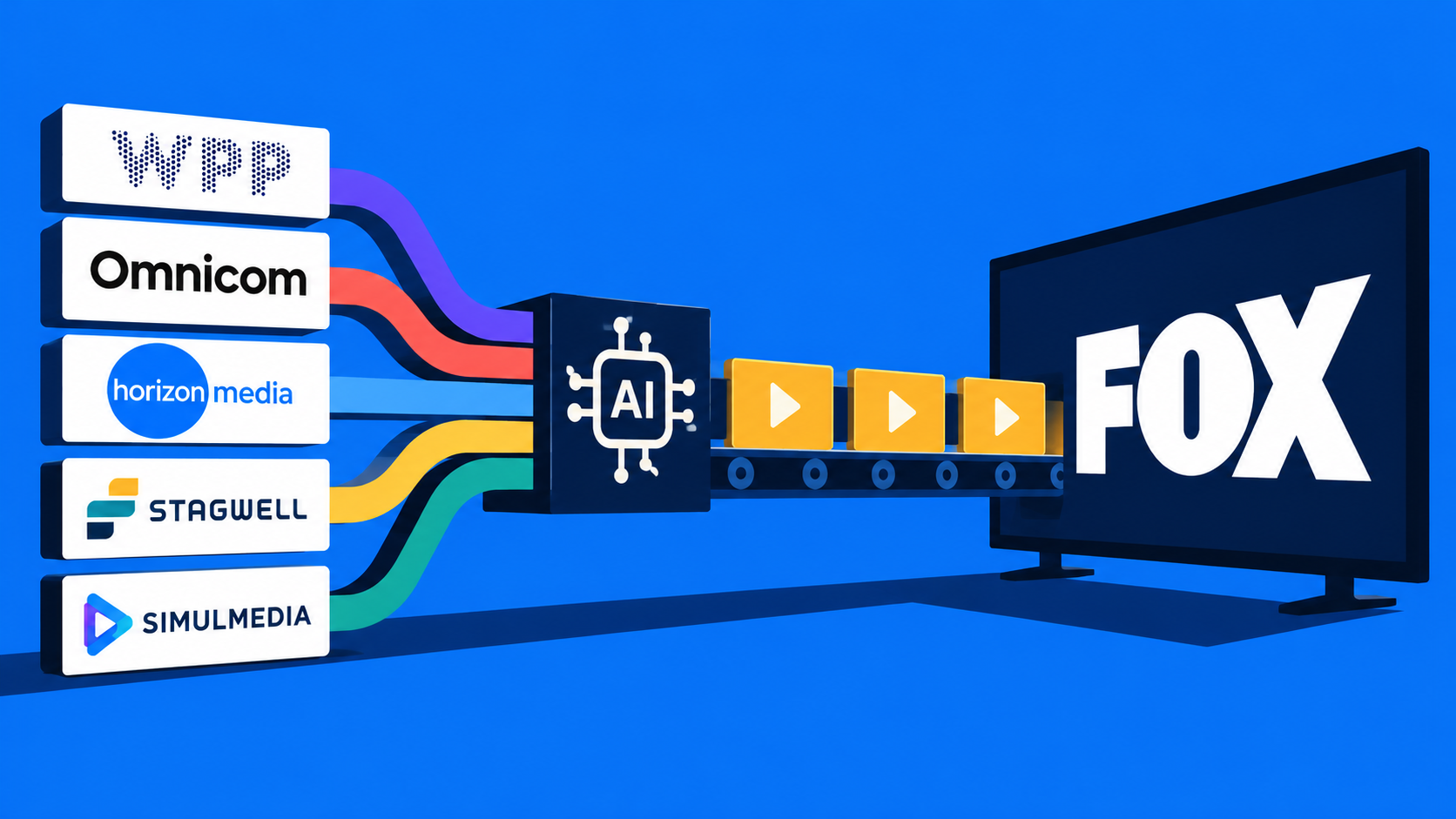
Fox has connected AI agents from WPP, Omnicom, Horizon Media, Stagwell and Simulmedia to live linear TV transactions through Fox AdStudio. The integrations let agency buying systems exchange orders, evaluate available inventory and complete approved transactions directly with Fox’s sales infrastructure.
Simulmedia says its integration has already executed more than 400 spot-level orders across 10 live campaigns. Fox is reducing the manual work required to buy its linear inventory as agencies increasingly allocate advertising budgets across linear and streaming. The commercial opportunity is to keep Fox’s programming competitive inside the systems making those spending decisions.
More Than 400 Spot-Level Orders Give Fox a Commercial Starting Point
Fox introduced its agentic advertising infrastructure in June. Simulmedia completed an initial live agent-to-agent transaction that month, with both companies approving the buy.
The integration has since expanded. As of October 16, Simulmedia’s VAMOS system was handling 10 live campaigns across five Fox properties, with more than 400 spot-level orders executed through its agentic buying system.
Those figures cover one participating partner. Fox hasn’t disclosed total transaction value, platform-wide order volume, execution costs or advertiser performance across the five integrations. The Simulmedia activity establishes a baseline for evaluating whether agentic buying can handle recurring commercial work across multiple campaigns.
Fox has also added infrastructure for broader agency participation. Each partner’s agent connects through a dedicated, permissioned account within Fox AdStudio. An integrated governance engine monitors transactions against established rules, while agency and Fox sales teams retain authority over key commercial decisions.
The architecture gives agencies a direct connection to the seller’s inventory without requiring them to abandon their own planning and buying systems.
Automated Substitutions Could Help Fox Keep More Inventory Sold
Fox’s agents can now recommend replacement inventory when a requested spot is unavailable.
In a conventional transaction, the unavailable spot may trigger another round of emails, schedule revisions and approvals. Fox’s agent can instead propose an alternative based on the advertiser’s target audience.
Simulmedia’s system can receive that counteroffer, evaluate it against the campaign’s audience requirements and return a response. The transaction becomes final after both sides confirm the terms.
That gives Fox another opportunity to retain spending within its inventory when an original placement can’t be fulfilled. It also reduces the work required to resolve routine scheduling conflicts.
The commercial tension sits inside the recommendation itself.
Fox benefits when an advertiser accepts alternative inventory. The agency benefits when that alternative delivers the intended audience at an acceptable price. A seller-recommended replacement can satisfy one requirement while changing another, including delivery timing, audience composition or effective cost.
Agencies therefore need rules governing which substitutions their agents can accept, which require approval and how the system evaluates comparable inventory.
Simulmedia says its agent exchanges are recorded and auditable. Fox’s governance engine monitors activity against established protocols. Neither company has disclosed substitution acceptance rates or the resulting impact on advertising yield.
Agency-Owned Agents Put More Control Over Spending Decisions on the Buy Side
The five partners are connecting different technology systems to Fox rather than adopting one common buying interface.
WPP has completed live agent-to-agent transactions and is working toward standards that support broader client adoption.
Omnicom is connecting its Omni marketing intelligence system to Fox AdStudio. Its implementation uses linear and CTV exposure data to inform audience planning and execute transactions at the individual spot level based on client objectives.
Horizon is connecting its agentic decisioning infrastructure through Databricks. Stagwell’s Media Machine can translate a client brief into an actionable TV plan and communicate directly with Fox. Simulmedia uses Google’s open Agent2Agent protocol to connect its VAMOS transaction system with Fox.
Each integration gives Fox access to buying activity originating inside an agency’s existing workflow.
The agency retains control over the planning system that evaluates audiences, budgets and campaign objectives. Fox supplies inventory availability, transaction rules and proposed placements.
That division creates competing advantages.
Fox can process more buying activity through a common seller-side connection. Agencies can reduce manual execution while retaining the ability to set their own buying criteria.
As agent integrations expand across sellers, agencies could compare more inventory through their own decisioning systems. That would reduce the operational advantage any single seller gets from a proprietary ordering process.
Fox’s ability to defend pricing would increasingly depend on the audience, programming and performance associated with its spots.
Streaming’s Upfront Lead Raises the Cost of Linear Buying Friction
Media Dynamics estimates that streaming captured $17.2 billion in 2026 primetime upfront commitments, compared with $16.6 billion for broadcast and cable combined.
Broadcast commitments declined 5.3%, while cable fell 7.7%. Streaming spending increased nearly 30%, giving it a narrow lead in primetime upfront advertising commitments.
Linear remains a substantial advertising business, particularly around live sports, news and programming capable of aggregating large audiences. Those advantages become less useful commercially when buying the inventory requires more operational work than buying comparable audiences through digital systems.
Fox has exposure on both sides of that spending shift.
Its broadcast and cable properties generate valuable advertising inventory, while Tubi’s audience has reached 110 million monthly active users, extending Fox’s reach into free ad-supported streaming.
Fox AdStudio gives advertisers a common technology environment for working across that portfolio. Omnicom’s integration adds a cross-screen planning component by bringing linear and CTV exposure information into agency decision-making.
The immediate capability centers on live linear transactions. Fully automated allocation of spending between linear and CTV remains a broader objective.
For Fox, easier linear execution can help preserve consideration for its traditional inventory when an agency evaluates spending across screens. The company can also use its streaming inventory to pursue audiences that broadcast schedules can’t reach efficiently.
The opportunity is especially relevant when an advertiser wants incremental reach rather than additional frequency against households already exposed to the campaign.
Agentic Buying Moves More Execution Inside the Upfront Agreement
The 2027 upfront will provide a larger test of how agencies incorporate these connections into their buying operations.
Upfront negotiations establish pricing, spending commitments, audience guarantees, cancellation provisions and access to high-demand programming. Those commercial terms continue to depend on direct negotiations between buyers and sellers.
Agentic systems can handle more execution after the parties agree on those terms.
An agency agent can assemble an order, check inventory, evaluate substitutions and submit approved placements without requiring employees to manage every exchange. The same infrastructure could eventually support more frequent schedule adjustments as campaign delivery and performance data change.
Simulmedia is pursuing that capability through automated negotiations involving individual spots, schedules, flight dates and audience targets. Its longer-term model incorporates advertiser response data, including website visits, app downloads, calls and purchases.
That would allow agencies to make more frequent adjustments to remaining linear inventory based on measured campaign results.
The commercial case still requires evidence that those adjustments improve performance or reduce operating expense.
Agencies will need to measure how much spending passes through agents, how often transactions require human intervention, how quickly substitutions receive approval and whether campaigns meet their original delivery and outcome requirements.
The existing transaction volume shows that the infrastructure can process live orders. Broader adoption will depend on whether it can handle larger commitments and campaign changes without introducing unacceptable pricing, fulfillment or compliance risk.
The Streaming Wars Take
Agency-controlled AI systems could become an increasingly influential point of allocation in TV advertising, particularly as more sellers make their inventory accessible through common transaction protocols.
That gives buyers another source of leverage. An agency can define acceptable audiences, prices, placements and performance thresholds before an order reaches the seller. Seller agents can recommend inventory, but the buyer’s rules determine which alternatives qualify.
Fox benefits from making its inventory easier to access. It also faces greater pressure to demonstrate why its programming deserves spending when agencies can evaluate more alternatives through automated workflows.
Premium live sports, differentiated audiences and credible outcome measurement become more important when operational barriers between sellers decline.
The next upfront negotiations could extend beyond pricing and inventory guarantees into the permissions governing automated execution: which substitutions agents can approve, which data determines an acceptable alternative and when human intervention is required.
Fox has an opportunity to reduce the cost of serving existing agency demand and increase the number of transactions its systems can process. Agencies have an opportunity to make inventory selection more responsive to audience delivery and campaign results.
The commercial balance will depend on who controls the rules used to accept, reject and redirect spending. Fox supplies the inventory and proposed alternatives. Agency buying systems increasingly determine how those proposals compete for the advertiser’s budget.
The Streaming Wars is intentionally ad-free
We don’t run display ads. Not because we can’t, but because we don’t believe in them.
They interrupt the reading experience. They cheapen the work. And they burn advertisers’ money on impressions nobody actually wants.
So we chose a different model.
We say the things people in this industry are already thinking but don’t say out loud. We connect the dots beyond the headline and focus on explaining why things matter to the people working in this business.
If you believe industry coverage can exist without clutter and interruption, you can support it here → SUPPORT TSW.
Support is optional. But it directly funds research and continued coverage — and helps prove this model can work.
Support TSW →