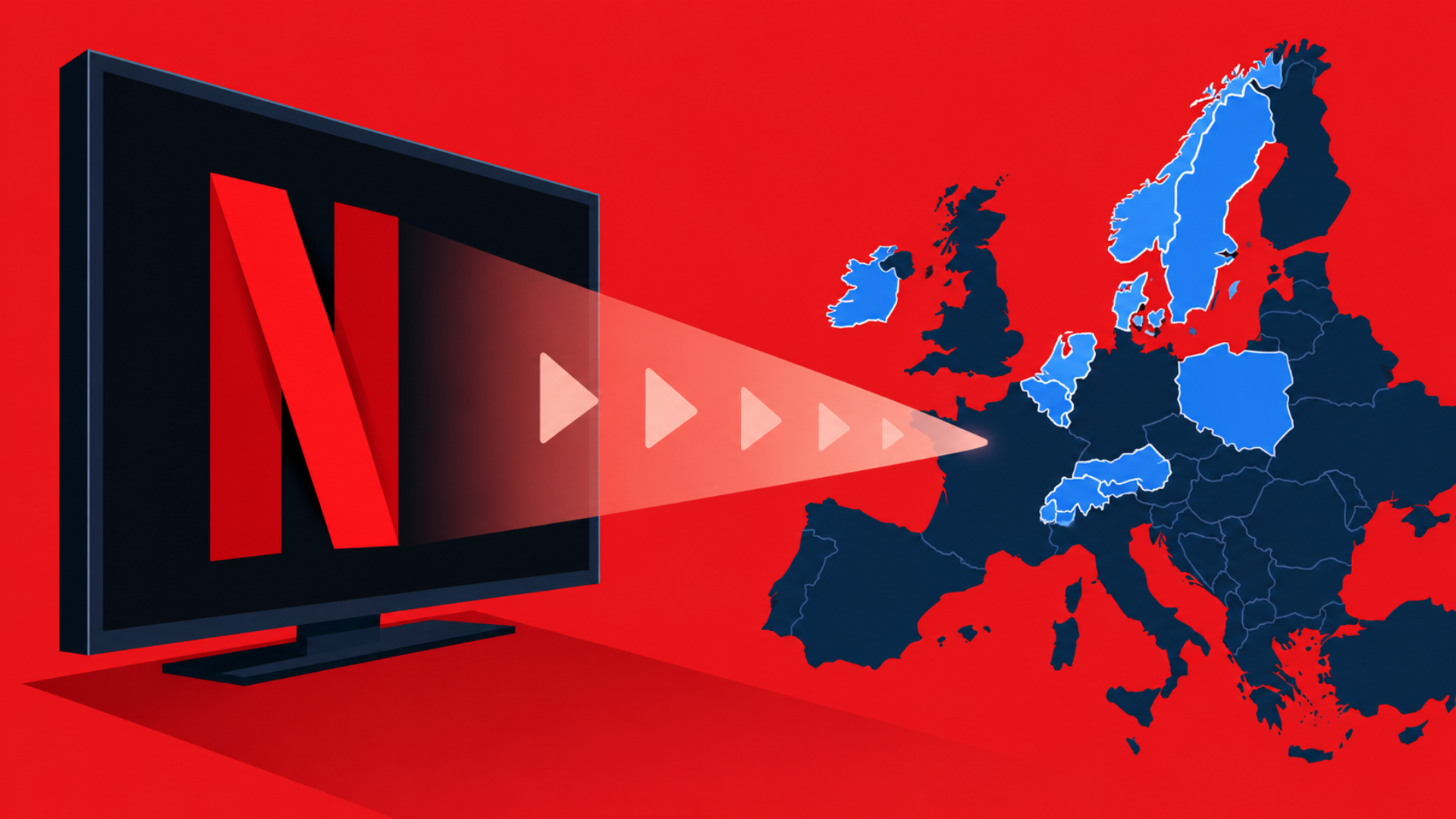
Netflix will launch its ad-supported plan in Austria, Belgium, Denmark, Ireland, the Netherlands, Norway, Poland, Sweden and Switzerland on March 1, 2027. Netflix already sells subscriptions in each market, so the expansion adds an advertising business to existing distribution, billing, apps, content and customer relationships. The lower-priced plan gives Netflix another way to monetize viewing while creating another subscription option for price-sensitive customers.
Netflix had already named all nine countries among 15 additional markets getting the ad-supported plan starting in 2027. Its September 24 U.K. upfront supplied the common launch date for the European group. Netflix hasn’t disclosed local prices for the new plans.
The economics will depend on who chooses that price, how much they watch and how effectively Netflix can sell the resulting inventory. New subscribers, returning customers, subscribers trading down from ad-free plans and customers who would otherwise cancel all produce different revenue outcomes.
The Ad Tier Puts Subscriber Mix at the Center of the Launch Economics
A new subscriber on the ad-supported plan gives Netflix subscription revenue it wasn’t collecting before, plus viewing it can monetize with advertising. A current subscriber moving from a more expensive ad-free plan gives up some subscription revenue, requiring advertising to close or exceed the difference. Keeping a price-sensitive customer who would otherwise cancel protects revenue that Netflix might have lost entirely.
Local pricing therefore determines more than the attractiveness of the new plan. The spread between ad-supported and ad-free subscriptions affects how many customers move down the price ladder and how much advertising revenue Netflix needs from those accounts, extending the broader shift toward monetizing viewers differently across ad-supported and ad-free subscriptions. Subscription price is increasingly one input in customer economics rather than the entire transaction.
Heavy users create more impression opportunities than light users, but additional inventory only produces incremental revenue when advertiser demand absorbs it at acceptable pricing. More available impressions can also pressure yield if supply grows faster than demand.
Netflix consequently needs the consumer offer and advertising operation to work together. A lower entry price can improve acquisition or retention while advertising raises the revenue attached to the viewing that follows.
Netflix Can Reuse the Ad Stack, but Demand Still Has to Be Built Country by Country
By November 2025, Netflix Ads Suite was operating across all 12 countries where the company then offered advertising. Its programmatic relationships included major buying systems such as Amazon, Google Display & Video 360, The Trade Desk and Yahoo, while Netflix had relationships with more than 50 measurement providers globally.
Netflix continued expanding those connections in 2026. Amazon shopping, browsing and streaming signals became available for audience targeting, with Yahoo data supporting additional behavioral targeting. The company also added planning APIs, clean-room integrations and broader programmatic availability across formats. Its September U.K. upfront said pause ads would become available programmatically through partner DSPs in October and demographic targeting would expand to income and household composition.
Those connections reduce the amount of commercial infrastructure Netflix has to invent for every expansion. Agencies already buying through supported DSPs can potentially route Netflix inventory through systems used for other CTV campaigns, reducing the operational cost of adding another media owner to a plan. That dynamic has already made Netflix inventory increasingly valuable inside its established DSP relationships.
Netflix hasn’t specified which buying, targeting and measurement capabilities will be available in each of the nine new countries on March 1. The existing stack gives the company a common technical base, while local campaign execution still depends on available inventory, sales coverage, audience data, creative requirements and the capabilities enabled in each market.
Advertiser demand also has to be developed locally. A functioning ad server can deliver an impression in Denmark or Poland. It can’t guarantee an agency has enough demand at the right price to buy that impression.
Measurement Will Determine How Quickly Launch Inventory Becomes Repeat Spend
Netflix enters the nine countries with evidence that its advertising business can reach meaningful scale in established markets. Barb data put the U.K. audience for Netflix’s ad-supported plan above 14 million viewers in September, representing nearly one in four people nationwide.
That number doesn’t establish the inventory available in Austria, Poland or Sweden. Agencies allocating local budgets will need market-level reach, audience composition and frequency data that can be compared with other video sellers.
Netflix has expanded its independent measurement relationships around that requirement. AudienceProject’s direct Netflix integration currently covers the U.K., Germany, France, Italy, Spain and Canada. Across the five European markets, AudienceProject said measured Netflix campaigns delivered an average 54% unique reach to TV among target audiences. Netflix and AudienceProject expanded their partnership in September to provide additional cross-media reach and frequency reporting.
The nine new countries aren’t included in that Netflix-specific AudienceProject coverage today. Establishing comparable measurement will influence how quickly agencies move from testing the new inventory to treating Netflix as a recurring part of local video plans.
Incremental reach can support a budget allocation when Netflix finds audiences that a broadcaster or another streaming service doesn’t reach efficiently. Reliable frequency measurement helps an agency understand whether additional spending expands the audience or repeatedly reaches the same households. Outcome measurement gives buyers another basis for deciding whether the campaign deserves renewal.
The stronger Netflix makes those comparisons, the easier it becomes for agencies to move budgets based on performance rather than simply experimenting with newly available inventory.
Local Broadcasters Keep Their National Advantage as Netflix Adds Regional Scale
The March launch introduces another large video seller into advertising markets where broadcasters and other streaming services already compete for local budgets.
Netflix brings a global consumer brand, an established subscriber relationship and advertising technology that can be extended across countries. Local broadcasters bring national programming, established sales relationships, market-specific audience knowledge and measurement systems built around the way advertising is bought in each country.
Europe’s media economics still reward that local density. Broadcasters are consolidating around national audiences, advertising markets and rights portfolios because much of the commercial value remains tied to local reach, language, programming and advertiser demand.
Netflix changes the allocation decision by adding another source of premium video inventory. Its value to an advertiser increases when it contributes incremental reach, a desirable audience or better campaign performance than the alternatives. Where it largely duplicates audiences available elsewhere, pricing and frequency become more important to the buying decision.
The common March 1 launch can make regional campaigns easier to organize. A multinational advertiser can work with one Netflix sales organization and familiar buying infrastructure across several countries rather than treating each market as an entirely separate media relationship.
The inventory still clears locally. Audience scale, advertiser demand, pricing and measurement will determine how much of a regional budget each country receives.
The Streaming Wars Take
Launching nine markets on the same date gives Netflix an opportunity to sell regional relationships before every individual country develops the scale of its mature advertising markets. Multinational advertisers and agency groups can negotiate across a larger European footprint while Netflix gains visibility into demand across several markets at once.
Standardized buying connections can lower the transaction cost of shifting additional CTV budgets toward Netflix. If agencies can use familiar DSPs, audience definitions and measurement workflows, adding another Netflix country requires less operational work. Where those capabilities remain limited or local reach develops slowly, broadcasters retain a stronger position for the next euro of video spending.
Regional scale also makes performance easier to compare. Agencies buying Netflix across several countries can see where inventory delivers incremental reach, where pricing is competitive and where measurement or audience scale falls short. That creates pressure on Netflix to make the commercial product consistent without assuming every national advertising market behaves the same way.
If Netflix can aggregate advertiser demand across the nine launches while proving performance at the country level, smaller markets become easier to monetize before each develops standalone scale. That gives Netflix more economic value from its regional sales relationships while keeping the burden of proof local.
Agencies can move budgets across the expanded footprint more efficiently when buying and measurement become consistent across markets, but renewal decisions will still depend on country-level reach, pricing and performance. Netflix’s advantage grows if it can make cross-market video spending easier to execute without asking advertisers to compromise on local accountability.
The Streaming Wars is intentionally ad-free
We don’t run display ads. Not because we can’t, but because we don’t believe in them.
They interrupt the reading experience. They cheapen the work. And they burn advertisers’ money on impressions nobody actually wants.
So we chose a different model.
We say the things people in this industry are already thinking but don’t say out loud. We connect the dots beyond the headline and focus on explaining why things matter to the people working in this business.
If you believe industry coverage can exist without clutter and interruption, you can support it here → SUPPORT TSW.
Support is optional. But it directly funds research and continued coverage — and helps prove this model can work.
Support TSW →