
Streaming services know an awful lot about what people watch. They know what you finished, what you abandoned, and probably how many times you’ve rewatched the same episode of The Office. What they’re much less clear on is why you decided to watch something in the first place.
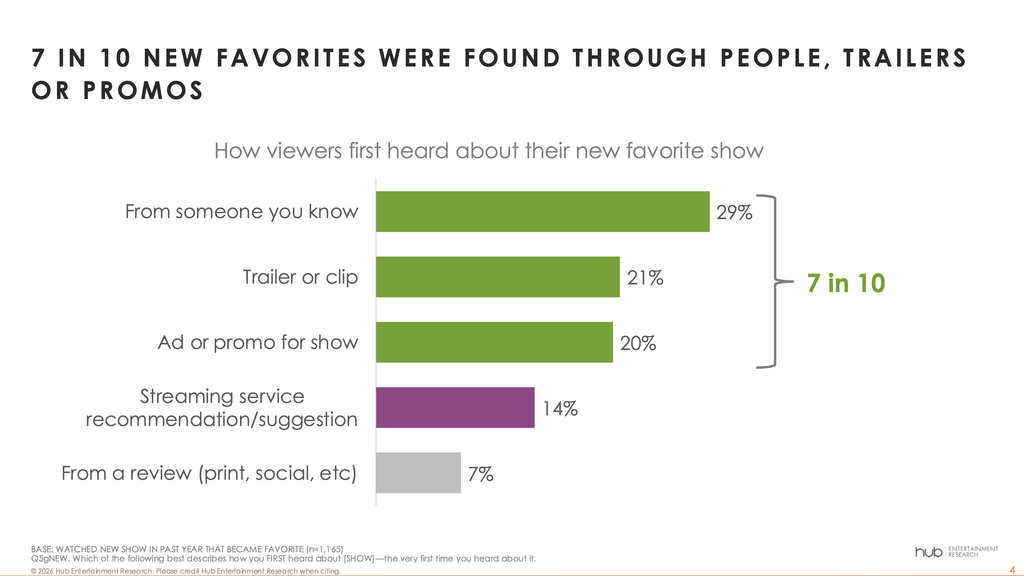
Hub Entertainment Research’s new Conquering Content study offers a pretty good clue. When viewers were asked how they first discovered their new favorite show, 29% said someone they know. Only 14% credited a streaming service recommendation.
That’s a pretty big gap for an industry that has invested so heavily in personalization.
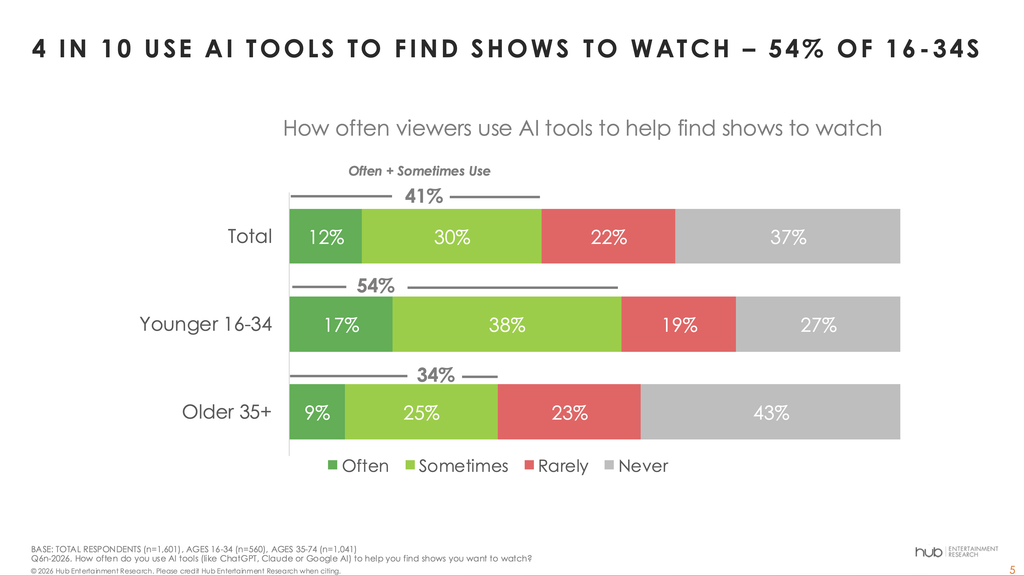
And now AI is getting in on the action. Hub found that 41% of viewers use AI tools to help find shows, rising to 54% among those ages 16-34.
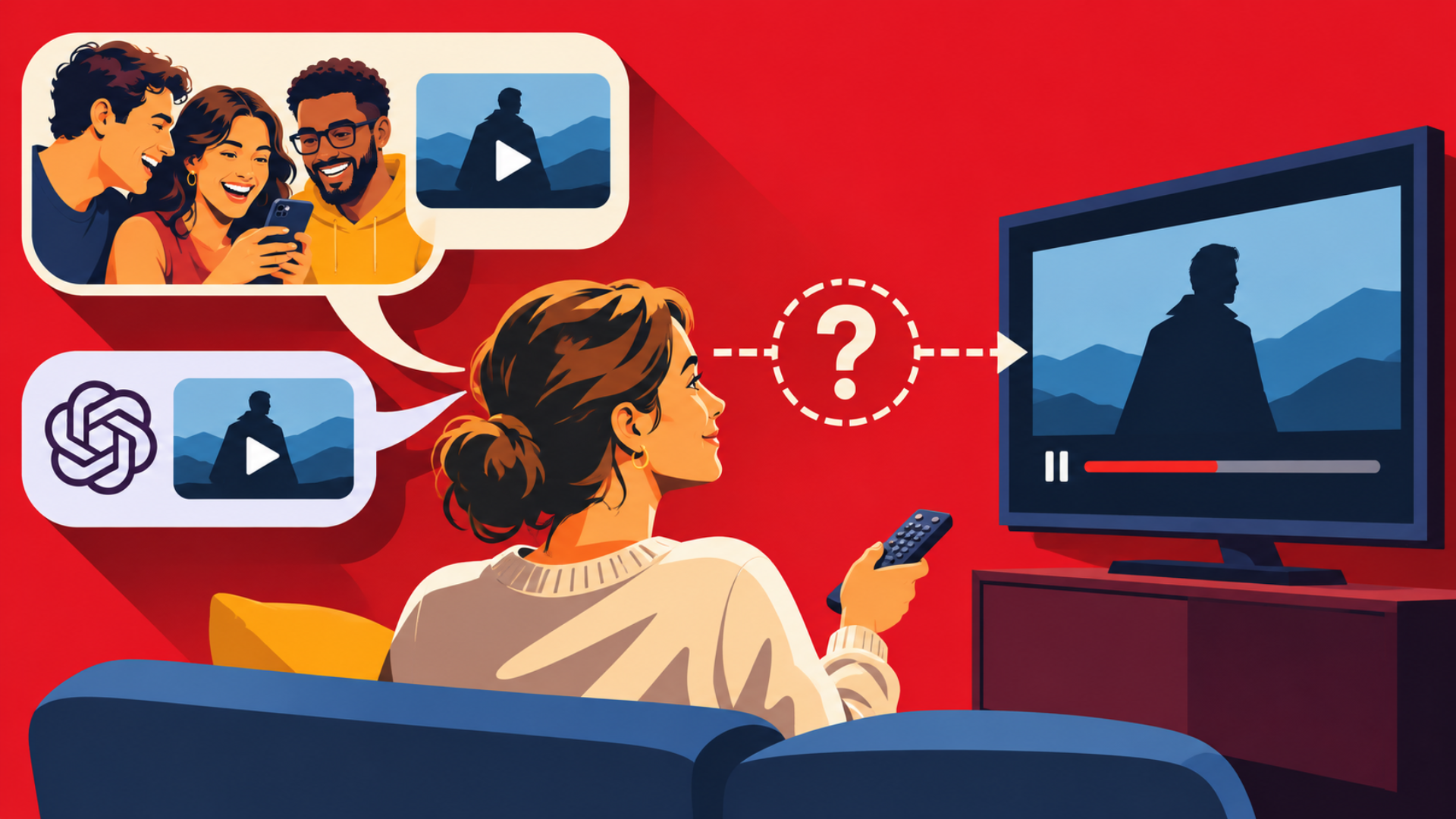
Streaming services have built incredibly sophisticated systems for figuring out what their subscribers might want to watch. Meanwhile, a huge amount of discovery is happening in group chats, social feeds, and conversations they can’t see.
There’s a business opportunity in figuring out how to turn more of those recommendations into actual viewing.
Friends Get First Dibs
Hub surveyed 1,601 U.S. consumers ages 16-74 in October and found that people they know were the leading source of initial discovery for viewers’ new favorite shows.
Trailers and clips came in at 21%, followed by ads and promotions at 20%. Streaming service recommendations accounted for 14%.
To be clear, those numbers tell us where people first heard about a show. They don’t tell us which recommendation finally convinced someone to hit play, or whether a friend’s suggestion is more accurate than an algorithm.
But they do show just how much discovery happens outside the streaming service itself.
And it tracks with other research. A July study from CTAM and Hub found that 68% of viewers do at least some of their viewing decision-making outside dedicated TV apps. Among viewers ages 13-24, 59% said TV recommendations don’t feel designed for them.
None of this should come as much of a surprise.
Your friend knows you’ve watched Succession three times and have strong opinions about the Roy family. They know you love a messy workplace drama, hate a slow pilot, and have been looking for something new to watch all week.
A recommendation engine has plenty of data, but your friend has context. And when they tell you to watch something, there’s a decent chance they’re going to ask you about it tomorrow.
Streaming services rarely know when that conversation happens.
They see the resulting viewing session, but they generally can’t tell whether someone arrived because of a friend’s recommendation, a TikTok clip, or something they heard at work.
That’s a lot of potentially useful information missing from the picture.
It’s especially frustrating when you consider that 47% of Hub’s respondents say they have trouble distinguishing the unique content offered by different streaming services, up from 41% last year. Another 56% wish it were easier to track when new movies become available to stream.
People are swimming in content and still asking their friends what to watch.
YouTube has already started bringing more of that conversation into its own experience through in-app messaging and video sharing.
The appeal is straightforward. Someone shares a video, another person watches it, and YouTube gets another opportunity to turn the interaction into more viewing.
Streaming services have plenty of programming people want to talk about. They’re just getting relatively little visibility into those conversations.
Old Shows, New Fans
One of the more interesting findings from Hub concerns older programming.
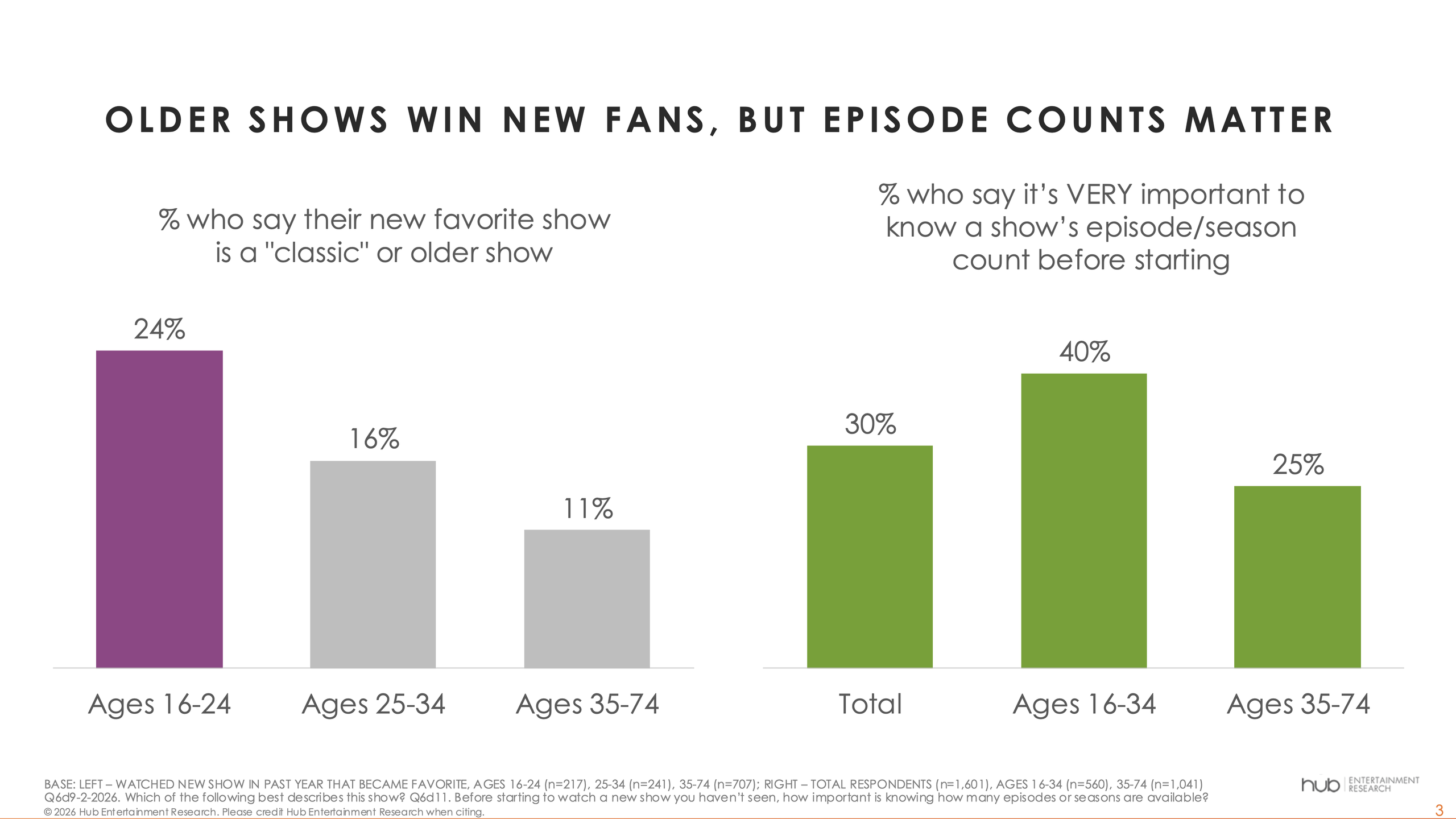
Among viewers ages 16-24, 24% said the new favorite show they discovered over the past year was a classic or older series. That compares with 11% of viewers ages 35 and older.
Young people are discovering shows that have been sitting in streaming libraries for years.
That’s good news for anyone with a deep catalog.
An older series can generate viewing hours long after its original marketing campaign has ended. For an ad-supported service, those hours can mean additional ad impressions. For a subscription service, they can contribute to engagement and potentially give subscribers another reason to stick around.
There’s also a fairly obvious problem.
Hub found that 40% of viewers ages 16-34 consider it very important to know how many episodes or seasons a show has before starting. Across all respondents, that number was 30%.
When Hub tested shows with different episode counts, the longest series received the lowest definite viewing-interest scores.
Which makes sense. Starting a show with 150 episodes is a commitment. You’d probably like some assurance that you’re going to enjoy it.
This is one place where fans are particularly useful.
Someone who loves a series can tell you why it’s worth watching, whether it takes a few episodes to get going, or which seasons are worth your time. Fan communities can do the same thing through viewing guides, discussions, and recommendations.
That kind of activity can keep old shows circulating long after the streaming service has moved on to promoting something newer.
The economics are worth paying attention to.
A service that owns its programming has already made the original production investment. Getting new audiences into that catalog can make the asset more productive. Licensed programming can benefit from additional consumption too, although the rights costs still have to make sense.
If existing fans can help introduce new audiences to older shows, streaming services have an opportunity to get more viewing out of programming they’re already paying to carry.
That’s an attractive proposition when every major service is trying to make its content spending work harder.
AI Wants In
Now there’s another player sitting between viewers and the shows they want to watch.
Hub found that 41% of viewers use AI tools such as ChatGPT, Claude, or Google AI often or sometimes to help find programming. Among viewers ages 16-34, that jumps to 54%.
And among people already using AI for discovery, 57% think it works better than traditional search engines.
It’s easy to imagine how this plays out.
A friend recommends a show. You vaguely remember the title, ask ChatGPT what it’s about, and then ask where you can watch it.
The whole discovery process can happen before you open Netflix, Hulu, or any other streaming app.
Tubi has already put its catalog inside ChatGPT, letting users describe what they’re in the mood for and receive recommendations they can watch on Tubi.
For a free, ad-supported service, that makes plenty of sense. More people finding the catalog creates more opportunities to generate viewing and advertising revenue. There’s no subscription decision standing between a recommendation and the content.
Netflix is taking a different route with AI Discover, which began rolling out to a small group of U.S. subscribers in November. Viewers can choose themes, refine recommendations, and give feedback directly inside Netflix’s TV app.
Netflix gets to keep those interactions inside its own service. Tubi gets another way to reach people who haven’t opened its app yet.
There’s a tradeoff in how much of the discovery process each company controls.
An outside AI service can influence which titles get suggested, how they’re described, and where the viewer goes next. That puts more importance on accurate metadata, current availability, and links that actually get people to the right show.
It also puts another company in a position to influence the viewing decision.
And AI still has some trust issues of its own. Gracenote’s 2026 research found that three-quarters of surveyed chatbot users verify AI responses, often through traditional search.
So there are still plenty of reasons for viewers to consult other sources before settling on something to watch.
What streaming services need to pay attention to is how much of that activity can take place without the viewer ever visiting their app until the final step.
Social Needs to Pay
There’s been a lot of discussion about making streaming more social. Some companies have already started experimenting.
Plex’s Discover Together experience lets people connect with friends, see what they’re watching, and share recommendations across their entertainment interests.
Netflix has introduced a mobile Clips experience that lets subscribers discover scenes, save titles, and share clips through messaging and social apps.
Both make it easier to turn someone’s enthusiasm for a show into something another viewer can act on.
But there’s a reason streaming services haven’t all rushed to build their own social networks.
Running a social product means dealing with moderation, privacy, identity, safety, and the small problem of getting enough people to participate in the first place.
And having a social graph doesn’t guarantee anyone wants to use it to watch TV.
Facebook learned that lesson with Watch. The company had an enormous user base, countless existing connections, and the ability to put video directly into people’s feeds. Its attempt to turn those advantages into a dedicated TV-viewing business didn’t work out.
Streaming services at least have something going for them that Facebook was trying to establish. People already show up intending to watch TV.
That makes smaller social features worth testing before anyone gets carried away building a full community product.
Think shareable watchlists, direct links to specific titles, recommendations from friends, and easy ways to find discussions about a show.
Those features could make existing social behavior more useful without requiring every streaming service to become a miniature Facebook.
Of course, adding a share button is easy compared with proving it makes money.
A thousand people sharing a clip sounds great. But how many of those shares brought someone into the service? How many led to an actual viewing session? Did those viewers stick around?
And would they have watched something on the service anyway?
That’s where the numbers start getting interesting.
Social features have operating costs. If they’re going to earn a place in the product budget, they need to generate viewing, improve engagement, or contribute to retention.
Likes and shares are nice. Additional viewing and revenue are better.
The Streaming Wars Take
Streaming services should start treating referrals as a measurable source of viewing demand.
A friend recommending an older series could lead to dozens of hours of consumption. A shared clip could bring an inactive subscriber back into an app. A recommendation from a fan community could introduce an entirely new audience to a show that hasn’t received a marketing push in years.
Each of those outcomes has a different economic value.
For an ad-supported service, additional viewing can generate more advertising inventory. For a subscription service, the question is whether those recommendations lead to more frequent engagement, subscriber reactivation, or better retention.
And there’s a catch. Getting someone to watch one title instead of another doesn’t necessarily generate more value for the service. The interesting number is the viewing that wouldn’t have happened otherwise.
That means testing social features against actual behavior. How many shared links turn into starts? Do referred viewers watch more than comparable viewers? Do those sessions translate into repeat visits? Does any of it reduce churn?
Those are much more useful questions than how many people clicked the share button.
The answers could also help services make better decisions about catalog promotion and marketing spending. If a relatively inexpensive referral feature gets people watching an older show, that may be a better use of money than another campaign promoting something subscribers already know exists.
AI makes the measurement challenge more urgent. More viewers are starting their searches in third-party products, giving those services greater influence over what gets recommended and where people end up.
Streaming companies can’t expect every discovery conversation to happen inside their own apps. They can make it easier for those conversations to lead to playback and do a better job measuring the value of the resulting activity.
There’s no need to build an entire social network to start figuring this out.
A friend is already telling someone to watch that show. The streaming service has already paid to make it available.
Getting better at connecting those two things could be a pretty good investment.
The Streaming Wars is intentionally ad-free
We don’t run display ads. Not because we can’t, but because we don’t believe in them.
They interrupt the reading experience. They cheapen the work. And they burn advertisers’ money on impressions nobody actually wants.
So we chose a different model.
We say the things people in this industry are already thinking but don’t say out loud. We connect the dots beyond the headline and focus on explaining why things matter to the people working in this business.
If you believe industry coverage can exist without clutter and interruption, you can support it here → SUPPORT TSW.
Support is optional. But it directly funds research and continued coverage — and helps prove this model can work.
Support TSW →