
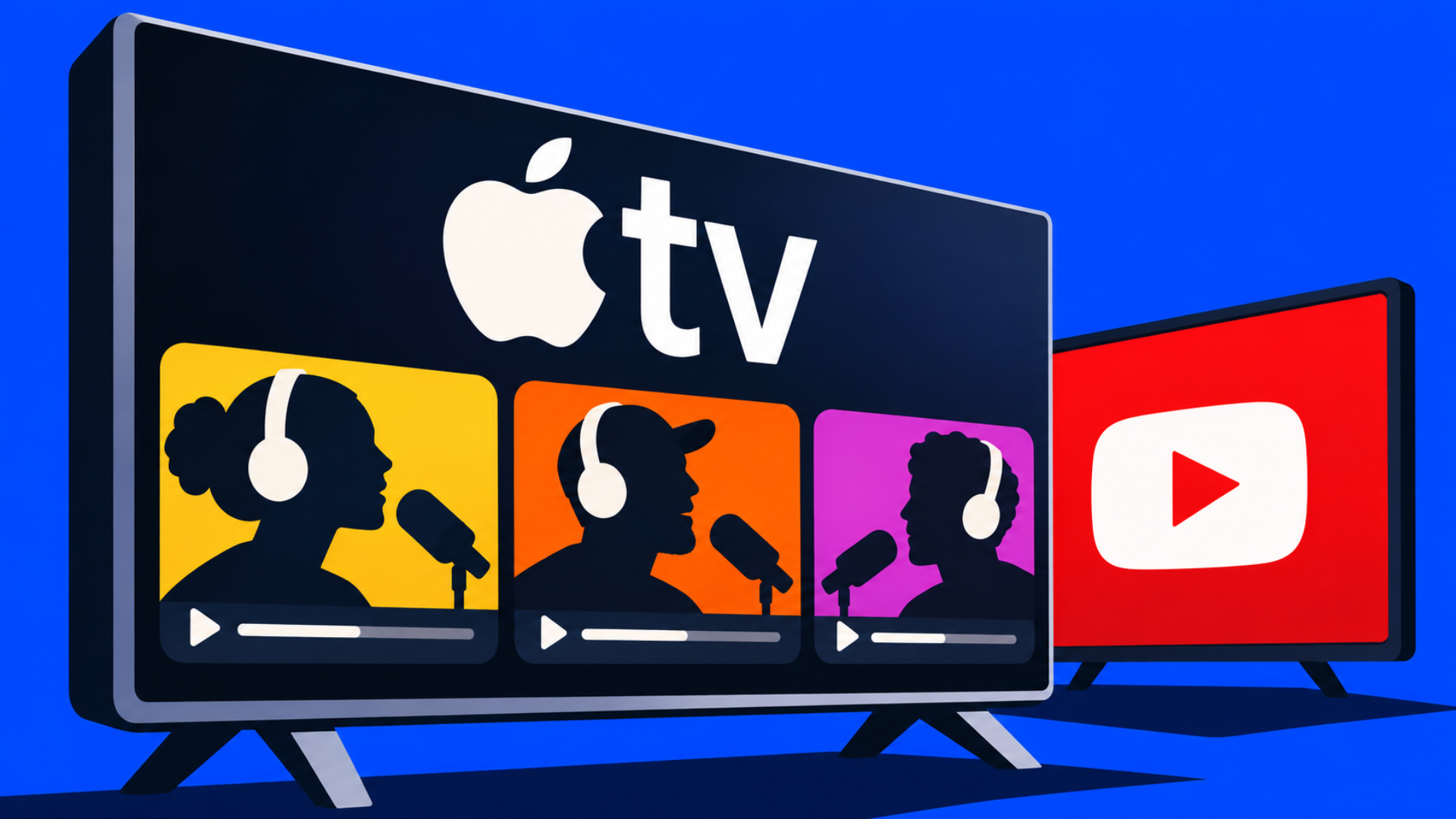
Apple is bringing free video podcasts into the Apple TV app, turning its existing podcast catalog into TV programming without negotiating individual licensing deals or paying to produce shows.
Developer testing began November 16, with a public rollout planned for the United States, United Kingdom, Australia, Canada and Mexico. Apple hasn’t announced a consumer launch date. The Apple TV app already reaches more than one billion devices globally, including Roku players and supported smart TVs. Viewers won’t need an Apple TV subscription.
Apple gains a supply of recurring programming at relatively little incremental content-acquisition cost. Publishers retain their advertising relationships and distribution rights. YouTube faces another competitor for the viewing hours that have made it the leading podcast destination.
Apple’s challenge is generating enough incremental viewing and advertising revenue to make that additional distribution commercially valuable.
Apple Skips the Check
Every eligible public video podcast distributed through Apple Podcasts will automatically appear in the Apple TV app. Publishers won’t need another agreement, and their existing feeds remain the source of the programming.
Apple laid the technical foundation with its HLS video upgrade to Apple Podcasts. Announced in February and rolled out in the spring, the system allows users to switch between watching and listening while supporting dynamic video advertising through participating hosting providers.
The TV app extends that infrastructure to another viewing environment without requiring Apple to negotiate programming rights individually.
Publishers finance the episodes and maintain production schedules. Hosting providers deliver the video. Apple supplies playback, discovery and distribution.
The company also benefits from an app already available on hardware made by competitors. Roku players, smart TVs and other supported devices give Apple access to living rooms without depending on Apple TV 4K hardware sales.
The tradeoff is limited exclusivity. Creators can continue distributing the same public episodes through YouTube, Spotify and other services while maintaining their existing sponsorships.
Apple can expand its programming catalog with minimal licensing friction. Its control over merchandising and discovery will determine how much viewing that catalog generates.
Spotify Feeds a Rival
Spotify is helping supply the infrastructure that can populate Apple’s competing TV experience.
On November 13, Spotify’s Megaphone began supporting HLS video distribution to Apple Podcasts. Publishers that enable the integration can deliver eligible video episodes to Apple without changing hosting providers.
Once distribution is configured, existing episodes can be processed for Apple Podcasts, and new video episodes are delivered automatically. Eligible public programming can then appear in the Apple TV app.
Spotify retains the hosting relationship. Apple gains another potential source of programming and viewer engagement.
The arrangement reflects Spotify’s broader approach to monetizing podcasts across competing services.
Its nonexclusive Joe Rogan agreement preserves Spotify’s advertising-sales and licensing relationship while allowing the show to reach audiences through YouTube, Apple Podcasts and other destinations.
Spotify can maintain commercial relationships with programming even when another company controls playback and discovery.
Megaphone’s integration extends that separation between publishing infrastructure and viewing destinations. Publishers can expand distribution without necessarily changing their existing hosting arrangements.
The commercial value of those relationships increasingly depends on which company controls advertising rights, which service attracts viewers and how effectively that consumption can be monetized.
Netflix Buys Scarcity
Netflix has approached video podcasts through negotiated programming deals.
Its partnerships with Spotify, iHeartMedia and Barstool Sports have brought established personalities and recurring shows into the streaming service.
The Barstool agreement gives Netflix exclusive video distribution rights to Pardon My Take, The Ryen Russillo Podcast and Spittin’ Chiclets, while their audio versions remain available elsewhere.
Netflix secures programming that competing video services can’t freely distribute under those agreements. That exclusivity requires commercial commitments and negotiations over which shows justify the investment.
Apple avoids those individual negotiations by distributing eligible public programming already available through Apple Podcasts.
Netflix can differentiate its catalog through exclusive video rights and offer publishers negotiated commercial terms. Apple can offer nonexclusive distribution across an existing device footprint without requiring publishers to surrender their other audiences.
The economics of Netflix’s podcast expansion depend on relatively inexpensive, frequently refreshed programming generating recurring viewing.
Established podcast personalities bring recognizable formats, production operations and release schedules. Netflix can use those programs to encourage repeat visits between larger entertainment releases.
Apple gets access to a broader catalog without making comparable commitments for individual shows.
Netflix pays for differentiated programming. Apple concentrates its investment on the technology and distribution needed to make public programming available at scale.
YouTube Owns the Hours
YouTube enters this competition with a substantial audience advantage.
Edison Podcast Metrics ranked YouTube first among services used most often by weekly US podcast consumers in the third quarter of 2026. Spotify followed at 17%, while Apple Podcasts accounted for 9%.
YouTube also reports more than one billion monthly podcast viewers globally.
In October 2025, viewers watched more than 700 million hours of podcasts on living-room devices, up from 400 million hours a year earlier.
YouTube has established consumption at a scale Apple hasn’t demonstrated for video podcasts.
Its advantage extends across discovery, engagement and monetization.
Clips introduce viewers to creators. Search and recommendations connect them to longer episodes. Subscriptions and notifications provide additional ways to generate recurring consumption.
YouTube is also extending its Stations format to creator programming, giving existing video catalogs another route into continuous, TV-style viewing.
Apple is developing its own merchandising capabilities for larger screens.
New widescreen artwork and 30-second show previews will help publishers present their programming inside the TV app. Playback will also synchronize between Apple Podcasts and Apple TV, allowing viewers to resume episodes across supported devices.
Those capabilities give Apple more ways to introduce programming to viewers and move existing podcast audiences between screens.
The company reports growth in its video catalog. Over the past three months, the number of shows publishing video through Apple Podcasts has more than doubled, while its catalog of video episodes has nearly tripled.
Apple also says popular podcasts that introduced video experienced total audience growth of more than 20% on average.
The company hasn’t disclosed the underlying show counts or total video-podcast viewing hours.
YouTube’s established viewing behavior gives it a commercial advantage that Apple will have to overcome through discovery, engagement and measurable incremental consumption.
The Ad Stack Has Holes
Apple is preserving the advertising arrangements publishers already use, although monetization capabilities vary across hosting providers.
Dynamic and baked-in video advertisements distributed through Apple Podcasts can continue playing inside the Apple TV app. Publishers retain control of their advertising relationships and aren’t required to transfer sales to Apple.
The availability of dynamic video advertising depends on the hosting provider.
Apple’s current hosting-provider directory lists Megaphone as supporting video distribution but not dynamic video ads. Other providers, including Acast, ART19 and Omny Studio, support both.
A publisher using Megaphone can distribute video to Apple Podcasts and maintain baked-in sponsorships. It can’t assume the same integration supports dynamically inserted video advertising.
That limits how easily some publishers can turn incremental viewing into addressable advertising inventory.
Apple has also announced plans to charge participating advertising networks an impression-based delivery fee for dynamically inserted HLS video ads. The company originally scheduled that fee for later in 2026 and hasn’t disclosed revenue generated through the new TV experience.
The broader TV app distribution will also exclude subscriber-only podcast episodes. Paid podcast content remains within the Apple Podcasts experience on supported devices.
For publishers, Apple’s free TV offering creates another potential source of advertising-supported viewing without another content-production commitment.
Their ability to monetize that opportunity depends on existing sponsorship rights, hosting capabilities and demand from advertisers.
Those operating requirements can influence whether a publisher simply enables another distribution destination or invests additional resources in maximizing its value.
The Metrics Lag the Pitch
Apple’s reporting creates another limitation for publishers evaluating video distribution.
Apple Podcasts currently groups audio and video consumption together in its overall show analytics. Publishers can monitor aggregate engagement, but those combined figures don’t independently establish how much consumption came from video or the Apple TV app.
Megaphone also counts HLS video streams and downloads as downloads within its reporting. Advertising impressions are counted when an ad or sponsorship is streamed or downloaded.
Those metrics provide consumption and advertising-delivery information, but they don’t independently establish the incremental connected-TV audience created by Apple’s expansion.
Publishers need to distinguish viewers who discover a show through the TV app from existing listeners moving between audio and video. Advertisers also need reliable reporting on unique reach, viewing frequency and monetizable inventory.
Without that visibility, publishers face greater difficulty assessing how much additional revenue Apple’s TV distribution generates.
The measurement challenge also affects licensing decisions.
A publisher considering exclusive video rights needs to estimate the revenue it would forgo by removing programming from other destinations. That calculation becomes less reliable when a potential distributor can’t separately demonstrate its contribution to viewing and advertising revenue.
Apple’s billion-device footprint establishes broad potential availability. Publisher investment will depend on the consumption, audience information and advertising returns those devices actually generate.
The Streaming Wars Take
Apple’s expansion gives hosting providers with comprehensive video advertising capabilities another opportunity to compete for publishers.
Companies that support HLS distribution, dynamic video insertion and detailed performance reporting can offer a more complete commercial proposition than providers offering video delivery alone.
That could create pressure on hosting vendors to expand their advertising and measurement capabilities as publishers evaluate which infrastructure best supports monetization across competing viewing destinations.
It also complicates the economics of exclusive video licensing.
Netflix can offer publishers negotiated compensation for surrendering competing video distribution rights. Apple offers another potential source of advertising revenue, but that opportunity has to be measured before publishers can incorporate it reliably into licensing negotiations.
If Apple’s TV app delivers incremental audiences and monetizable advertising inventory, publishers will have more revenue to consider when negotiating exclusivity. Buyers seeking those rights could face higher compensation demands.
YouTube retains the strongest established viewing position. Spotify can preserve hosting and advertising relationships even when audiences consume programming elsewhere. Netflix can provide exclusive placement and negotiated economics.
Apple has reduced the cost of adding another TV distribution outlet without taking on the financial commitments associated with licensing individual shows.
The pressure now shifts toward the infrastructure supporting that distribution.
Hosting providers need to make video advertising commercially viable. Apple needs to give publishers enough visibility into viewing behavior to establish the incremental value of its TV audience.
Until publishers can measure and monetize that additional viewing, Apple’s billion-device footprint will have limited influence over what buyers must pay for exclusive podcast rights.
The Streaming Wars is intentionally ad-free
We don’t run display ads. Not because we can’t, but because we don’t believe in them.
They interrupt the reading experience. They cheapen the work. And they burn advertisers’ money on impressions nobody actually wants.
So we chose a different model.
We say the things people in this industry are already thinking but don’t say out loud. We connect the dots beyond the headline and focus on explaining why things matter to the people working in this business.
If you believe industry coverage can exist without clutter and interruption, you can support it here → SUPPORT TSW.
Support is optional. But it directly funds research and continued coverage — and helps prove this model can work.
Support TSW →