
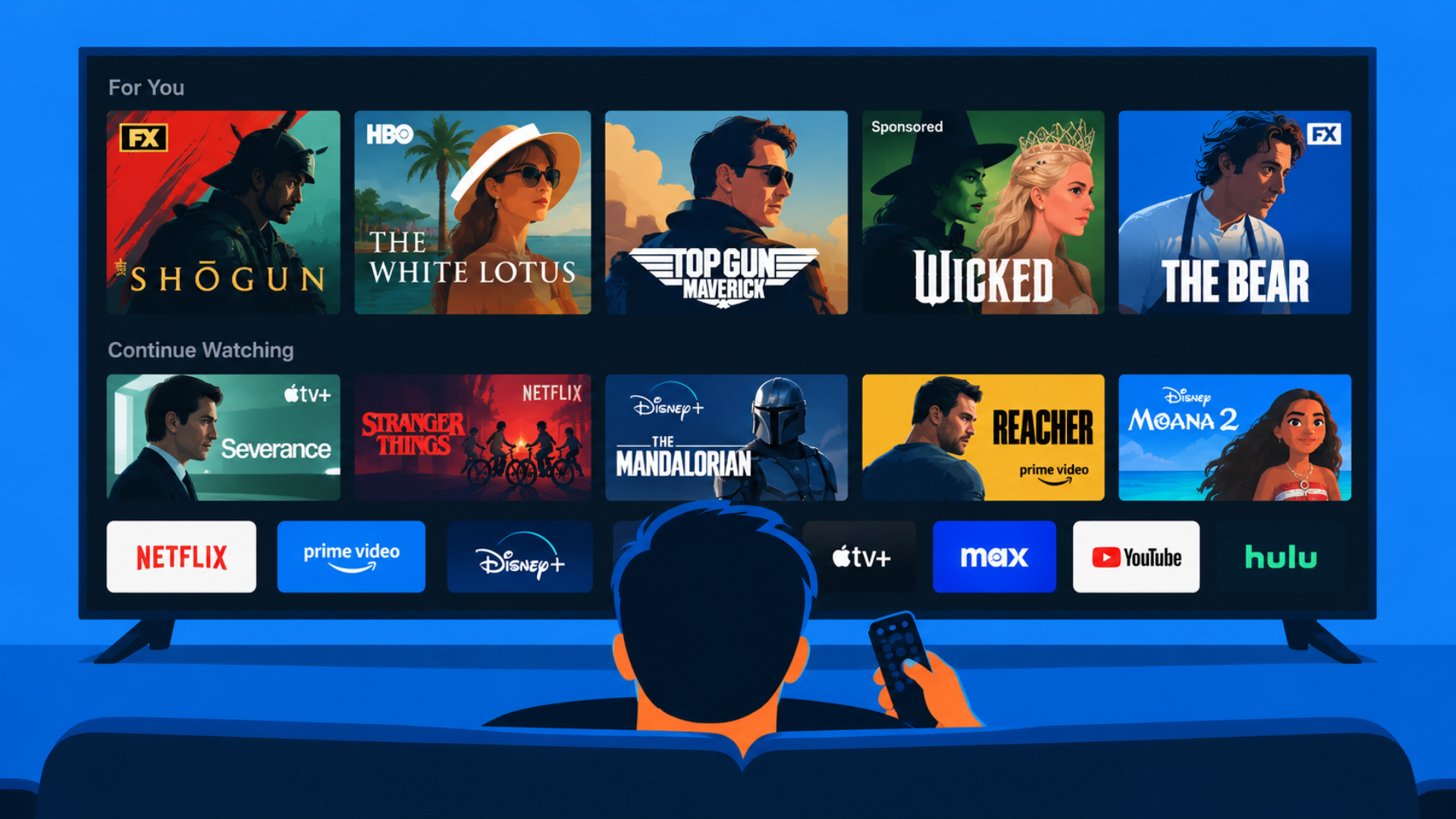
When a paid title sits next to an editorial pick or a personalized recommendation on the TV home screen, should the viewer have to be told which one was bought?
— Reporter
If money changed whether the viewer saw the recommendation, the viewer should be able to tell.
Amazon already puts paid Fire TV tiles inside rows labeled “Sponsored.” Google says ads on Google TV and Android TV are labeled as ads. The basic disclosure isn’t hard.
It gets messier when the paid tile looks almost exactly like everything around it.
The same movie artwork can show up because somebody bought the placement, an editor picked it, an algorithm thinks you’ll like it, a distribution deal included promotion, or the OS has its own reason to push that destination.
Those are very different reasons to get the same piece of real estate.
The Home Screen Catches You Mid-Decision
TV home-screen inventory is valuable because it catches the viewer while they’re deciding what to watch.
Roku sells native ads that sit directly on its home screen. Google sells the first slot in the Google TV Featured carousel as its Masthead. Samsung is making high-impact home-screen inventory available programmatically.
These aren’t commercials running between shows. They’re sitting inside the place where people pick the show.
They’re valuable because they sit right where the viewer is choosing what to watch, which is exactly why a paid tile needs a clear label.
The closer a paid placement looks to an ordinary recommendation, the easier it is for the viewer to assume the TV put it there because it was relevant.
The Same Tile Can Get There for Very Different Reasons
TV operating systems can put a title in front of you for several different reasons before you ever open an app.
Somebody paid for it.
An editor picked it.
The recommendation system picked it.
The streaming service supplied it.
The distributor promised the programmer some merchandising as part of a broader deal.
All five can wind up looking like a rectangle with key art.
You’d judge each one differently.
A paid placement has to justify the spend. An editorial placement is a programming choice. An algorithmic recommendation should be relevant to the viewer. A negotiated placement belongs in the economics of the distribution deal.
Mix all of that together in reporting and you’ll eventually give credit to the wrong thing.
The marketer thinks the campaign drove the traffic. Distribution thinks it won great merchandising. Product blames the algorithm. Meanwhile, the competitor may have simply bought the slot.
That gets expensive quickly because premium home-screen positions are scarce. Put one title in the best position and something else moves.
I want reporting that tells me why the title got that position
If “Sponsored” Hurts Performance, That Tells You Something
Suppose adding “Sponsored” to a placement lowers the click-through rate.
Now you know some of the performance may have come from viewers treating the tile like an ordinary recommendation.
A clearly labeled native ad can still work extremely well. You’ve got the audience, the timing, the creative, and some of the best real estate on the TV.
If the economics only work when viewers don’t realize somebody paid for the placement, some of the value is coming from the confusion.
I wouldn’t build much of a business around that.
A Disclosure You Can’t Read From the Couch Doesn’t Count
The FTC already gives advertisers a pretty sensible standard.
When a native ad could be mistaken for non-advertising content, the disclosure needs to be clear and prominent enough for people to actually notice and understand it.
TV adds a practical problem: the viewer may be ten feet away.
The artwork is huge. The supporting copy can be tiny. A tile can expand when it gets focus. Video starts moving. The UI changes as you navigate.
A little “Sponsored” label that technically exists but can’t be read from the couch isn’t doing a whole lot.
“Sponsored” is fine. Make it readable. Keep it attached to the placement when the tile expands or changes state. Don’t bury it somewhere the viewer has to click to find.
If money changed why that recommendation is on the screen, somebody sitting on the couch should have a fair shot at knowing it.
The Answer Can Be an Ad
Conversational discovery makes this more important because the recommendation sounds like advice.
Amazon already puts sponsored entertainment titles inside Alexa+ entertainment queries on eligible Echo Show devices. Viewers can interact with the paid result by voice or touch and move into a subscription, rental, or purchase.
Alexa+ is also now making personalized entertainment recommendations on Fire TV.
Suppose I ask, “What’s a good thriller to watch tonight?”
If a studio paid to influence the answer, tell me.
“Here’s a sponsored pick you might like” is enough.
One plain word can do the job.
And if the recommendation is spoken, say the disclosure too. If somebody paid for the answer coming out of the speaker, “sponsored” should come out with it.
A spoken recommendation feels personal because the viewer asked a direct question and got a direct answer. If somebody paid to influence that answer, make that obvious.
Streamers Need to Know Why They Got the Slot
Streamers need the same clarity.
If my title showed up 500,000 times, I want to know why.
How much came from paid media? How much was editorial? How much came from the recommendation system? How much was guaranteed in a distribution deal?
Without that split, I can’t tell what worked.
I might increase my media budget because I think the paid campaign drove the launch when the OS actually gave me a pile of free editorial exposure.
I might blame weak organic discovery when a competitor bought the premium inventory around me.
I might credit my own marketing for traffic the TV home screen created.
A lot of the most important discovery now happens before the viewer ever enters the streaming app. By the time your app analytics start, the OS may already have decided which title the viewer saw, how prominently they saw it, and which service they clicked.
Partner reporting should separate paid, editorial, algorithmic, and negotiated exposure.
A screenshot and a big impression number aren’t enough.
Don’t Call Everything “Sponsored”
I’d keep the label tied to actual paid placement.
Roku promoting The Roku Channel is different from Warner Bros. Discovery paying Roku to promote a premiere. Amazon surfacing Prime Video is different from a studio buying Fire TV inventory. Samsung promoting Samsung TV Plus is different from an advertiser buying Samsung’s home screen. You get it.
The OS still has a financial interest in its own service. Nobody paid it for that particular placement.
Track that separately.
How much premium inventory goes to the operator’s own service? What happens when its service and a partner carry the same title? Which positions are available to buy? Which ones are reserved? Did the programmer actually get the merchandising promised in the distribution agreement?
Those questions belong in the distribution deal.
Making “Sponsored” mean every situation where the OS has an economic interest would make the label useless.
If Everything Looks Paid, Recommendations Get Less Useful
TV operators have every reason to make this a big business.
Roku sells high-visibility home-screen native ads. Samsung is opening premium home-screen inventory to programmatic buyers. Google sells the first slot in its Featured carousel.
That space is valuable because the viewer is already there looking for something to watch.
A recommendation also works better when the viewer believes relevance had something to do with why it appeared.
If every prominent title looks bought, the home screen starts turning into a Google results page: technically useful, but you’re scanning past the ads to find the answer you actually trust.
Eventually it makes the paid inventory worse too, because advertisers are buying access to the same viewer attention the OS just trained people to distrust.
Paid Placement Doesn’t Need to Hide
I have no qualms with TV OS owners making money from discovery.
Streaming services will pay for home-screen exposure when it creates incremental subscribers, viewing, or transactions. Studios will pay to put a premiere in front of millions of households before those viewers disappear into an app. That inventory is worth real money because it sits between “I want to watch something” and the thing they actually choose.
Label the paid placement.
Keep paid, editorial, algorithmic, and negotiated exposure separate in partner reporting. Make the disclosure readable from the couch. If AI says the recommendation out loud, carry the sponsorship into the answer. Give buyers enough information to verify what they actually bought.
Then measure the hell out of it.
If the labeled placement still produces incremental business, keep selling it.
If performance falls apart once people know somebody paid for the recommendation, price that into the media product instead of hiding the label.
Ask Me Anything
Whether you’re fed up, fired up, or just want the truth behind the trends, send me your questions using this form. Anonymity guaranteed. Bullshit not included.
The Streaming Wars is intentionally ad-free
We don’t run display ads. Not because we can’t, but because we don’t believe in them.
They interrupt the reading experience. They cheapen the work. And they burn advertisers’ money on impressions nobody actually wants.
So we chose a different model.
We say the things people in this industry are already thinking but don’t say out loud. We connect the dots beyond the headline and focus on explaining why things matter to the people working in this business.
If you believe industry coverage can exist without clutter and interruption, you can support it here → SUPPORT TSW.
Support is optional. But it directly funds research and continued coverage — and helps prove this model can work.
Support TSW →