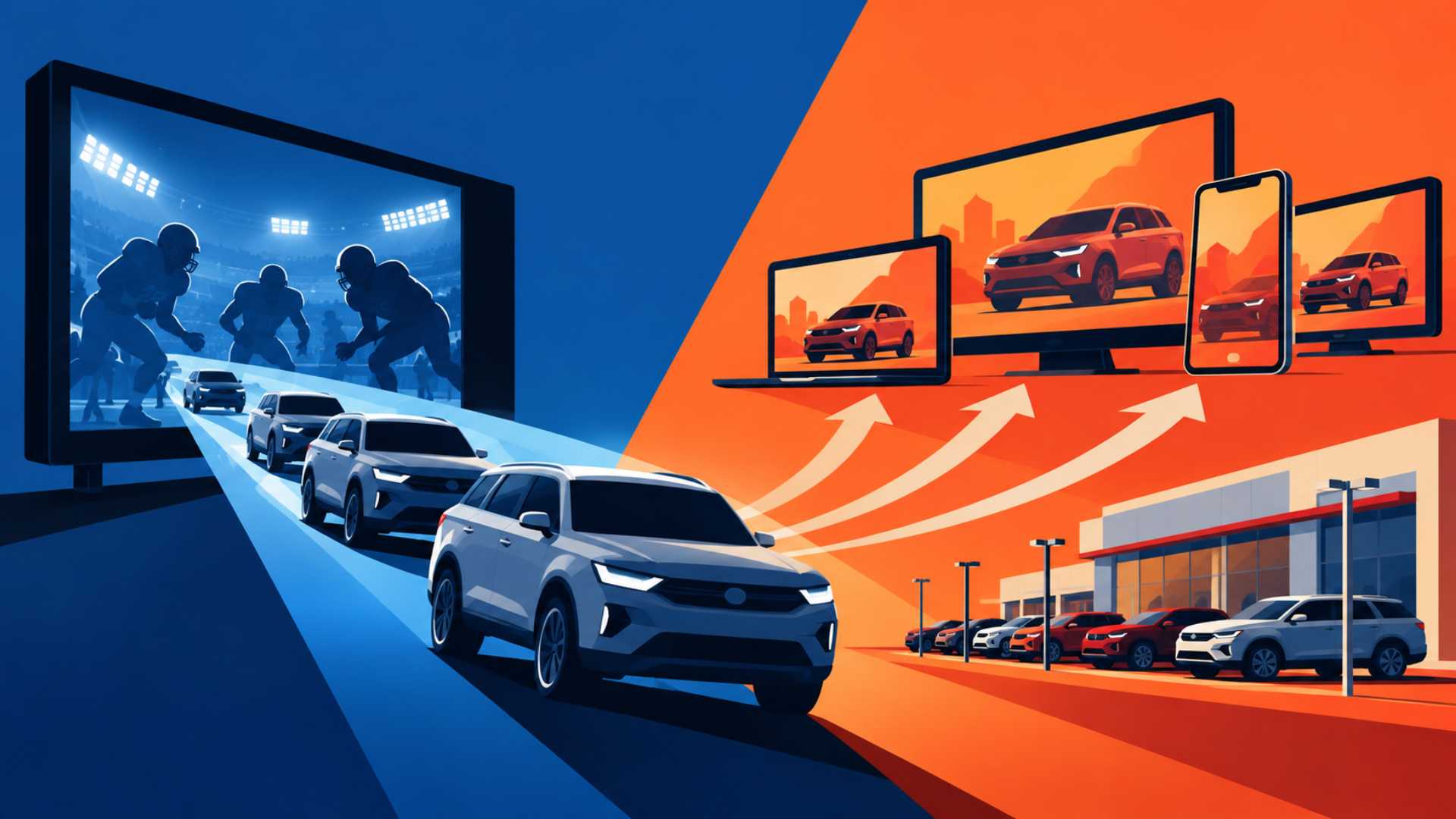
Automakers are moving advertising dollars from national TV campaigns toward streaming and regional promotions tied more directly to vehicle sales. iSpot estimates national linear TV spending by automakers fell 14.8% through August 2026, while regional dealer campaigns have taken a larger share of the category’s remaining linear budget. National networks are losing a dependable source of advertising demand, giving buyers more leverage to challenge premium rates and redirect spending toward sellers that can demonstrate results closer to the dealership transaction.
Automakers Cut National TV Spending, Weakening Networks’ Leverage in Ad Negotiations
Automakers spent an estimated $1.1 billion on national linear TV through August 2026, down 14.8% from the same period in 2025, according to iSpot. Household TV ad impressions declined 16% over the same period.
The pullback is visible even in programming that continues to attract automotive advertisers.
During the NFL season’s opening week, car and truck commercials totaled 107 across 15 games, compared with 158 across 16 games three years earlier. The samples differ in game count and distribution, including one game moving to streaming, so the commercial totals aren’t directly comparable spending measures. The national spending decline provides stronger evidence of the category’s reduced investment.
Guideline’s January–May 2026 data shows total automotive media spending fell 3% year over year. Digital accounted for 69% of the category’s media mix, compared with 29% for linear TV. Digital includes search, social, display and online video alongside streaming.
Automakers are reducing overall spending while reallocating more of the remaining budget outside traditional TV. Networks consequently face pressure from both a smaller category budget and a lower share of the spending that remains.
Automotive advertisers have historically supplied substantial demand for national programming, particularly live sports and primetime entertainment. A smaller pool of national commitments forces networks to replace that spending with other categories or negotiate more aggressively on pricing, placement and audience guarantees.
Cable faces particular exposure because much of its general entertainment inventory competes with alternative digital video buys that offer geographic targeting and more flexible campaign budgets.
Automakers Shift Linear Budgets Toward Regional Dealers, Forcing Networks to Compete Market by Market
Regional Tier 2 campaigns accounted for nearly 40% of automakers’ linear TV spending through August 2026, up from approximately 20% in 2023.
The figures describe a change in spending share rather than absolute regional spending growth. They show that a substantially larger portion of the category’s linear budget now goes toward regional campaigns rather than national brand advertising.
Automakers have a financial incentive to direct advertising toward markets where a promotion can produce an immediate sale.
Vehicle availability, dealer inventory, financing terms and manufacturer incentives differ across regions. A truck promotion may generate stronger returns in one market while another needs support for a different model or lease offer.
Regional campaigns can adjust those messages without purchasing nationwide coverage. Dealer associations can concentrate spending around specific vehicles, financing offers and promotional periods, then change the creative as sales conditions change.
The shift also changes who competes for the advertising dollars.
National network sales teams previously captured more spending through broad campaigns purchased centrally by automakers. Regional budgets create opportunities for local broadcasters, cable operators, streaming sellers and advertising technology companies that can reach specific markets.
Some of that money remains within linear TV through local stations and regional placements. Other spending moves into streaming and digital media capable of serving different messages to households within the same viewing market.
Local targeting introduces its own pricing risk. Political advertising has already pushed premium CTV CPMs as high as $43 in some competitive markets, increasing competition for geographically limited inventory ahead of the November 3 elections.
An automaker can reduce wasted national exposure by concentrating spending around dealerships, but regional demand can make the audiences it needs more expensive to reach.
The economic advantage depends on whether the additional sales generated by that targeting justify the cost of the impressions purchased.
Streaming Sellers Gain Auto Video Impressions, Facing Pressure to Prove Sales Beyond Clicks
Streaming sellers are gaining automotive advertising activity as manufacturers seek greater control over audience selection, creative variations and campaign spending.
Sensor Tower estimates that automotive advertising gained approximately eight percentage points in OTT’s share of video ad impressions between the first quarter of 2024 and the second quarter of 2026.
Innovid’s 2026 automotive advertising research found that 86% of surveyed automotive marketers were increasing CTV spending.
Streaming allows an automaker to run different campaigns across households and markets without changing the programming carrying the advertising.
A manufacturer can promote a particular model in markets where dealerships have available inventory, adjust the offer as incentives change and direct viewers toward relevant dealership information.
That flexibility gives streaming sellers a stronger position when automakers allocate spending against immediate sales objectives.
The measurement requirements become more demanding as budgets move closer to the transaction.
Website visits, vehicle searches, quote requests and inferred dealership visits can provide useful signals about campaign performance. Those activities don’t establish how many additional vehicles the advertising caused consumers to purchase.
Urban Science’s 2026 automotive research found that vehicle buyers increasingly cross-shop across brands and dealerships over purchase journeys lasting one to three months. Delays in dealership sales data also make it harder to connect advertising activity with completed purchases.
A buyer may encounter national TV advertising, streaming commercials, search advertising and dealership promotions before making a purchase. Individual media sellers can claim influence over the same transaction, creating a risk of overstating their contribution.
Innovid found that 78% of surveyed automotive marketers identified fragmentation across publishers and platforms as a major challenge, while 56% cited cross-channel measurement complexity.
Automakers therefore need reliable dealer sales data, consistent campaign identifiers and methods for estimating incremental purchases if they want to judge targeted advertising against actual vehicle sales.
Streaming sellers gain access to budgets that national networks previously captured more routinely. Retaining those budgets will require stronger evidence that their advertising produces additional sales rather than simply reaches consumers already preparing to buy.
Networks Sell Live Sports Reach Into a Smaller Auto Market, Raising the Bar for Premium Rates
National TV retains substantial advertising exposure even as automakers redirect spending.
Comscore attributed 77.7% of measured in-home TV ad-exposure time to broadcast and cable programming in August 2026. That includes commercials delivered through virtual pay-TV services and attributed to their originating networks.
The Comscore exposure figures measure advertising time rather than unique reach, spending or campaign effectiveness. Networks still need to establish what advertisers should pay for that inventory.
Pricing pressure is already evident in the broader market.
Media Dynamics estimates cable’s 2026–27 primetime upfront commitments declined approximately 7.7%, while average cable CPMs fell 8.5% to $17.70. Broadcast commitments and average rates also declined, although less sharply than cable’s.
Those figures reflect marketwide negotiations rather than the isolated effect of automotive spending. The category’s pullback adds pressure to sellers already competing for smaller national commitments.
Live sports retain a stronger commercial position because they concentrate large audiences around programming that viewers consume at the same time.
Automakers continue to purchase that reach. NFL preseason games accounted for more than 22% of their national linear TV spending in August, according to iSpot.
A national campaign can introduce a new vehicle to millions of potential customers and establish brand demand across markets. Streaming’s geographic targeting offers a different purchasing proposition, particularly when the objective is to convert existing interest into dealership activity.
The challenge for networks is defending premium rates across programming that delivers different levels of incremental reach.
High-profile sports can justify national investment when automakers need broad awareness for a model launch. General entertainment and cable inventory face a harder negotiation when buyers can pursue similar households through targeted digital alternatives.
Networks can respond by combining national reach with local addressable advertising, regional placements and cross-screen measurement.
Those packages would let advertisers retain broad distribution while directing portions of their spending toward individual markets. They would also require networks to demonstrate how the combined inventory contributes to results beyond the audiences an automaker can already reach through streaming and digital campaigns.
The Streaming Wars Take
National networks have an opportunity to change the commercial terms of automotive advertising by selling national brand reach and regional sales activation within the same agreement.
Such packages could combine live sports, local affiliates, addressable inventory and streaming distribution, allowing an automaker to support a national vehicle launch while directing separate messages toward markets with specific inventory or promotional needs.
Executing those campaigns introduces additional obligations for sellers. Creative must reflect current offers, geographic targeting must match dealership coverage, and measurement must distinguish additional customer reach from repeated exposure.
Streaming sellers face comparable requirements around verified sales outcomes. The ability to identify a household or target a ZIP code provides limited evidence of economic return without reliable information about resulting purchases.
Automakers also face a cost beyond media placement.
National brand advertising creates demand that regional dealers can convert through financing offers and promotions. Reducing brand investment too aggressively could leave dealers more dependent on discounts and incentives to move vehicles, potentially offsetting advertising savings through lower margins.
That risk gives manufacturers a reason to maintain national campaigns even as they demand stronger performance from the spending allocated to individual markets.
The commercial opportunity for TV sellers is to establish how much additional demand national reach generates and connect that demand to measurable local activity.
Networks that can demonstrate that contribution have a stronger basis for defending premium rates. Those relying primarily on aggregate audience exposure face buyers with more alternatives, narrower geographic requirements and greater control over where the next advertising dollar goes.
The Streaming Wars is intentionally ad-free
We don’t run display ads. Not because we can’t, but because we don’t believe in them.
They interrupt the reading experience. They cheapen the work. And they burn advertisers’ money on impressions nobody actually wants.
So we chose a different model.
We say the things people in this industry are already thinking but don’t say out loud. We connect the dots beyond the headline and focus on explaining why things matter to the people working in this business.
If you believe industry coverage can exist without clutter and interruption, you can support it here → SUPPORT TSW.
Support is optional. But it directly funds research and continued coverage — and helps prove this model can work.
Support TSW →