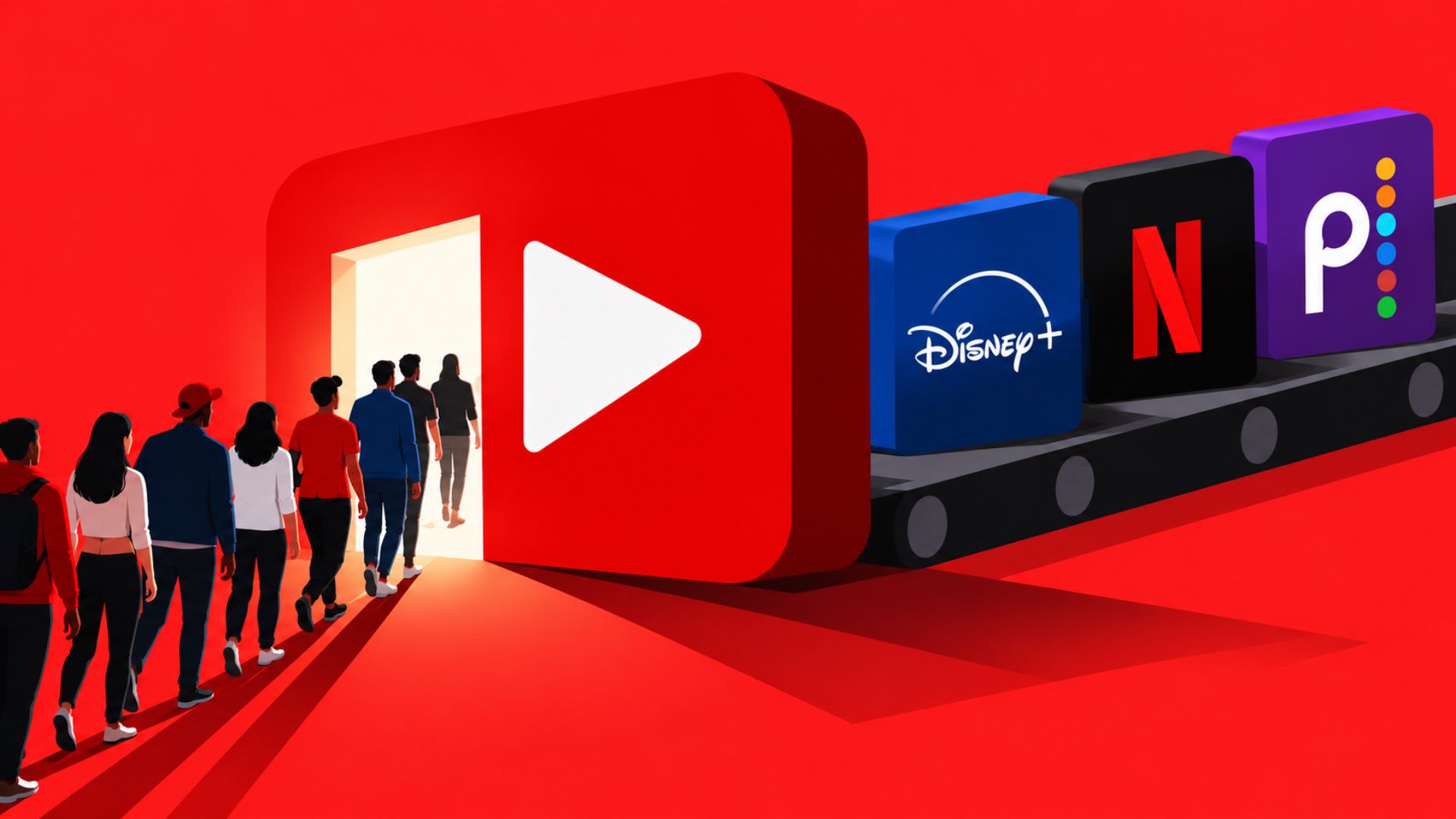
YouTube Music and Premium surpassed 150 million global subscribers, including trials and registered family-plan members, in the third quarter as YouTube advertising revenue grew 9.2% to $11.21 billion. The reported subscriber count has increased by more than 25 million since March 2025, while advertising growth slowed from 13% in the second quarter.
Google is expanding its recurring subscription business while building a larger membership base that can support distribution partnerships. Beginning in early 2027, eligible U.S. YouTube Premium subscribers will gain access to ad-supported Peacock Premium, giving Google additional programming value and NBCUniversal access to an established paying audience. The arrangement strengthens Google’s negotiating position as streaming services weigh the reach of wholesale distribution against the economics and customer control of direct subscriptions.
YouTube’s 15.8% TV Share Puts Network Ad Rates Under Pressure
YouTube generated $11.21 billion in third-quarter advertising revenue, up $946 million from $10.26 billion a year earlier.
The 9.2% increase represents a slowdown from 13% growth in the second quarter and 11% in the first. YouTube also trailed Google Search, which grew 12% to $63.35 billion.
Meanwhile, YouTube is capturing an increasingly large share of American TV viewing.
Nielsen measured YouTube at a record 15.8% of U.S. TV viewing in August, compared with 13.1% a year earlier. Viewing among adults 50 and older increased 9% from July, expanding Google’s access to audiences traditionally reached through broadcast and cable networks.
That audience growth strengthens Google’s pitch for TV advertising budgets while pressuring networks to defend their rates.
Google can offer advertisers access to older consumers across creator videos, podcasts, music and professionally produced programming without requiring them to purchase specific network schedules.
An advertiser targeting those audiences can evaluate whether YouTube delivers comparable reach at a lower cost, putting pressure on networks to demonstrate the incremental audience value of their inventory.
Nielsen’s viewing figures and Alphabet’s advertising results measure different parts of YouTube’s business. Nielsen tracks U.S. TV viewing time, while Alphabet reports global YouTube advertising revenue across devices. The figures establish growing U.S. TV reach alongside slower worldwide advertising growth, but don’t reveal how much revenue Google generates from TV viewing specifically.
That revenue depends on advertiser demand, pricing, available impressions, ad load and the share of viewing eligible for advertising.
YouTube’s expansion among older viewers gives Google a stronger position in TV budget negotiations. Sustaining advertising growth requires converting advertiser demand into revenue across its worldwide business, including viewing on phones, computers and TV screens.
Premium subscriptions introduce another way to monetize that audience, including viewers who would rather pay than watch advertising.
Six Subscribers Can Still Produce One Payment
YouTube’s subscriber milestone measures registered membership across Music and Premium, including trials and family-plan members.
Alphabet counts every registered member attached to a family plan. One paying household can contribute as many as six subscribers to the reported total.
The 150 million figure also combines two products with different economics.
YouTube Premium provides ad-free viewing across most YouTube content, background playback, downloads and YouTube Music Premium. Music Premium provides the music subscription without the full video benefits.
A Music Premium subscriber doesn’t eliminate ordinary YouTube video advertising in the same way as a full Premium subscriber.
YouTube TV and standalone NFL Sunday Ticket subscriptions aren’t included.
The latest count has increased more than 20% from the 125 million Music and Premium subscribers YouTube disclosed in March 2025.
That growth expands the number of people registered to use Google’s paid products. It doesn’t establish how many additional households are paying, how much they’re spending or how many viewers have stopped generating video advertising impressions.
Trials generate different revenue from full-price subscriptions. Family plans spread one payment across multiple users. International pricing and product mix further separate subscriber growth from revenue growth.
The financial contribution depends on the number of paying relationships, the revenue attached to them and the costs of delivering the services. For distribution partners, the more relevant figure is the size and engagement of the eligible subscriber audience they can actually reach.
Google Gets Paid When Viewers Skip Its Ads
YouTube Premium converts consumers’ willingness to avoid advertising into recurring subscription revenue.
When someone moves from free YouTube to full Premium, Google gives up the opportunity to sell most advertising impressions against that person’s viewing. In exchange, it collects a monthly subscription payment.
The economics depend on whether that payment exceeds the advertising revenue Google would otherwise generate, after accounting for creator compensation, music rights and other costs.
A relatively light viewer could generate more revenue through Premium than through advertising. A heavy viewer watching large volumes of monetized content presents a different calculation.
Google hasn’t disclosed the revenue, costs or viewing behavior needed to determine the profitability of those conversions.
YouTube’s existing free audience gives it a large pool of potential subscribers without requiring a separate subscription-only programming library.
Creators already supply most of the programming that attracts viewers to the free service. Premium changes how Google monetizes that viewing while continuing to compensate eligible creators and rights holders.
Netflix, Disney+ and other subscription streaming services use lower-priced advertising tiers to attract customers who might resist paying full price. YouTube approaches the transaction from free access, charging viewers who place enough value on removing ads and receiving additional features.
Google retains advertising revenue from viewers who stay free while collecting recurring payments from those who upgrade.
As advertising growth slows, Google has greater incentive to improve subscription conversion and retention through additional features, pricing options and content bundles. Those investments can increase recurring revenue without requiring a proportional increase in advertising inventory.
Google’s $14.29 Billion Catchall Conceals Premium’s Economics
Alphabet reports YouTube advertising revenue separately every quarter. It doesn’t provide equivalent financial disclosure for YouTube Music and Premium.
Google subscriptions, platforms and devices generated $14.29 billion in third-quarter revenue, up 11% from $12.87 billion a year earlier.
That category includes YouTube Music and Premium, YouTube TV, NFL Sunday Ticket, Google One, Google Play, Pixel devices and other products.
Google doesn’t break out the revenue attributable to Music and Premium, making it impossible to calculate average subscription revenue, incremental profitability or the share of YouTube’s overall business coming from paid memberships using its public disclosures.
Subscriptions create recurring revenue, but their contribution depends on plan pricing, churn, customer acquisition costs and payments to content owners.
Music subscriptions require payments to labels, publishers and other rights holders. YouTube Premium compensates eligible creators for viewing by subscribers.
Google’s broader reporting includes those businesses without disclosing their individual margins.
The $11.21 billion advertising figure establishes the scale and growth of one major YouTube revenue stream. The subscription milestone establishes growing membership across paid products.
Investors still lack a direct comparison of the revenue and profitability generated by the two models, including the financial impact of converting advertising-supported viewers into Premium subscribers.
Partnerships involving third-party programming introduce additional wholesale costs and potential retention benefits that Google hasn’t quantified.
Peacock’s Subscriber Plateau Gives Google More Bargaining Power
NBCUniversal is preparing to put Peacock inside YouTube Premium, giving Google another way to strengthen its subscription offering without financing the underlying programming.
Beginning in early 2027, eligible U.S. YouTube Premium subscribers will receive access to ad-supported Peacock Premium through the companies’ expanded partnership.
The arrangement represents Peacock’s largest wholesale distribution agreement and will make the service available to millions of existing YouTube Premium subscribers.
Those eligible customers represent a narrower audience than YouTube’s 150 million global Music and Premium members.
Peacock finished the third quarter with 48 million paid subscribers, unchanged from June on Comcast’s rounded figures, despite growing 17% year over year.
The service generated $261 million in quarterly adjusted EBITDA, its second consecutive profitable quarter. Its subscriber plateau increases the importance of pricing, retention and wholesale distribution.
NBCUniversal can use YouTube’s existing subscriber relationships to expand Peacock’s reach without acquiring every customer through its own marketing channels.
Google gets access to Universal movies, NBCUniversal series and live sports that can make YouTube Premium more attractive and potentially improve retention.
The deal also gives NBCUniversal opportunities to earn advertising revenue from Peacock viewing. YouTube Premium removes advertising from most YouTube content, while the bundled Peacock Premium product remains advertising-supported.
Peacock is already available separately through YouTube Primetime Channels, with Premium Plus added in June and the ad-supported Premium tier in September. Google can therefore offer Peacock as a standalone paid subscription or include it as part of a broader Premium membership.
Standalone subscriptions let Peacock reach customers who specifically want its programming. The bundle introduces Peacock to an existing paying audience that may not have purchased the service independently.
The wholesale economics remain undisclosed.
NBCUniversal must weigh the revenue and advertising engagement generated through bundled viewers against the terms it accepts for distribution. Those terms may also determine who controls billing, customer data and renewal relationships.
Google’s existing subscription base gives content owners access to potential customers, while third-party programming gives Google more reasons for consumers to maintain their memberships.
The bargaining power of that audience depends on how many eligible subscribers engage with the bundled programming and how much incremental revenue the arrangement generates for each partner.
The Streaming Wars Take
The Peacock agreement puts a more consequential set of commercial terms into play for streaming services evaluating wholesale distribution: customer ownership, upgrade rights, data access and the revenue generated after the initial bundled subscription.
NBCUniversal will need to determine whether YouTube Premium members produce genuinely incremental viewing and advertising revenue, how many eventually purchase higher-priced Peacock tiers and whether the bundle displaces customers who would otherwise pay full retail prices.
The contract’s treatment of billing, marketing permissions and customer relationships after cancellation will influence how much long-term value NBCUniversal can capture from those viewers.
Google has incentives to preserve control over subscription packaging, discovery and the customer relationship. NBCUniversal has incentives to retain direct marketing opportunities, access to viewing data and the ability to convert bundled viewers into more valuable Peacock customers.
Those interests won’t always align.
NBCUniversal also has bargaining power through the programming it controls. Live sports, Universal films and recognizable entertainment franchises can increase the appeal of YouTube Premium, particularly if they improve acquisition or retention.
That makes programming value and distribution value competing inputs in the wholesale negotiation.
Other streaming services considering similar arrangements will have to calculate whether lower customer acquisition costs and additional advertising engagement compensate for potentially reduced subscription revenue and less direct control over the customer.
The calculation becomes more demanding as wholesale distribution accounts for a larger portion of subscriber relationships.
A service that depends on third-party bundles for growth may gain reach while surrendering some flexibility over pricing, packaging and renewal offers. Its ability to recover that flexibility depends on the rights negotiated with the distributor.
Google can bring an existing subscription audience to the table while continuing to compete for advertising budgets through YouTube’s free service. Programmers that want access to both distribution and advertising opportunities have another reason to negotiate with the company.
The commercial terms of those deals will determine how much economic value remains with the content owner and how much shifts to the distributor.
YouTube’s expanding membership gives Google a stronger position in that negotiation. Streaming partners will have to price the value of access against the customer relationships they’re prepared to give up.
The Streaming Wars is intentionally ad-free
We don’t run display ads. Not because we can’t, but because we don’t believe in them.
They interrupt the reading experience. They cheapen the work. And they burn advertisers’ money on impressions nobody actually wants.
So we chose a different model.
We say the things people in this industry are already thinking but don’t say out loud. We connect the dots beyond the headline and focus on explaining why things matter to the people working in this business.
If you believe industry coverage can exist without clutter and interruption, you can support it here → SUPPORT TSW.
Support is optional. But it directly funds research and continued coverage — and helps prove this model can work.
Support TSW →