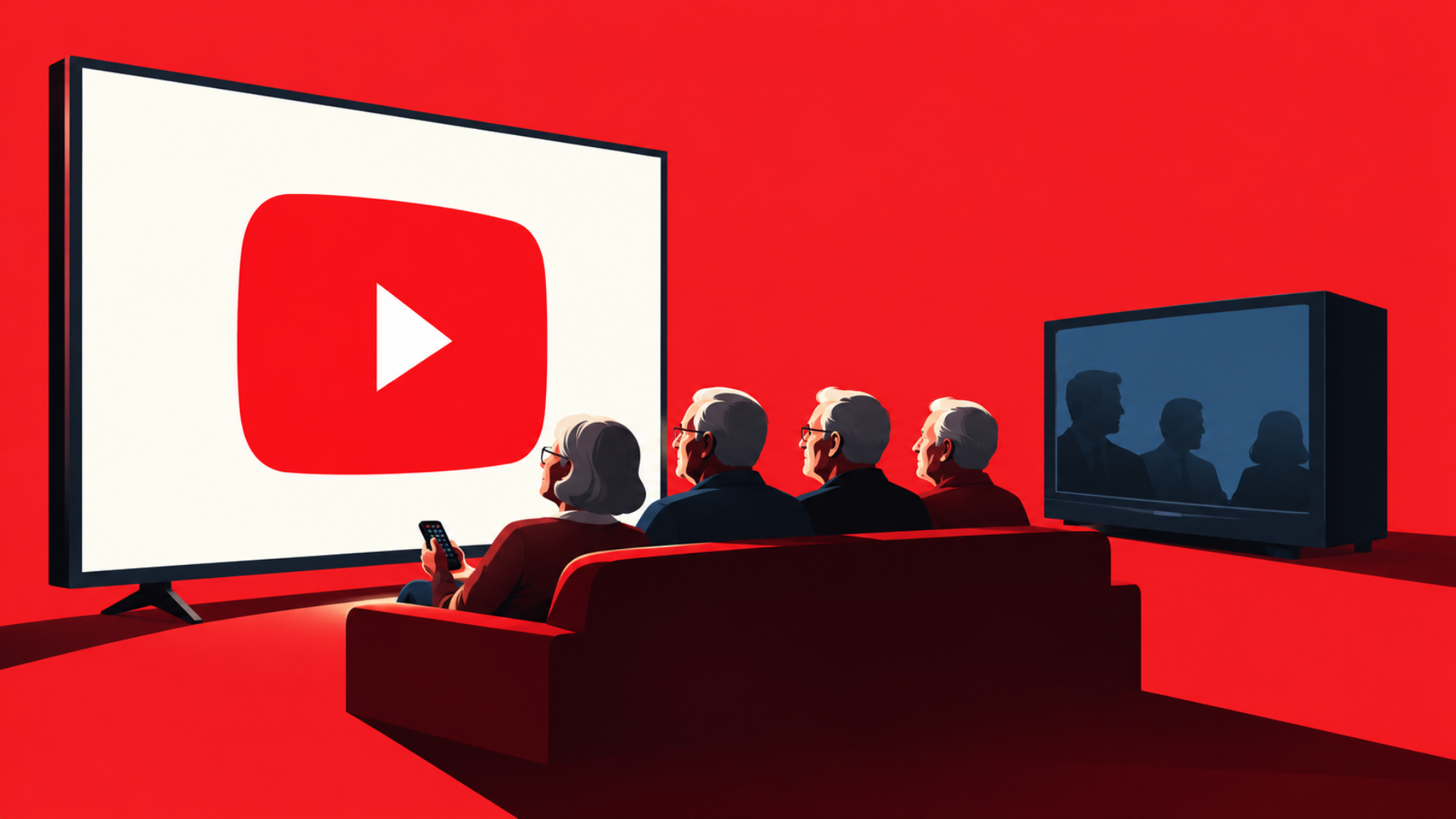
YouTube captured a record 15.8% of U.S. TV viewing in August as viewing among adults 50 and older increased 9%. Google now has stronger evidence to pursue advertising budgets traditionally directed toward broadcast and cable networks for older audiences. Those sellers face a tougher pricing test as advertisers compare the incremental reach and commercial value of network inventory against an increasingly competitive YouTube buy.
The pressure arrives while TV advertising prices are already falling. Advertisers are committing more money to streaming while negotiating lower costs per thousand viewers across broadcast, cable and streaming. YouTube’s growth among older consumers gives Google another demographic to compete for as those budgets are allocated.
YouTube Gained Older Viewers as TV Usage Fell, Challenging Networks’ Audience Advantage
YouTube viewing increased 6% during Nielsen’s August measurement period, even as total TV usage declined 4.4% and streaming usage fell 3.2%.
The five-week period ran from July 27 through August 30, following the conclusion of the FIFA World Cup and ahead of the full return of football. Viewing among children and teenagers declined with the return to school, while YouTube recorded a 9% increase among adults 50 and older.
YouTube finished August with 15.8% of total TV viewing, compared with Disney’s combined 9.3% across broadcast, cable and streaming and Netflix’s 7.7%. YouTube held 13.1% in August 2025, giving it a 2.7-percentage-point gain over the past year.
The expansion gives advertisers more reasons to include YouTube when assembling campaigns aimed at older consumers.
Broadcast and cable networks have traditionally sold advertisers access to demographic audiences through identifiable programming and schedules. News, syndicated entertainment and other established formats give buyers predictable ways to reach older viewers.
YouTube offers those buyers a different purchasing model. Google aggregates viewing across creators, publishers, music, podcasts and professionally produced programming, then sells advertising against audiences that can span thousands of individual channels.
An advertiser targeting older consumers can pursue that audience across YouTube without committing its budget to the schedules and programming packages offered by traditional networks.
The 9% increase measures viewing time among adults 50 and older, rather than the number of additional people available to advertisers. Nielsen’s figures don’t establish how much of that viewing produced sellable advertising impressions.
Google can nevertheless use the demographic growth to compete for a larger role in TV media plans. Networks seeking premium rates for older audiences face stronger pressure to demonstrate how much additional reach their programming supplies.
Google Can Put YouTube Into TV Budget Comparisons, Giving Advertisers More Leverage on Network Rates
Google already provides advertisers with tools to compare the economics of YouTube and traditional TV.
Its TV in Reach Planner product allows U.S. advertisers to model campaigns using YouTube and linear TV, compare estimated unique reach and frequency, and evaluate costs under different budget allocations.
Buyers can examine scenarios that maintain linear TV spending while adding YouTube or reallocate a portion of the TV budget toward Google’s advertising inventory.
That capability becomes more valuable as YouTube attracts viewing from demographic groups that networks have historically sold at premium rates.
Consider an advertiser buying adults 50 and older through cable news and syndicated entertainment.
If a YouTube campaign reaches a substantial portion of the same audience, the advertiser can evaluate how many additional people a network purchase would deliver and how much that incremental reach costs.
A network may justify higher CPMs through exclusive programming, trusted content environments or stronger advertising performance. Repeated impressions among households already reached through YouTube provide less justification for a premium when the advertiser’s objective is broader reach.
The financial pressure is already evident in the wider TV advertising market.
Media Dynamics estimates that advertisers committed $17.2 billion to streaming during the 2026–27 primetime upfront, compared with $16.6 billion across broadcast and cable.
Streaming commitments increased nearly 30%, while broadcast declined 5.3% and cable fell 7.7%.
Buyers also negotiated lower advertising rates across all three categories. Average broadcast CPMs declined 4.2%, cable CPMs fell 8.5%, and streaming CPMs decreased 4.9%.
Those estimates cover the broader primetime market and precede Nielsen’s August viewing results. They establish the commercial environment in which Google is pursuing additional advertising demand.
The 2026 upfront shift toward streaming has already reduced the money committed to traditional primetime inventory while increasing advertisers’ access to competing video supply.
YouTube’s older-audience growth gives agencies another input for evaluating network prices. A seller charging a premium for access to adults over 50 must demonstrate that its inventory adds audience delivery or advertising performance beyond what the buyer can purchase elsewhere.
Networks Can Defend Premium Pricing Through Programming Guarantees, Raising the Measurement Bar for YouTube
YouTube’s scale strengthens Google’s advertising position, but total viewing share doesn’t determine the value of an individual advertising impression.
Network sellers retain advantages in exclusive programming, live audiences and identifiable content environments.
Cable news accounted for 25% of cable viewing in August, while cable sports viewing rebounded 26% from July. Broadcast news remained prominent, with ABC World News Tonight leading the month’s broadcast program rankings.
Advertisers buying those programs can secure placements associated with specific content, established audiences and predictable viewing occasions.
YouTube can offer reserved inventory and content controls, but broader audience-targeted campaigns draw from a much larger collection of programming. The content surrounding an impression and the ability to verify that placement become important considerations when advertisers compare inventory.
Those requirements can influence how much money moves between linear TV and CTV.
A May 2026 Gracenote survey found that 86% of U.S. media planners would shift more linear TV spending to CTV if show-level targeting and reporting were available.
That conditional demand identifies a commercial obstacle for sellers seeking larger budgets. Advertisers want access to audience targeting while retaining visibility into the programming their campaigns support.
Network sellers can use content guarantees, verified delivery and established programming environments to defend higher prices. Google must show advertisers that its larger audience can deliver comparable targeting, placement quality and campaign results.
Measurement also limits how directly YouTube can monetize its latest viewing record.
Nielsen’s 15.8% figure represents total TV viewing time, not YouTube’s share of available advertising impressions or TV advertising revenue. Actual monetization depends on ad eligibility, frequency, placement, audience composition and advertiser demand.
For advertisers targeting older consumers, the commercial comparison involves the number of people reached, how many additional exposures a purchase produces, and the cost of achieving those results.
Networks that can demonstrate incremental audience delivery and premium placement quality retain a defensible sales proposition. Inventory that primarily adds frequency among viewers advertisers already reach faces greater pricing pressure.
The Streaming Wars Take
Agencies have an opportunity to make deduplicated reach a more explicit component of 50-plus advertising negotiations.
Rather than relying exclusively on demographic ratings and gross impression guarantees, buyers can request campaign-level reach estimates that account for YouTube and other CTV inventory already in their plans.
That could change the guarantees networks are asked to provide.
A network selling older-audience inventory may face requests to commit to incremental reach targets, with additional placements or makegoods when campaigns fail to deliver the agreed audience.
Such arrangements would shift more measurement and duplication risk toward the seller. Networks would need to establish how their inventory adds unique viewers, controls frequency or improves advertising performance within the advertiser’s broader media plan.
The commercial consequences would vary by programming.
Exclusive sports, established news franchises and other programming capable of delivering identifiable audiences could retain pricing advantages. General entertainment inventory with substantial audience overlap would face greater pressure to compete on cost or offer more flexible guarantees.
Google faces its own conversion challenge. Increased viewing among older adults strengthens its sales case, but larger advertising commitments require evidence of ad-reachable audiences, content suitability and measurable delivery.
Network sellers can protect premium pricing where their programming contributes verified reach or performance beyond an advertiser’s existing YouTube investment.
Where that incremental value cannot be demonstrated, Google’s growing older audience gives buyers stronger grounds to negotiate lower rates or move spending into competing inventory.
The Streaming Wars is intentionally ad-free
We don’t run display ads. Not because we can’t, but because we don’t believe in them.
They interrupt the reading experience. They cheapen the work. And they burn advertisers’ money on impressions nobody actually wants.
So we chose a different model.
We say the things people in this industry are already thinking but don’t say out loud. We connect the dots beyond the headline and focus on explaining why things matter to the people working in this business.
If you believe industry coverage can exist without clutter and interruption, you can support it here → SUPPORT TSW.
Support is optional. But it directly funds research and continued coverage — and helps prove this model can work.
Support TSW →