

Gracenote’s 2026 State of Play report exposes an increasingly expensive problem for streaming services. Some 72.3% of viewers want one guide covering everything available across their subscriptions. Meanwhile, 51.3% have signed up to watch a specific program or event and canceled afterward at least once.
A streaming service needs subscribers to stick around long enough to justify its programming, marketing and distribution costs. A TV OS can maintain its relationship with the household across multiple subscriptions, earning advertising revenue, participating in subscription transactions and helping viewers find programming regardless of which service carries it.
If someone subscribes to Peacock for one game and cancels afterward, Peacock stops collecting that subscription revenue. Roku can continue making money from the same household through advertising and future subscriptions to other services.
Gracenote surveyed 3,000 streaming adults across Brazil, France, Germany, Mexico, the U.K. and the U.S. The findings don’t establish that universal guides cause cancellations, but they show strong demand for consolidated discovery among consumers already comfortable moving between subscriptions.
Subscribe, Binge, Bounce
Among viewers ages 18-24, demand for a single streaming guide jumped from 58% to 78% in one year.
The same age group has plenty of experience treating subscriptions as temporary purchases. Gracenote finds that 68.6% have subscribed to watch something specific and canceled afterward, either once or twice or frequently.
Those are separate survey findings, but together they describe a customer segment that wants easier access to programming across services and is already comfortable moving between them.
A streaming service can spend money bringing someone in for a hit series, a major sporting event or an exclusive movie. The company then needs that customer to continue paying after the original attraction has run its course.
Every additional paid month helps recover the cost of acquisition. A customer who leaves immediately after watching the programming that triggered the subscription contributes far less than one who sticks around for another year.
Better discovery within the service can help. Finding another worthwhile show gives that customer a reason to keep watching and potentially another reason to renew.
Nearly 70% of Gracenote’s respondents want their streaming services to tell them where to find programming, even when it’s available somewhere else.
Sending someone to a competing service may improve the consumer experience. It can also give that person a reason to reconsider which subscriptions they need.
More than half of Gracenote’s respondents pay for three or more services. Some 55.9% say they’re streaming more video than they were a year ago.
Consumers can spend more time streaming and maintain several subscriptions while remaining relatively uncommitted to any individual service.
For a media company, the relevant measure is how much profitable viewing and recurring revenue its catalog generates. More activity across the broader streaming market doesn’t automatically translate into better subscriber economics for every service competing within it.
The Home Screen Gets a Cut
During the World Cup, Roku’s Sports Experience generated more than one million subscription sign-ups across seven international markets, connecting viewers with programming on Peacock, Paramount+, FOX One and ViX.
For the participating streaming companies, Roku provided a customer acquisition channel. For Roku, it created opportunities to earn subscription revenue without financing the underlying sports rights.
In the third quarter of 2026, Roku generated $727.4 million in advertising revenue and $580.9 million in subscription revenue.
Advertising operated at a 63.2% gross margin, compared with 40.9% for subscriptions.
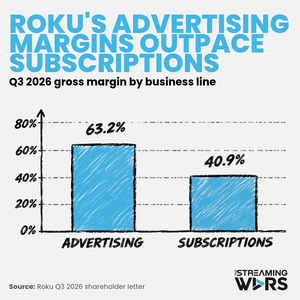
Those are company-wide business-line margins, rather than the profitability of an individual home-screen promotion or subscriber referral. Still, they show the attractive economics of an operation that can monetize advertising and subscription relationships around programming largely financed by other companies.
Roku is also expanding its wholesale subscription business, giving viewers more ways to purchase individual services and bundles through their existing Roku accounts.
That means the operating system can participate in discovery, subscription merchandising, checkout and recurring billing.
Citing a commissioned Antenna study, Roku says approximately 95% of Premium Subscription sign-ups come from customers who hadn’t previously subscribed to the purchased service directly.
That figure doesn’t establish how many subscriptions wouldn’t have happened without Roku. But it supports the company’s pitch as an alternative acquisition channel.
A streaming service may willingly share subscription revenue when the distributor brings in customers it couldn’t acquire economically on its own. If the same customers would have subscribed directly, the distributor’s participation becomes an additional cost.
Roku also has an incentive to reduce cancellations on subscriptions it bills, and the company says its redesigned home screen is showing early signs of doing exactly that.
But Roku’s commercial relationship with the household doesn’t end when a particular subscription does.
The consumer can cancel one service, subscribe to another, watch free programming on The Roku Channel and continue generating advertising opportunities.
Fox’s completed $22 billion acquisition of Roku puts Roku’s discovery, advertising and subscription businesses alongside Tubi, FOX One and Fox’s sports and news portfolio. Fox can promote its own programming while selling advertising and distribution services to competitors.
The DOJ closed its investigation after Fox committed to nondiscriminatory search results and other protections for Roku’s third-party partners. Those partners remain central to Roku’s advertising and subscription businesses.
The Catalog Tax
More than 27% of Gracenote’s respondents often or always miss programming because they can’t find it. Another 19% frequently search for something to watch, come up empty and do something else.
And 46.8% say the overwhelming volume of programming and services leads them to rewatch familiar titles instead of searching for something new.
A streaming service may already have thousands of titles available. The production or licensing investment has been made, and the company needs those assets to generate viewing, advertising opportunities and subscriber engagement.
A viewer who repeatedly chooses the same familiar programming leaves much of that catalog competing for attention it may never receive.
The service can acquire more titles, commission additional originals or invest in getting viewers to discover programming it already owns or licenses.
Another original requires additional production spending. Acquiring a library adds licensing expense. Better discovery may generate additional consumption from existing programming without a comparable increase in content investment.
The economics vary by rights arrangement, but the opportunity to make existing assets more productive is substantial.
Nearly 35% of Gracenote’s respondents say they’re spending more time with FAST channels because the subscription landscape has become overwhelming.
For free ad-supported services, better discovery creates an opportunity to attract additional viewing without requiring a consumer to approve another monthly charge.
A viewer who finds something interesting can start watching immediately. If that viewing produces monetizable advertising impressions, the service has an opportunity to earn revenue.
Subscription services need a different outcome. More viewing can increase perceived value, but the financial return ultimately depends on retaining customers and generating enough recurring revenue.
A universal guide could help both models by making their programming easier to find.
It could also expose more subscribers to free alternatives when they’re deciding what to watch.
A media company can pay to secure programming that differentiates its service. The discovery environment can make competing options easier to compare, including titles available without another subscription.
The financial return depends on whether additional discovery produces viewing that wouldn’t otherwise happen, extends paid subscriptions or simply shifts existing consumption to another destination.
Sports Have a Clock
Sports makes the discovery problem especially expensive because the opportunity to monetize live viewing has a deadline.
Gracenote finds that 65.5% of respondents would be likely to subscribe to a service because of its live sports offering.
Yet nearly 52% say they frequently don’t know which channel or service carries a specific sporting event.
That’s a serious issue when rights fees are committed long before the game takes place.
A streaming service can spend heavily on exclusive sports rights and still struggle to reach the full audience interested in watching.
Unlike an on-demand series, the live event has a narrow window to generate its highest-value advertising impressions, sponsorship exposure and subscription acquisition opportunities.
Once the game ends, the potential audience for that particular live broadcast is largely gone.
A distributor can earn revenue by helping fans subscribe to the service carrying a game. The rights buyer still needs those customers to generate enough subscription and advertising revenue to recover its rights and acquisition costs.
A fan who signs up for one event and cancels afterward may represent a useful acquisition for both parties. The service still needs to determine whether the customer’s paid lifetime produced a positive return.
For leagues and rightsholders, discoverability deserves a larger role in distribution negotiations.
Accurate event schedules, current availability, standardized identifiers and working links help preserve the audience opportunity that makes live sports rights valuable.
Exclusivity can justify premium pricing. Making the event difficult to locate can weaken the return on that exclusivity.
Metadata Gets Another Buyer
Cross-service discovery depends on accurate title identifiers, rights windows, episode information and working links to programming. The same title can appear under different identifiers across streaming catalogs, availability changes by territory, and sports rights can vary by event.
Keeping that information current creates licensing and integration opportunities for metadata suppliers serving multiple streaming services and TV operating systems.
Advertisers need much of that same information to know which programming carries the impressions they’re buying. Inconsistent content classifications and incomplete program information across streaming services make inventory harder to evaluate and compare.
Gracenote expanded its collaboration with Magnite, allowing participating CTV inventory to be organized into custom advertising deals based on standardized content information.
The arrangement can help buyers identify inventory around particular programming, including live sporting events distributed across multiple services.
Gracenote has also integrated show-level content intelligence with The Trade Desk, bringing more granular programming information into advertising targeting and reporting.
And Tubi Media Group is testing Gracenote content identifiers in programmatic bid streams while using the company’s data to support discovery across Tubi and FOX One.
The same content information can therefore support two distinct commercial activities: helping viewers find programming and helping advertisers identify the programming they want to advertise against.
For content intelligence providers, that expands the potential customer base beyond companies building TV guides and recommendation systems.
For publishers, better program identification can help buyers recognize inventory that deserves a premium.
But standardization also makes inventory easier to compare.
An advertiser looking for impressions around a particular sporting event may be able to evaluate opportunities from multiple participating services through a common buying workflow.
That can improve access to relevant inventory while giving buyers more flexibility in where they spend.
Publishers with genuinely differentiated programming may benefit from greater transparency. Services selling relatively interchangeable inventory could face additional pricing pressure as buyers gain more comparable options.
Whether richer metadata increases advertising revenue depends on buyer demand, campaign performance and the cost of transacting.
And Gracenote isn’t the only company positioned to participate. TV operating systems, competing metadata suppliers, search technology vendors, DSPs, SSPs and publishers themselves all contribute pieces of the information required to connect programming with viewers and advertisers.
These companies earn revenue through different arrangements. Metadata suppliers license data, advertising technology providers facilitate media transactions, and distributors can monetize subscriptions and advertising. Media companies ultimately need those services to generate enough additional viewing, advertising revenue or subscriber retention to justify their costs.
The Streaming Wars Take
Streaming distribution agreements should address search placement, referral attribution and subscriber retention alongside billing and revenue-share terms.
A sign-up tally tells a service how many transactions happened through a distributor. It doesn’t establish how many customers were incremental or whether they generated enough revenue to cover acquisition and distribution costs.
For subscription services, the more useful comparison is the contribution profit from a distributor-acquired subscriber versus a comparable customer acquired directly. That calculation includes acquisition expense, distribution fees and the number of paid months retained.
The results can strengthen a distributor’s case for higher compensation when it delivers profitable customers a service couldn’t efficiently acquire itself. They can also weaken that case when the distributor primarily collects fees on customers who would have subscribed directly anyway.
Sports rightsholders have another opportunity to protect their investment. Distribution agreements can establish requirements for accurate event listings, updated availability and functioning links to the correct service. Those obligations can help reduce the risk of fans missing an event the rights buyer has already paid to carry.
The advertising economics deserve similar scrutiny. Publishers can test whether standardized content identifiers increase effective CPMs and demand for their inventory or simply give advertisers more comparable buying options. Metadata and advertising technology providers need to demonstrate that their licensing and transaction costs produce a measurable return.
Fox’s ownership of Roku makes those commercial relationships particularly interesting. The same company can sell advertising and subscription distribution services to competitors while operating its own streaming businesses. That puts additional weight on transparent search practices, reliable referral data and the ability to demonstrate the value of each transaction.
For media companies, the financial exposure extends beyond the subscription or advertising revenue generated by a particular program.
A content owner evaluating a major sports rights agreement or exclusive programming investment needs to model the cost of reaching viewers, the fees paid to distributors and how much customer revenue remains after those relationships are accounted for.
A programming investment that looks attractive before distribution expenses can produce a very different return once the full cost of acquiring and retaining its audience is included.
The Streaming Wars is intentionally ad-free
We don’t run display ads. Not because we can’t, but because we don’t believe in them.
They interrupt the reading experience. They cheapen the work. And they burn advertisers’ money on impressions nobody actually wants.
So we chose a different model.
We say the things people in this industry are already thinking but don’t say out loud. We connect the dots beyond the headline and focus on explaining why things matter to the people working in this business.
If you believe industry coverage can exist without clutter and interruption, you can support it here → SUPPORT TSW.
Support is optional. But it directly funds research and continued coverage — and helps prove this model can work.
Support TSW →