
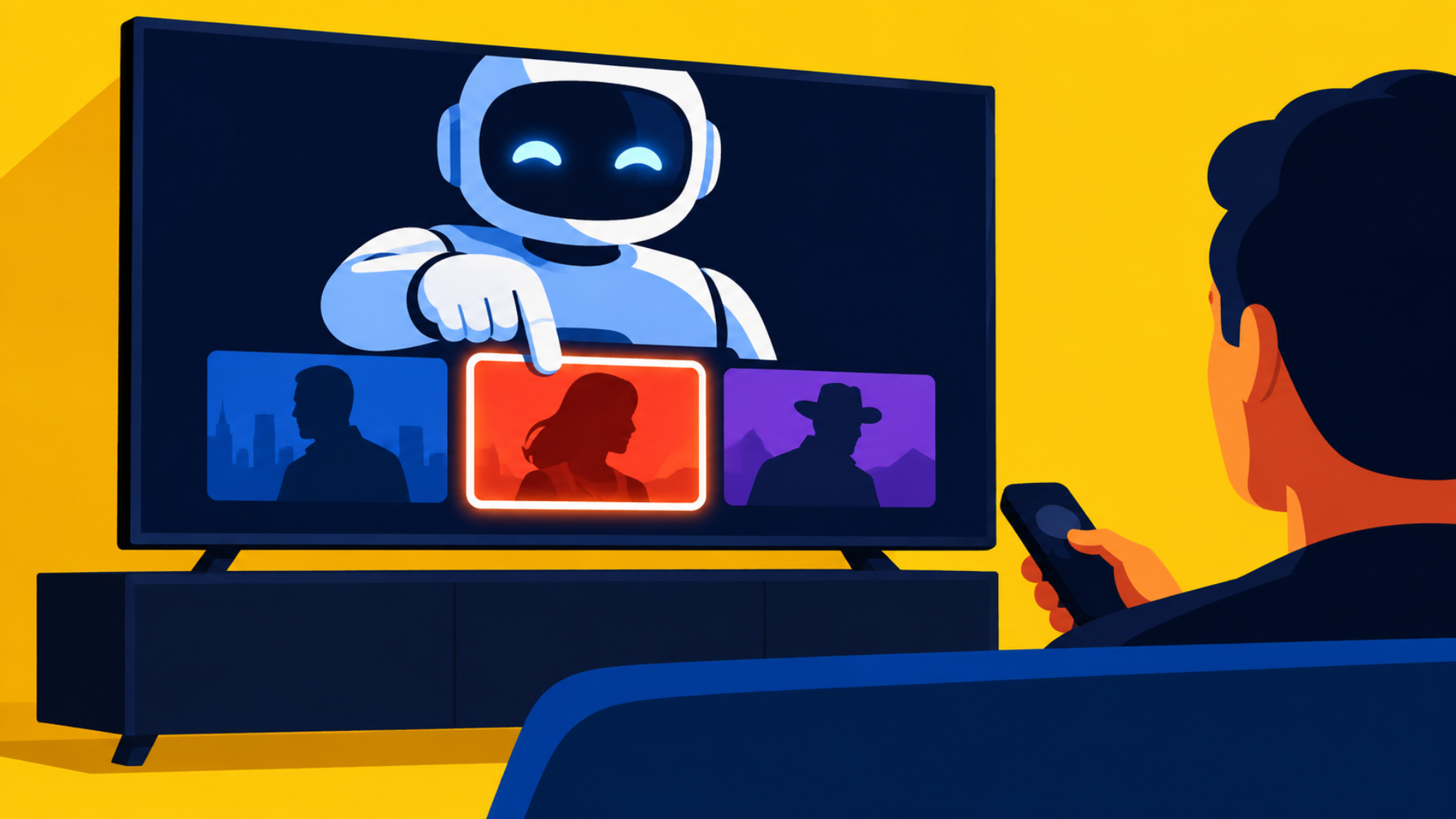
If viewers start asking the TV what to watch instead of scrolling, how do we make sure our service is one of the answers? And are we eventually going to have to pay for that?
— VP, Audience Development
Yes. The recommendation is already becoming inventory.
Alexa+ now lets people ask Fire TV for movies and shows conversationally, and Amazon says viewers are choosing its top movie recommendation more than 40% more often than they chose the O.G. Alexa. Amazon also sells sponsored entertainment placements inside Alexa+ queries on Echo Show. Google TV’s Gemini can tell you which apps have the show or movie you’re looking for. Samsung’s Vision AI Companion can answer natural-language questions and suggest what to watch.
The OS now gets to decide which titles make the answer, which service gets the click, and eventually how much of that decision it can sell.
One Answer Is Worth More Than Ten Rows
A conventional TV home screen can hold a lot of shit.
There’s a hero, app tiles, live programming, recommendation rows, editorial collections, sponsored placements, search results, and whatever else the product team can squeeze onto the screen.
Ask an AI concierge, “What’s a good crime series to watch tonight?” and it may hand you three choices. Maybe one.
That makes the recommendation a lot more valuable. The viewer’s already said what they want and handed the TV the job of picking the shortlist.
As search starts giving you an answer instead of a list, the company picking that shortlist gets a lot more control over what you end up watching.
If the first answer starts deciding what people actually watch, that slot’s going to get expensive.
Metadata Is Becoming the Admission Ticket
Before you worry about buying the answer, make sure the TV isn’t confused about your catalog.
It needs to know what the title is, who’s in it, where it’s available, whether the viewer already has access, and where to send them when they click.
Alexa+ on Fire TV can use what somebody subscribes to, what they’ve watched, and what’s actually available when it answers an entertainment question. Google TV can tell viewers which apps carry the title they’re looking for.
All of that depends on a lot of boring stuff being right: metadata, entitlements, availability, identifiers, rights windows, schedules, and deep links.
And that data can’t sit around getting stale. Availability, rights, schedules, identifiers, and deep links increasingly need to stay current because the answer is being assembled when the viewer asks.
If you’re carrying tonight’s game and the TV thinks your rights expired yesterday, the viewer may never see you as an option.
The more specific the question gets, the more ways bad data can knock you out of the answer.
Entitlement Can Beat Brand Size
Suppose I ask for a comedy tonight and already subscribe to three streaming services. A title included with one of those subscriptions has a pretty obvious advantage over a $19.99 rental unless I’ve told the TV I’m looking to spend more money.
That gives mid-sized services a real opening.
You don’t have to outspend Netflix or Disney if your title fits the request, the viewer already pays for your service, and the TV knows it can send them straight into playback.
A smaller brand can still be the better answer.
But the TV has to be able to see that you have it, know the viewer already pays for it, and send them straight into playback.
Amazon Already Sells the Answer
Amazon already lets media advertisers put sponsored titles into Alexa+ entertainment queries on eligible Echo Show devices. Viewers can respond by voice or touch and move into a subscription, rental, or purchase. Amazon has also brought Alexa inventory into the same Sponsored Tiles buying system that includes Fire TV and Prime Video.
Amazon hasn’t said it’s selling those sponsored conversational recommendations inside Fire TV yet.
The pieces are already sitting next to each other. Alexa+ is part of Fire TV discovery. Viewers can ask complicated entertainment questions, refine what they want, get recommendations, see where something is available, and head toward playback. Fire TV already has a paid discovery business.
Every TV OS building an AI concierge is going to face the same temptation: the viewer has just told you exactly what they want. How much of that moment can you sell before the answer starts sucking?
Money Shouldn’t Be Able to Buy a Bad Answer
I’m fine with sponsored recommendations inside an AI answer, but the recommendation still has to actually fit what the viewer asked for.
If I ask for a family movie included with subscriptions I already pay for, a studio shouldn’t be able to turn a $19.99 rental into the “best” answer because it submitted the highest bid.
That’s a shitty concierge.
A sponsored answer still has to be a good answer: relevant to the request, available to that viewer, and one click away from actually watching.
Once a title clears those tests, sell the hell out of the placement.
Sell a labeled sponsored recommendation. Sell a stronger position in the shortlist. Sell a bigger visual treatment. Sell another qualified suggestion.
But don’t let the bid beat relevance. If the paid answer is worse than the organic one, viewers will stop trusting the recommendation.
The TV Can Pick the Service, Too
A viewer asks what to watch. The AI recommends a title. Three services carry it.
One is already included in the viewer’s subscriptions. Another offers a free trial. The third lets the OS sell the subscription directly.
The TV can influence the title, which service gets chosen, whether a transaction happens, and where the viewer lands afterward.
A lot of money can move before your app gets control of the screen.
The OS already has plenty of leverage before your app opens. Conversational discovery lets it take the viewer from “I want something like this” to “here’s what to watch and where to watch it” in the same exchange.
You can have the perfect title for the viewer. If the TV can’t recognize that and route them to you, you still lose the session.
Niche Wins When the Question Gets Specific
I wouldn’t automatically assume the giants own this.
A mid-sized or niche service can have exactly what the viewer is asking for.
Maybe you’ve got a deep catalog in one genre, strong coverage of a particular sport, a regional audience, a library of older films, or programming built for a community the broad services barely serve.
The interesting part is what happens when the question gets really specific.
“Where can I watch women’s college volleyball tonight?” “Give me a 1970s Italian horror movie.” “What can my kid watch about dinosaurs that’s under an hour?”
Those are good questions for smaller services. You don’t need the biggest catalog when you’ve got the best answer to exactly what somebody asked for.
Make sure the TV can see it.
Keep the rights current. Keep availability accurate. Get the schedule right. Fix the identifiers. Make entitlement clear. Make sure the deep link lands where it’s supposed to.
That’s also why TSW put together the Guide to Metadata. If the data underneath your service can’t tell the TV what you have, where it’s available, who can watch it, and where to send them, AI discovery isn’t going to magically figure it out.
Owning the perfect answer and disappearing because the TV can’t make sense of your catalog would be a spectacularly stupid way to lose a viewer.
Buy the Answer Only When It Changes the Outcome
If TV operators start selling more conversational recommendation inventory, I’d want reporting that starts with what the viewer actually asked.
I’d want to know whether our title would’ve qualified without the media spend, where it appeared in the answer, whether it was labeled sponsored, which other choices were shown, whether the viewer followed the recommendation, whether they reached playback, whether they subscribed, and how much of that behavior we actually added.
That tells me a lot more than some giant “AI impressions” number.
Of course, TV platforms aren’t exactly famous for over-sharing with their content partners. You’ll usually get some combination of campaign reporting, stream counts, or whatever else the platform decides to expose. That still may not tell you how much of the result came from the paid recommendation versus traffic you would’ve gotten anyway.
And that’s the expensive part.
The viewer has already told the TV what they want. If you’re paying to influence that answer, you need to know whether the spend actually changed the outcome.
Get the metadata, entitlement, availability, and deep linking right first.
Then buy the recommendation when the paid placement adds viewing, subscribers, or transactions you probably wouldn’t have gotten organically.
If stale rights data or a broken deep link is keeping you out of the answer, fix that before you start writing checks to the concierge.
Ask Me Anything
Whether you’re fed up, fired up, or just want the truth behind the trends, send me your questions using this form. Anonymity guaranteed. Bullshit not included.
The Streaming Wars is intentionally ad-free
We don’t run display ads. Not because we can’t, but because we don’t believe in them.
They interrupt the reading experience. They cheapen the work. And they burn advertisers’ money on impressions nobody actually wants.
So we chose a different model.
We say the things people in this industry are already thinking but don’t say out loud. We connect the dots beyond the headline and focus on explaining why things matter to the people working in this business.
If you believe industry coverage can exist without clutter and interruption, you can support it here → SUPPORT TSW.
Support is optional. But it directly funds research and continued coverage — and helps prove this model can work.
Support TSW →